Reimagining Education: Increasing access to digital learning in Adjumani District
“The internet provided by UNICEF and Airtel this year is so huge, says Sister Abiyo, “especially with the new lower secondary curriculum which is mainly research based and most of this research can be got on the internet”.

According to a recent household-level Assessment of Life Skills and Values Report, internet connectivity and digital device ownership remain low in Uganda. In the report, 84 per cent of children and youth interviewed were unable to access the internet and visit a favourable website through smartphones or tablets.
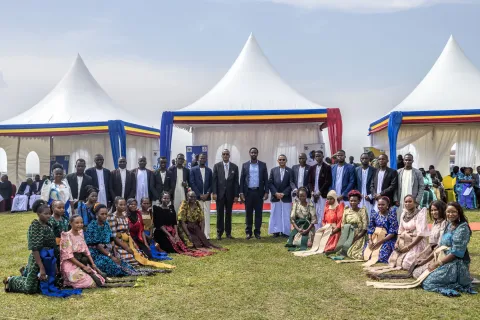
UNICEF and Airtel Africa’s signed a five-year partnership in 2021 to increase access to digital learning for boys and girls in 13 countries across Africa. In Uganda, the partnership between UNICEF, Airtel Uganda and the Government of Uganda was launched in March 2023 at St. Mary Assumpta Girls Secondary School (SMAG) in Adjumani District, West Nile Region, North-Western Uganda.
The occasion was an opportunity to showcase digital learning between learners in St. Mary Assumpta Girls Secondary School and Kitende Secondary School in Wakiso District, over 400 kilometres away in Southern Uganda. Kitende Secondary School was another school connected to the internet through the UNICEF - Airtel partnership.
Students, teachers, parents, school administrators, the local district government, and Ministry of Education and Sports officials at SMAG and Kitende SSS were delighted by the possibilities of digital learning.
“Our school received 10 desktop computers from Uganda Communication Commission in 2009, when learning was not digitalized and access to the internet was a challenge," recalls Sister Rebecca Abiyo, headmistress of St. Mary Assumpta Girls Secondary School.
“Internet connectivity at the school was via a very expensive and slow-speed internet router, which provided 30-day access. The limitations of internet availability posed difficulties for the students at this school to fully embrace digital learning,” she recollects.
School internet connectivity and digital platforms like Kolibiri, an e-learning platform that has been whitelisted by Airtel Uganda, is accessible with or without the internet on any digitally enabled device. This is just one component of the three-pillar plan of the UNICEF-Airtel partnership to advance access to digital learning and reach up to 400,000 children and adolescents, teachers, and caregivers, including those with disabilities, in 1,000 Ugandan rural and urban schools by the end of 2025.
"The internet provided by UNICEF and Airtel this year is so huge, says Sister Abiyo, “especially with the new lower secondary curriculum, which is mainly research-based and most of this research can be done on the internet."
The appreciation from Sister Abiyo represents similar sentiments of the students, teachers, and a district education official who shared their experiences with broadband internet connectivity during UNICEF and Airtel’s joint documentation visit in November 2023.
Atimaku Gladys in Senior Six had won 2nd prize at the National Science Competition 2022 for designing a solar-powered fan from used CD players, plastic bottles, and other local materials. She narrates, “I practiced with materials on Kolibri, an e-learning platform."
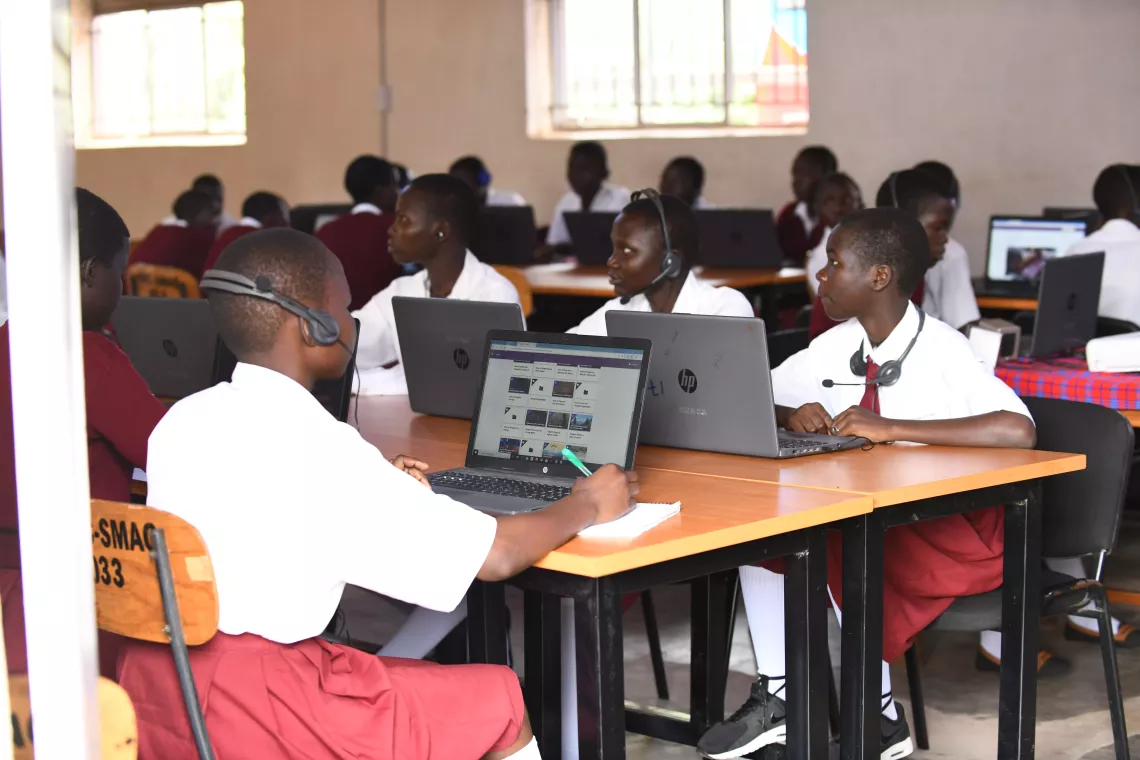
Gladys notes that her learning has greatly benefited from the internet and access to computers in the ICT computer lab: “during lessons, for some of the parts that I didn’t pick well from the class, I just come and search for them directly on the internet.”
The teachers are just as ecstatic with the internet connectivity. The connectivity has made the ICT lab better utilised, improved the learning methods, and ably met the research needs of students. The Head of ICT department, Alex Opono, says “the internet has made this ICT lab into a digital library.”
Joyce Maninyitia in Senior Four, with a smile, says, “Research has become easier for us. Unlike books, where you search page by page. With the internet, you only need to type a keyword for any topic, and it gives you the results immediately.”
Some lessons are only taught in theory. The internet has made practical lessons possible. Keliki Ruthrock Queen says, “some things cannot be found in the physical library, so you come in the ICT lab to check practical examples online of what the teacher has taught in theory form.”
The academic performance of SMAG is noteworthy. The school led in both the Ordinary level and Advanced level certificates of secondary education in Adjumani District. A fact attributed to the increased access to digital learning. Sister Abiyo says, “The students and teachers have been having zoom lessons with many of the top performing schools in the country. SMAG participated with 25-50 schools around the country in over 30 practical lessons from March to November 2023.
Since the launch of the partnership in March 2023, ten schools have been connected to the internet, and the Kolibri platform has been accessed by 8,129 users countrywide, with 510 newly registered users since the platform was whitelisted in April 2022.
Plans are underway to connect 33 Secondary schools and seven youth centres in 2024. Additionally, the Ministry of Education and Sports is working on guidelines to ensure that the efforts to advance digital education correspond to the objectives of the Digital Agenda Strategy for Education sector.
Sister Abiyo’s leadership has stirred her teachers and students to fully utilize the opportunities availed by the internet connectivity at SMAG. She encourages other schools receiving this internet to “embrace the usage of the internet provided as a golden opportunity to enhance digital learning to maximize learning for students”.