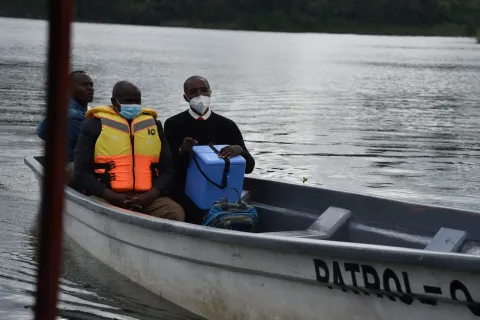
High expectations as Uganda introduces malaria vaccine into routine immunization schedule
“We have a mosquito net at home but the mosquitoes are simply so many given the location where we live in Barobia Cell,” Caroline Akot.

On its long winding journey to the Mediterranean Sea, the River Nile passes through many of Uganda’s administrative districts providing a source of livelihoods to millions of people. Fishing, water transport, water, and tourism among others.
However, on the River Nile’s eastern banks, is Apac District. Although many people in Apac get their livelihoods from the Nile, it is also a source of concern. Apac is a low-lying district with swampy areas and often experiences the excesses of the world’s longest river. Being in the tropics with two rain seasons a year, torrential rainfalls are also a constant occurrence. Flooding is common. Swampy areas are lush, everywhere and near people’s homes providing uninterrupted breeding bases for mosquitoes. Where mosquitoes exist in big numbers, high malaria cases are the norm, not the exception.
This was evident on 2 April 2025 when Uganda held a function in the district to launch the malaria vaccine introduction into the country’s routine immunization schedule. In a tent set up to provide testing of malaria at the Boma Grounds in Apac Municipality, several children were found positive.
One of the mothers whose child tested positive for Malaria is 31-year-old Caroline Akot.

“We have a mosquito net at home but the mosquitoes are simply so many given the location where we live in Barobia Cell,” she explains. “When I heard of a malaria vaccine, I thought that it was important to bring my 9-month-old child for testing and immunization,” she added.
The vaccine is expected to reduce 800 severe cases of malaria everyday while saving mothers like Akot Shs15,000 (approximately US$4) that would have been used on treating a case of complicated malaria in children. Also, it will reduce the number of people who die due to malaria every day.
“Every day, 16 people in Uganda die of malaria, a preventable disease. Of these, 10 of those who die are children under the age of five,” revealed Dr Jane Ruth Aceng Ocero, Uganda’s Minister of Health. “In Apac alone, 41 deaths caused by malaria were recorded in 2024, a number that is higher than the national average,” she added, pensively.
Indeed, Uganda is one of the worst hit countries accounting for 4.8 per cent of the 12.6 million malaria cases worldwide, according to the World Malaria Report. Malaria is responsible for 30 per cent of all illnesses in Uganda.
This explains why rolling out malaria vaccine into routine immunization is critical. Speaking at the launch event in Apac, President Yoweri Museveni in a message delivered by the Prime Minister, Hon Robinah Nabbanja, called for collective action.
“The malaria vaccine is a game changer in our fight against malaria but it must be used in addition to other existing measures,” Hon Nabbanja said while delivering the president’s message. “Our people must continue sleeping in insecticide treated bed nets every night, indoor residual spraying must continue and people must seek treatment.”


Dr Robin Nandy, the UNICEF Representative to Uganda, said that the introduction of the malaria vaccine is a historic milestone that will significantly reduce the incidence of malaria and further contribute to the reduction in under five mortality rates in the country.
He called upon parents, caregivers and the community to ensure that the children receive all available vaccines that are safe and offered free of charge by the Ministry of Health among other recommended measures. “This is the best way to protect the children and ensure their good life,” he said.
He reiterated UNICEF’s commitment to supporting Uganda’s primary healthcare system including its immunization programme thereby ensuring equitable access to services that lead to universal health coverage.
For the first year, Uganda was allocated approximately 3 million dozes of malaria valued at more than US$11 million of which 2.2 million dozes are already in the country and distributed. For the second year, more than 4 million dozes will be allocated. The target is to reach at least 1.4 million children every year. “This will be the largest rollout of malaria vaccines globally,” Dr Nandy revealed.
The malaria vaccine is administered in four dozes at six months, seven, eight and eighteen months.
With the introduction of the malaria vaccine, parents like Akot and her husband, 45-year-old Patrick Oyita, hope that mosquitoes won’t be ravaging them mercilessly as they are today. “It will also save us time and money wasted on treatment of malaria,” Oyita says.