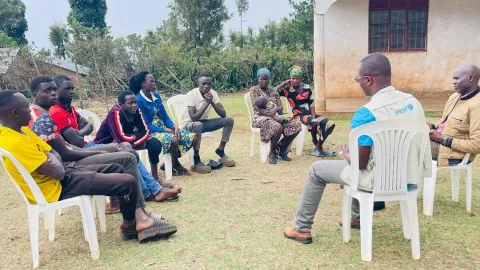
Empowering youth through skills development in Kikuube District
In Kikuube District, a narrative of resilience and innovation unfolds, fueled by the transformative power of education and skills development.

Robert Agondeze, a pupil currently in Primary Seven at Bugoma Primary School in Kyangwali, Kikuube District, has been making and selling popcorn in the evening after his classes for the past one year. He has saved his earnings and reinvested them in piggery. He owns five piglets.
Jamil Tusiime, his classmate emboldened by Agondeze’s success, kickstarted his own savings journey three months ago and is now the proud owner of two piglets, which he tends to on a family-owned piece of land.
Evelyne Taremwa, also in Primary Seven in the same school, makes and sells pancakes after class and saves so that she can contribute to necessities at home.
“I use the money I earn to buy sugar and salt at home, but I always put something aside for a rainy day,” Taremwa says.
Previously, Agondeze and his peers faced the possibility of a bleak future exacerbated by the high incidences of school dropout rates that are common among pupils in the area. According to a 2021 UNCHR report, at least 50 percent of school-going children in Kyangwali are unable to attend school. The introduction of the Canadian NatCom-supported Life-Skills Toolkit in 2022 averted the imminent dire situation at Bugoma Primary School.
The Life-Skills Toolkit features seven modules covering adolescent-centred content on ten core competencies for building resilience. These competencies include communication, self-esteem, critical thinking, problem-solving, conflict resolution, creativity, innovation, hope, goal setting, resilience, and managing emotions.
Jane Afoyocan, the Education Specialist for UNICEF in the Western and Central Zone Office, says UNICEF’s Adolescent Development Programme primarily focuses on skills development.
“In Kikuube District, our emphasis lies in the Life-Skills Toolkit programme, which equips adolescents with transferable skills essential for navigating the challenges of the 21st century. This programme aims to prepare adolescents to excel in school, work, and life, catering to both in-school and out-of-school adolescents. For those enrolled in schools, we strive to implement the Life-Skills Toolkit programme optimally,” Afoyocan says.
“We have trained school club patrons who in turn train their club members during co -curriculum hours. For the out of school, UNICEF has trained sub county-based volunteers who in turn train their club members at an agreed time of the week. The programme is currently being implemented across forty government aided primary and secondary schools in Kikuube District. We also have eleven functional sub county-based clubs.”


Daisy Muchwa, Bugoma Primary School's head teacher, lauds the Life-Skills Toolkit for its many benefits. "The Life-Skills Toolkit has made a positive impact in various aspects of our learners' lives. Pupils' participation during class lessons has increased tremendously, and their performance has improved.”
“They have also become very enterprising, dabbling in activities like snack-making, piggery, poultry farming, and crop cultivation after classes. Our learners have been encouraged to save part of their earnings in locally made piggy banks. The programme is so successful that it has even enticed back children who had previously dropped out of school."
The toolkit's impact extends beyond financial and academic benefits, tackling confidence issues like shyness and addressing menstrual education gaps. Muchwa says that according to the current education curriculum, the topic of reproduction, where menstruation is covered, is only taught in Primary Six, yet most of the learners start their period long before they reach the class.
"This gap in information used to cause confusion among learners. However, that is now in the past because the Life-Skills Toolkit which covers topics like menstruation is taught to learners nine years and up,” she says.
An alternative to the Life-Skills Toolkit is the UPSHIFT programme, tailor-made for out-of-school youth. Through this initiative, participants identify community challenges, undergo intensive training, and develop innovative solutions, creating employment opportunities in the process.
“We have trained two youth led community-based organisations whose staff are providing mentorship to ten upshift groups based in Kyangwali Settlement and host communities across Kikuube District,” says Afoyocan.
Arinda Twaikya, an UPSHIFT mentor from Inspire Africa Youth Foundation, in Kikuube District emphasises the project's objective of nurturing young change-makers.
"UPSHIFT training instils problem-solving skills and prepares youth to tackle community challenges head-on."
“UPSHIFT-supported adolescent youth living in the settlement are making waves in their community with innovations that include poultry farming, plastic recycling, basket making and manufacturing of an assortment of products like animal medicine, charcoal briquettes, and organic manure,” Twaikya says.

Shukuru Mugenyi, a member of one of the UPSHIFT youth groups at the settlement, says that malaria is one of the biggest challenges that they face in the community, with women and children hit the hardest.
“We realised that while treatment for malaria was available, there were no prevention interventions. After our UPSHIFT training, we sat down and brainstormed how we could solve that challenge. Because malaria is spread through mosquito bites, we resolved to make rosemary repellent soap. We then tested it, and it was established that when our clients bathe with the soap, mosquitoes avoid them.”
Mugenyi is happy that the soap has proven to be effective at preventing malaria in the community and is eager to scale up the business with ambitions of expanding his group’s initiative to the neighbouring districts and across the country. “This initiative is bigger than making a living for us. It is exciting to be able to be part of the effort to fight malaria in Kyangwali and beyond,” he says.
Similarly, Grace Mugooli and her group are championing hygiene with their liquid soap innovation. Mugooli is a 16-year-old adolescent who is enthusiastic about education but has had to drop out of Katonga Primary School, a school within her community, due to financial woes and her father’s ill health.
“We are required to make a monetary contribution to the school every term, but my family has other demands that are more important than me going to school.”
Faced with this challenge, Mugooli and her group of four sought out to solve the problem of hygiene on their block, so they embarked on their project. “With many refugees living so close together, maintaining proper hygiene can be challenging,” she says.
Mugooli adds that the group’s initiative is important for key hygiene activities like handwashing, cleaning latrines, bathing, and washing clothes. Mugooli is positive that the income she and her team make every week will enable her to go back to not only support her family but also return to school and pursue her dream of becoming a journalist.