How youth volunteers are getting pupils back to school –one peer at a time
“Dropping out of school doesn’t mean the end of your future.”

In Uganda’s West Nile sub region, a quiet revolution is taking place—not in boardrooms or parliaments, but in dusty villages and bustling community centres. It is being led by young volunteers who have taken it upon themselves to fight one of Uganda’s most persistent challenges: school dropouts, especially among adolescent girls.
More than 40 per cent or almost 43 out of every 100 pupils in Uganda drop out before finishing primary school, and girls are most affected, according to data from the Uganda National Examinations Board (UNEB) and Education and Sports Sector Annual Performance Reports of 2024 (ESSAPRs). Many are forced out of school by early marriage, pregnancy, or poverty. But in Adjumani District, a group of determined young people is changing that narrative—one door, one girl, and one conversation at a time.
“Dropping out of school doesn’t mean the end of your future,” says Patricia Asienzo, 30, a community health worker and member of the Adolescent Volunteer Action Team (AVAT). “We remind young mothers that they can go back to school, even after childbirth. Some return to formal schooling, while others opt for vocational training. What matters is that they don’t give up.”
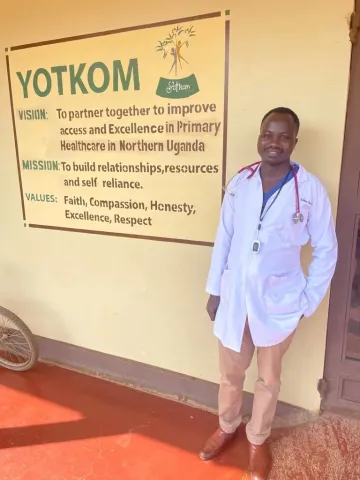
Patricia's passion is personal. At Dzaipi Health Centre III in Adjumani, she regularly pauses her clinical work to speak to young women waiting at the outpatient department, encouraging them to dream again. She’s seen what stigma and silence can do, and what compassion can reverse.
Patricia's passion is personal. At Dzaipi Health Centre III in Adjumani, she regularly pauses her clinical work to speak to young women waiting at the outpatient department, encouraging them to dream again. She’s seen what stigma and silence can do, and what compassion can reverse.

One of her proudest moments was helping a fourteen-year-old boy recover from a traumatic experience after being sexually assaulted. “He ran away from home out of shame. But after a long search, we found him and helped him receive medical care and emotional support. Today, I am proud to report that he is back in class at Biyo Primary School. I take great pride in the role I played in helping him rebuild his life. That’s what healing looks like,” she says with quiet pride.
Patricia is not alone. Alex Amegovu, 25, an Information and Communication Technology teacher and AVAT member, is also a powerful voice for second chances. A school dropout himself, Alex left school in 2016, thinking his dreams were over. However, after attending vocational training and earning a diploma in ICT, he decided to pay it forward.
“I know what it’s like to feel hopeless,” says Alex, “that’s why I speak to young mothers and school dropouts with empathy. I tell them: I was once where you are, but I came back. You can, too.”
Last year, Alex helped Unzia Beatrice, a young mother, return to school through an Accelerated Education Programme implemented by partners including UNICEF with funding from the David Beckham 7 Fund through the UK National Committee for UNICEF. She graduated in 2024. “That moment when she finished her exams—it reminded me why this work matters,” he says.
But these stories are not just about individuals—they reflect the growing impact of AVAT, and peer-led initiatives supported by UNICEF. Volunteers like Anzo Justine Odong, 20, are reaching deep into their communities to bring girls back to school.
Anzo, a student at Dzaipi Secondary School, is the Chairperson of AVAT in Dzaipi Sub County. He started as a beneficiary and is now a beacon of hope. “I joined AVAT in 2020 after attending a training sponsored by UNICEF using funds from the David Beckham 7 Fund channeled through the UK National Committee for UNICEF. That’s where I learnt how to support others who face the same challenges I once did,” he says.
Anzo has helped several girls return to school, including Mazira Queen Elizabeth, who rejoined and is now in Senior One, her fees paid by UNICEF. Another girl, Adea Liz Kajoiying, returned to school after giving birth, encouraged by Anzo’s patient guidance.

“I told her, ‘You can still finish school. If not formal school, then a vocational course. But don’t give up,’” Anzo recalls. Today, Adea is planning to enroll in a tertiary institute to study agriculture.
The challenges are many. “Sometimes, we walk long distances, and people ask, ‘Who will pay the fees?’” Anzo explains. “We don’t always have answers. But we have hope. And that’s where we begin.”
Indeed, hope powers this movement—but it also needs resources. AVAT operates without consistent funding. Volunteers like Patricia speak of struggling to conduct sensitisation meetings without refreshments or transport. Their small office lacks basic equipment. Yet their spirit remains unbroken.
“What motivates me is seeing a child who once dropped out put on a school uniform again,” Patricia says.
This passion has inspired local governments to take notice. With support from UNICEF, AVAT is creating a blueprint for grassroots-led education advocacy, combining health, protection, and education into a single conversation about dignity and opportunity.
Their message is clear: Uganda’s education crisis won’t be solved by policy alone. It will be solved by people—people like Anzo, Alex, and Patricia—who believe that every child deserves a second chance, and who are willing to knock on doors, listen, and walk the long road back to school with those who need it most.