Busoga Kingdom takes a stand against teenage pregnancy
"Instead of treating teenage pregnancy as solely a 'women's issue’, the campaign places men and boys at the centre of the solution."

According to the Uganda Annual Health Sector Performance Report 2023/24, teenage pregnancy remains the leading killer of girls aged 15-19 years in Uganda, with Busoga Region bearing a disproportionate burden. COVID-19 lockdowns exacerbated the situation where girls as young as 13 years of age became pregnant, leading to increased school dropouts and loss of lives.
Owing to that, earlier in 2025, the Kyabazinga (King) of Busoga Kingdom, His Majesty William Wilberforce Gabula Nadiope IV had called his kingdom to account demanding answers to why so many girls were becoming pregnant as teenagers.
On 29 May 2025, through his Kyabazinga Initiative, he convened his subjects to target schools across Busoga Region, responding to an open letter he had sent requesting they identify drivers of high teenage pregnancy and dropout rates.
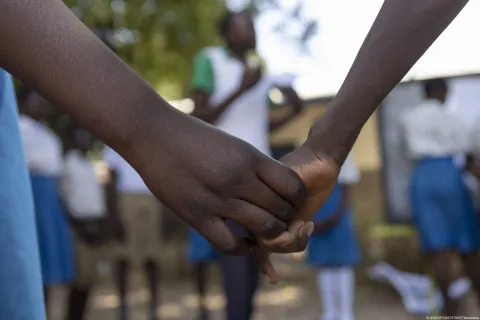
With the mid-morning sun casting shadows across the Igenge Royal Palace Grounds in Bugembe, Jinja City, the official residence of the Kyabazinga, the King of the Busoga Kingdom, children in school uniforms sat alongside teachers, district officials, and cultural leaders beneath white tents eager to hear from the Kyabazinga.
The Kyabazinga had invited officials from UNAIDS, UNICEF and UNFPA, the kingdom government and district officials to the Igenge Royal Palace Grounds to forge a lasting partnership that would help him tackle the scourge teenage pregnancies in the region.
Rather than look on, the Kyabazinga chose action; to address teenage pregnancy in his kingdom. He, thus, launched "Abasaadha Ne'Mpango" (Men are the pillars), a revolutionary campaign which encourages men to take an active role in addressing the root causes of teenage pregnancies, such as poverty, lack of parental involvement, and limited access to reproductive health services. He is also the UNAIDS Goodwill Ambassador to lead the fight against teenage pregnancy in Busoga and Uganda.
"Abasaadha Ne'Mpango will be instrumental in that it reframes the conversation. Instead of treating teenage pregnancy as solely a 'women's issue’, the campaign places men and boys at the centre of the solution," the Kyabazinga stated during the event. "We cannot end teenage pregnancy without confronting the silence of men. Men must be present, protective, and proactive. This is our shared responsibility."
In his remarks, the UNICEF Representative to Uganda, Dr. Robin Nandy reinforced the approach: "To effectively combat teenage pregnancy in Uganda's Busoga region, a multifaceted approach involving education, community engagement, cultural leadership, and health is essential."
He also praised the ‘Abasaadha Ne'Mpango’ campaign for demonstrating, "the power of the Kingdom in driving change, especially around commonly practiced behaviours at household and community level."
The most powerful moment at the event came when a secondary school girl rose, her voice steady: "We want to learn. We want to become doctors, teachers, leaders. But we need protection from our communities, and especially from the men who are supposed to guide us."
The King's response, although firm, was comforting, “parents give birth to children you can afford to look after but most importantly raise your children with discipline and culture. The children are our only continuity plan for both our legacy and our country."
Turning to the children present he further said, "children, avoid bad influence and focus on your studies. Avoid drugs and early relationships."
Dr. Nandy not only reaffirmed the Kyabazinga’s message but also framed the stakes: "Teenage pregnancy is not merely a health issue, it's a development crisis, a gender equality issue, and a barrier to realizing the full potential of girls and society."
But his message carried hope: "Through the ‘Abasaadha Ne'Mpango’ initiative, we would like to imagine a region where every girl completes her education, chooses her own future, and contributes meaningfully to the development of her community."
As the event concluded, one thing was clear, Busoga wasn't waiting for others to solve its problems but taking initiative and lead while others follow.
The ‘Abasaadha Ne'Mpango’ campaign represents a cultural commitment positioning men as protectors of girls' potential rather than obstacles. Contrary to the popular belief that culture and progress often clash, the Kyabazinga proved they can work together, creating a kingdom that protects its most vulnerable rather than abandoning them.