Listening, playing, holding
Positive parenting in Tunisia
We mothers used to think we had to keep the kids out of the kitchen. Now I’ve learned that it’s better to tell my child, ‘Come in and help me cook. Let’s bake some cake together.’ It’s better to include them.

A cold wind blows over the verdant hilltop village of Balta, in Tunisia’s northwest Jendouba province. Villagers wrapped up tightly in scarves or beanie caps walk briskly past the door of a humble barbershop lit by a single light bulb. Within the shop, Nasreddine Guedri moves back and forth with scissors and comb in hand, clipping at the beard of Hamed Jefali, a local man who has come in for a trim up. Nasreddine speaks rapidly while focusing intently on Hamed’s beard, trying to spout as much information as possible on positive parenting techniques during the quick haircut.
“A child is like a sponge, understand? They absorb all the behaviors of the people in front of them. They learn from adults’ actions. We have to be careful how we act with them. We have to treat them right,” Nasreddine says, as Hamed nods and responds with anecdotes about his own children and grandchildren.

UNICEF, thanks to funding from the Italian Agency for Development Cooperation, the EU Delegation to Tunisia, and civil society organizations in Tunisia, supported the Government of Tunisia with the development of a national positive parenting program as part of the Early Childhood Development Multisectoral Strategy, approved for the years 2017-2023. Positive parenting aims to avoid things like violence between parents and children, reduce stress, to encourage play with kids, parents’ engagement in their children’s education, healthy communication, and more shared time between parents and children. Quality time together is critical to the development of healthy and happy kids—and as these kids grow up, a productive and more cohesive society.
Offering ten-session training courses to parents in villages like Balta, the Positive Parenting Program teaches participants about child emotional and cognitive development, and how to impact that development as positively as possible. Some of those parents trained in Positive Parenting go on to become trainers themselves. Some, like Nasreddine, try to challenge negative parenting habits in their communities and spread what they’ve learned while they are literally on the job.
In his home in the fields beside a train track just outside Balta, Nasreddine trotted around his living room on his hands and knees with his two sons, Abdelmomen, 6, and Mohamed Yamen, 4, perched upon his back. Nasreddine reached back and tried to grab the boy’s dangling feet to tickle them, which they vigorously tried to escape while giggling uncontrollably. Minutes later, Nasreddine’s wife Olfa and the boys ran around the house looking for toys Nasreddine had deftly hidden, excitedly peeking under pillows and under tables. The atmosphere was warm, humorous and loving.
![“I teach them [other fathers] that hitting the kids can’t and never will help them calm down. I tell them about how I play with my kids each night at home. Playing is the most important thing. It’s the best way to make the child feel loved.” Says Nassereddine. / Balta, Jendouba. 2021.](/tunisia/sites/unicef.org.tunisia/files/styles/media_large_image/public/positiveparenting-4_0.jpg.webp?itok=ihejtA28)
Sometimes I speak to fathers whose child is having tantrums. They don’t know what to do. I teach them how to talk with their kids, and show them that they understand what the kids are feeling
“Before I had no idea what positive parenting was,” Nasreddine said. “But one day I went to pick up my son from kindergarten. I found a group there, taking pictures for the Positive Parenting program. They told me about the program. And I went and took the ten-session training.”
Now, he says, he teaches parents attending trainings in Balta, and his barbershop clients alike.
“I have some friends who come in here, and when I tell them about the Positive Parenting, they really absorb it, and they go home and apply the ideas. At first, when I ask if they help their wives with housework, they may say, ‘What? You want me to do women’s work?’ But over time they become convinced. They see that when they help their wives that it reduces their stress and reflects positively on them and the family.”
Nasreddine went on, “Sometimes I speak to fathers whose child is having tantrums. They don’t know what to do. I teach them how to talk with their kids, and show them that they understand what the kids are feeling. I teach them that hitting the kids can’t and never will help them calm down. I tell them about how I play with my kids each night at home. Playing is the most important thing. It’s the best way to make the child feel loved.”

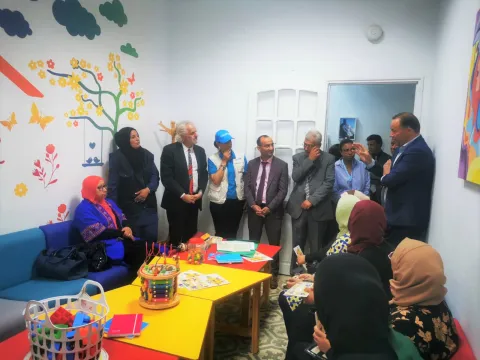
Halfway across the country, in the town of Haffouz in Kairouan province, a colorful Positive Parenting Unit has been built with UNICEF support just across the street from the town’s preschool reference center. The Unit welcomes parents and caregivers for trainings, knowledge sharing and a beautiful space to be with their children and peers.
In the Unit's fresh-looking living room, Hafidha, a mother and Positive Parenting trainer, spoke about the difference she saw in other parents’ behavior with their children after she trained them.
Speaking rapidly with excitement, she said, “The difference? It’s big! The parents aren’t violent with their kids anymore. They listen to them better. They play with their children a lot. Some parents before used to say, ‘I don’t have time to be affectionate with my kids.’ Now they know that when they hug their kids, they transmit a feeling that makes their children balanced and calm.”
Sitting in the same living room on a couch with her baby daughter Abrar and husband Ghazi, Lamia Diwani speaks about the things she learned after attending the Positive Parenting trainings, while playing with her squirming baby girl.

“We mothers used to think we had to keep the kids out of the kitchen. Now I’ve learned that it’s better to tell my child, ‘Come in and help me cook. Let’s bake some cake together.’ It’s better to include them.”
Lamia looked at her husband with a sweet smile, and said, “Now we’ve learned to help each other better. When I’m working on something at home and Abrar needs attention, he says, ‘Let me take Abrar. You finish what you’re doing.’ He helps me.”
Andrea Senatori, Director of the Italian Agency for Development Cooperation - Tunis Regional Office, a main funder of UNICEF Tunisia’s Early Childhood Development work, including Positive Parenting, talked about how they supported this work concretely.
“The Italian Cooperation has financed a KAP Survey - Knowledge Attitudes and Practices of parents of children aged 0-6 years. This analysis served to establish the theoretical and operational basis of a parenting programme. The set of information produced by the study led to the strengthening of professional capacities of childcare providers, improving capacities of parent groups and implementing multimedia campaigns and programmes. It is important to reach parents and caregivers of children aged up to 6, and raise awareness of the importance of parental education, including an online support network for parents.”

Oumayma Mabmoum, the director of the Haffouz Center, spoke proudly of her work. Sitting amid a group of parents playing with their little ones, she said, “We have conferences with parents here, discussing Positive Parenting and what it is. Parents who were uneasy at first start to get engaged. Before you know it, they are giving us suggestions on how to add to the program and make it better! But it’s not just that they are happy with the program—they are continuing the program by applying what they learn at home.”