Handwashing facilities at health centers help save lives from COVID-19
Ensuring that all procedures are done in safe and clean environments

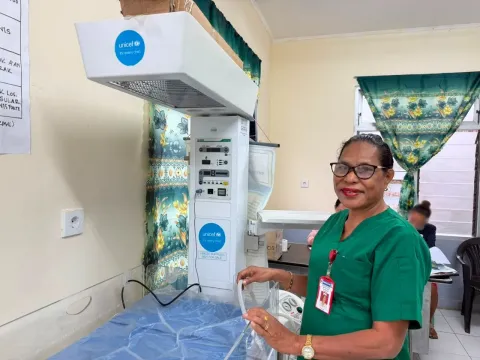
Quelicai, 23 June 2024 – To get to her workstation in the Pharmacy at Quelicai Community Health Centre (CHC) in Baucau Municipality, Esperança dos Santos, passes through the busy corridors at the health centre, observing the growing number of patients milling about, awaiting their turn to be attended to.
While the reviews and consultations begin at various wards, most patients end up at Esperança’s door, holding prescriptions for the medications which will help with their recovery. This means at the end of each day, Esperança interacts with patients with various ailments, making it essential for her team to always keep a clean environment to prevent contamination and the spread of infections.
“On each day 50 to 60 patients are attended to at the health centre, while five to six mothers deliver at this centre every week and all these patients end up at the pharmacy. To reduce contamination which can occur because of the regular flow of patients and staff, we regularly wash all the equipment and storage cans in the pharmacy, we also need to wash our hands before handling tablets and also after serving a patient,” says Esperança as she describes the extensive demands for a clean water source at the pharmacy.
Since starting work at the CHC in 2011, Esperança and her team have been aware of the daily struggles for water, which affect every part of the health centre. Across the health facility there is no reliable flow of water at the hospital, which meant they had to improvise on getting water to get their assignments done in a clean and professional environment.
“In the past, we had to go far, for at least one kilometer, to fetch water and bring to the health centre for use. The family of the patients also had to bring water from home for us to use at the health centre, especially for procedures at the maternity,” says Esperança as she describes how the staff at the health facility had to carry the burden of finding water, on top of their daily duties.
“When COVID-19 Vaccines were first introduced, we even had more work on our hands as we needed to continue dispensing the regular medications, and also ensuring that COVID-19 vaccines were administered, while also being forced to find time to fetch water from different sources” says Esperança, as she describes the required balancing act of ensuring trying to ensure that the pharmacy remains a sterile area, even in the face of a pandemic.

UNICEF has been a key partner to the Ministry of Health in the capacity building of the health workers on infection prevention and control where Water, Sanitation and Hygiene (WASH) facilities have a critical role. To support sustainability of upgraded facilities, WASH and Infection Prevention and Control (IPC) supply packages consisting of 25 items were provided to all CHCs. This package includes essential consumables, surface cleaning agents, waste collection equipment and staff safety gear.
A key component of WASH upgrades was to improve the reliability of water supply to the CHCs by upgrading water sources, transmission lines, storage capacity and distribution system. This immensely helped many nonfunctional toilets and handwashing stations to be functioning again. UNICEF also improved disability access to these WASH facilities as well as installed a number of new internal and external handwashing stations benefiting both health staff and community. Apart from the improvements to the WASH facilities, UNICEF is also supporting the Ministry of Health through social behavioral change activities, which are undertaken through health promotion corners in all community health centres across the country.
The Health Promotion Corners help with dissemination of information on COVID-19 prevention, including the importance of washing hands with soap and clean water. Patients and visitors can access this information while they are waiting for treatment.
Esperança is grateful for the positive changes brought by the water installation to this health centre through this project of cooperation.
“The installation of WASH facilities at this centre, has really been helping us, to wash my hands before and after doing my work as a pharmacist. I touch different health equipment hence this expanded capacity for handwashing within the health centre has helped me to maintain good hygiene standards while I do my work, says Esperança.
The water system that provides the water to Quelicai CHC is jointly used by the community members and the health centre. To save water and ensure a consistent supply, another water storage facility has been built near the centre thus feeding water to each and every building within the health center ensuring functional toilets and active handwashing stations during health procedures.

With support from USAID, and in collaboration with the Ministry of Health, UNICEF has been upgrading WASH facilities in 55 Community Health Centers and 20 Health Posts in 10 municipalities across Timor-Leste nation in responding to COVID-19 outbreak.

These WASH facilities have been benefiting the visitors, patients and health staff for washing their hands and other health equipment to protect themselves from COVID-19 and other diseases.
###Ends