UNICEF supports newborn care programme in Timor-Leste
Through the eyes of a midwife in Lautem Municipality

Lautem Municipality is found in the far east of Timor-Leste. The journey from Dili, the capital, to Lospalos, the main town of Lautem, takes about five to six hours by car.
“As Head of the Maternal and Child Health under the Municipal Health Services, my job is not easy. It is a big responsibility. I supervise the newborn care team in five community health centres across Lautem Municipality. These centres are far from one another and often difficult to reach, especially during the rainy season because of poor road conditions. The success of the programme depends on my supervision and monitoring, which is why I say it is not easy,” Beatris Fernandes explains.
Beatris is a midwife who began her career in 1992, when Timor-Leste was under Indonesian occupation. After the country gained independence, she continued her service as a midwife and remains dedicated to her community.
As she supervises and monitors all the community health centres in her area, she ensures that the equipment is complete and in good condition and guides the midwives to perform well. Her supervision and monitoring reports are then submitted to the Head of the Municipality Health Services for evaluation and future planning.


UNICEF's contribution of health equipment and training for the newborn care programme really helps health professionals do their work, benefiting mothers and newborns by ensuring they receive high-quality health services.
“The health equipment, such as sterilizers, baby warmers, delivery sets, dopplers, tensiometers, thermometers, newborn care packages, and delivery beds, makes a big difference,” Beatris says. “Before, we used old sets that were not complete. Now, all the newborn care equipment is modern and reliable. It really helps pregnant mothers when they give birth at this health centre,” she adds.
“I carry out supervision once every quarter as required. But I do monitoring every week, especially at the Lospalos Community Health Centre,” Beatris explains. “During supervision and monitoring, I also check the LISIO book (LISIO = Livru Saude Inan no Oan, English: Mother and Child Health Handbook of pregnant mothers and those who have just given birth at this health centre.” The LISIO book is produced by the Ministry of Health. It records the health and progress of pregnant mothers and children up to five years old.

Working in midwifery feels like a good fortune for Beatris. When she studied midwifery during Indonesia’s occupation, she only learned theory in the classroom, which was not enough for her.
Later, she received training from the Ministry of Health, with support from UNICEF, on Essential Newborn Care (ENBC) and Safe and Clean Delivery (SCD). These training sessions strengthened and enriched her knowledge, equipping her with the skills she needs to serve mothers and babies with confidence.
“I feel lucky that I continue my profession as a midwife, alongside my responsibility as Head of the Maternal and Infant Health Department,” Beatris says. “I had the opportunity to attend the ENBC and SCD trainings, and I received a certificate from each of those trainings. The training teaches me how to help pregnant mothers in emergencies and complications. It brings great benefits, improves our knowledge, and strengthens our ability to support mothers during childbirth. Also, on how to assist the mothers to have a safe and clean delivery”
Beatris says that she has learned many new skills from the recent training. She learned how to assist pregnant mothers during birth, manage complications such as when a baby’s feet come out first, and help mothers who feel dizzy or suffer from high blood pressure during delivery, and to make sure every delivery is safe and clean. She also learns how to respond quickly when bleeding happens during or after birth, and how to handle cases when a baby dies in the mother’s womb.
“Before the training, I only learned the theory. But in this training, I receive both the theory and the chance to practise. And I have been practising what I learned,” Beatris says confidently.

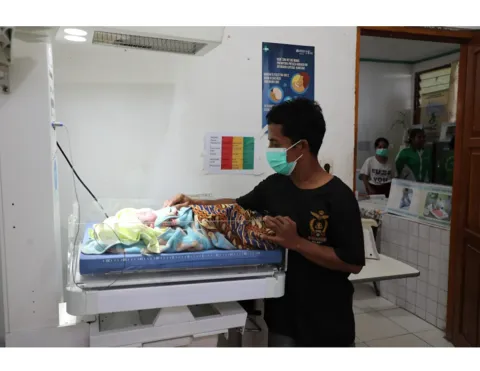
Pregnant mothers are aware and understand that giving birth at a health facility helps save both their lives and their babies’ lives. They know that delivering a baby at home carries great risks for mother and child. The three delivery beds donated by UNICEF make mothers feel safe and comfortable when they give birth at Lospalos Community Health Centre.
Other equipment, such as the fetal doppler, is used in ultrasound to monitor the heartbeat. Additionally, it is used to diagnose blood clots, blocked arteries, and heart valve defects. This equipment also greatly helps the midwives in their work.

In a normal schedule, a pregnant woman visits a health facility at least eight times for antenatal care before giving birth. However, many mothers do not follow this schedule for different reasons, such as the long distance from their homes to the health facilities.
If the pregnant patient does not come for a visit, health professionals follow up with them by phone.
Health professionals use this finding as a basis to take follow-up action through health promotion activities, both during outreach programmes in the villages and at the health facility itself.
Health professionals always check the mother’s status from the first visit until the last one before birth. After antenatal care at the health centre, some mothers give birth at home with the support of health professionals, often because of distance issues. For example, in the past three months, health professionals have helped with nine home deliveries.
A lack of delivery equipment and human resources at health posts across Lautem Municipality remains a challenge.
“Normally, there should be at least one midwife at each health post and twelve at the health centre level,” Beatris says. “Another challenge is that we are low on equipment and end up buying what is easily available, but it might not be the best quality.”

Using the national Tetun language to explain messages during outreach activities in the field and during counselling sessions with parents is effective. But communicating in the local language has an added value — it touches the hearts of community members.
Beatris speaks Tetun, and other local languages such as Fataluku, Makalero, and Makasae. When she provides counselling to mothers before and after giving birth, she always uses their language, so it is easier for them to understand.
“I remain enthusiastic and continue to work as a midwife,” Beatris says.
“For the future, I want to continue this work because I enjoy helping pregnant and breastfeeding mothers, as well as their children,” smiles Beatris.