It’s never too late to learn
How Goodness found her way back to school in Kigoma, Tanzania

When Goodness smiles in class, it is more than a moment of joy. It’s a quiet victory after years of being denied the chance to learn.
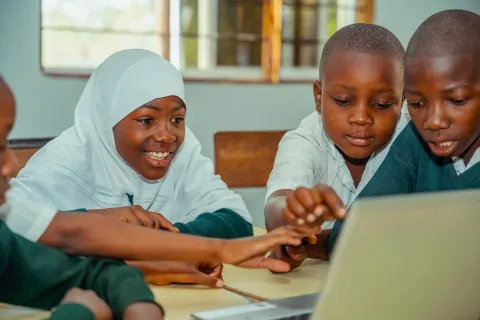
At 18 years old, Goodness sits in a Grade 9 classroom in Kigoma Region of Tanzania, pen in hand, eyes fixed on a future she once believed had slipped away.
But her seat in this classroom was never guaranteed.
Goodness first enrolled at a primary school in Mbanga village, Lindi Region, in southern Tanzania, but was forced to drop out in Grade Two at 11 years old, when her family’s financial struggles became overwhelming, and school fees, uniforms, and basic supplies were no longer possible.
While her two younger siblings continued their studies, Goodness was sent to Dar es Salaam to work as a house-help.
“I wanted to study, but there was no way.”
In 2020, she moved again with her family. This time to Kigoma. Still out of school, her days were spent doing small chores at home to help make ends meet.
But something changed in 2022.
“I saw children my age going to school in the afternoon,” she says. “I asked them who was teaching them in the afternoon as school ends in the morning for many children.”
To answer that question, they introduced her to the Complimentary Basic Education in Tanzania (COBET) programme a pathway designed to support children and adolescents who have dropped out of, or never entered, the formal education system.
It is implemented by the Government of Tanzania and is part of the ‘Equitable Access to Quality Primary Education for Out-of-School Children in Tanzania’ programme implemented by UNICEF in partnership with the Education Above All (EAA) Foundation and with support from the Qatar Fund for Development.
Goodness took the initiative to go to the school herself and ask how she could join.
From that day, Goodness’ journey back into education began.
Through the programme, Goodness began catching up on years of missed learning, but returning to school was not easy.
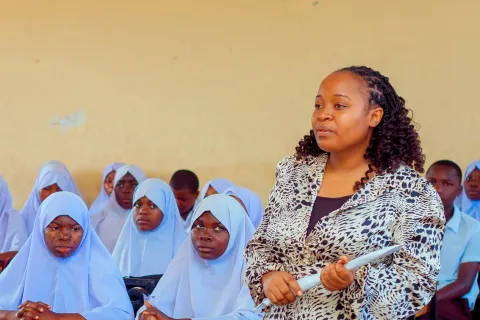
“She was older than many of the other learners,” says teacher Maono Meshack, a COBET teacher who taught Goodness throughout the programme. “At times, she struggled with self-doubt due to her age and felt she stood out.”


Teacher Maono was among educators who received training under the programme, focusing on psychosocial support and inclusive teaching methods for children who had been out of school.
Seeing Goodness withdraw into herself, Maono offered a simple but powerful reminder, “Education has no age limit.”
“Before the training, I wouldn’t know how to support Goodness,” she explains. “But the training helped me understand what children like Goodness are going through and how to guide them.”
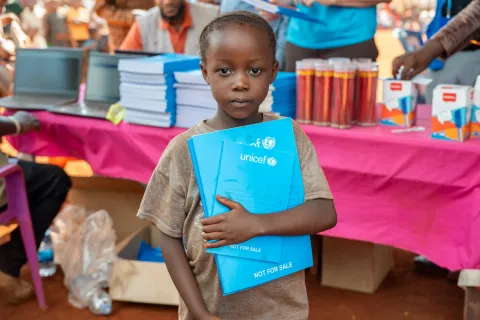
Through the programme, she received learning materials including books, pens, and a school bag, items her family could not always afford. She also benefited from menstrual health education and access to sanitary pads, helping her attend school with dignity and confidence.
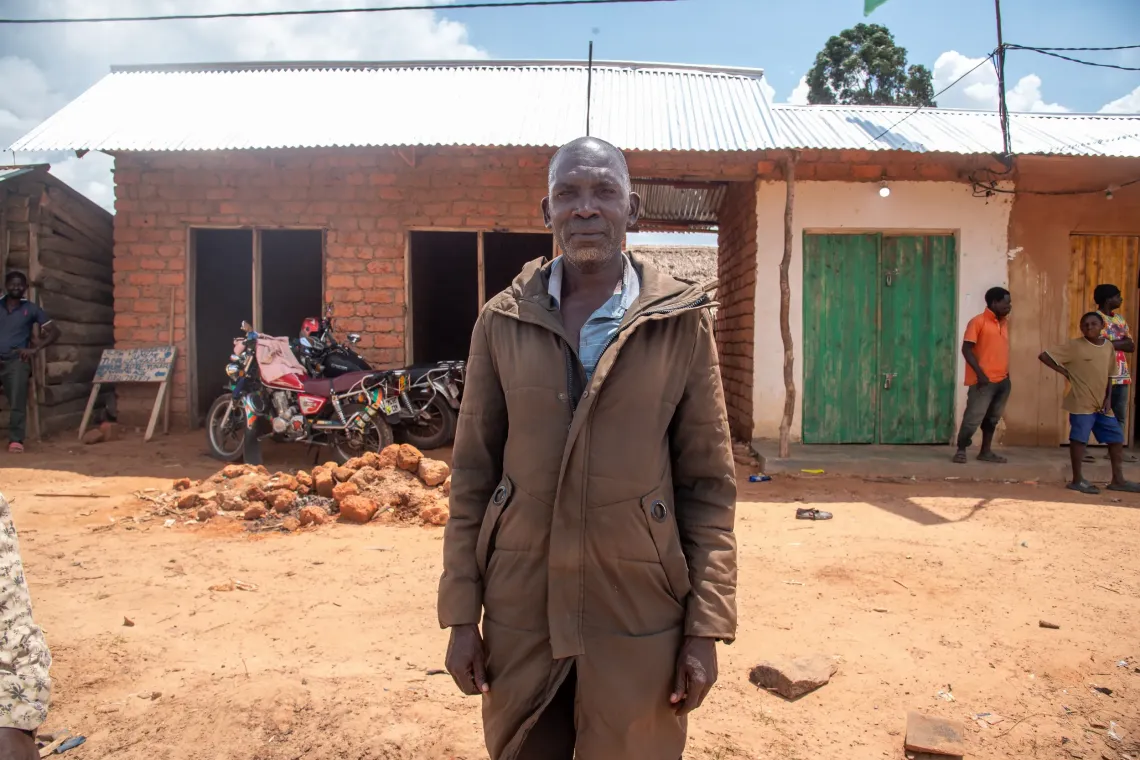
“Even if I did not get education, I am happy to see Goodness back to learning again,”
Her father, Osea Said, talks about her transformation with pride. A coffee farmer with limited income, Osea never had the chance to attend school himself. “My father died when I was very young,” he explains. “I never learned how to read or write.” Yet he understands the value of education.
After completing the programme in 2023, Goodness was registered to sit for the Grade Four National Assessment (SFNA). She passed with good results, prompting the school to advance directly to Grade Seven, where she sat for the national Primary School Leaving Examination (PSLE) in 2024 and passed again, earning a B grade. When Goodness passed her exams and became eligible to transition into secondary school, the family made a difficult decision. Despite financial strain, her family committed to enrolling her in a private school.
“The fees worry me,” Osea admits. “But I will do what I can.”
Today, Goodness is progressing steadily in school. She speaks about her past, including the pain of being sent to work while her two younger siblings were able to attend school. As she shares this memory, her voice trembles. But her focus remains forward-looking.
“When I grow up, I want to work somewhere I can help children like me,” she says. “If I met the younger version of myself, I would tell her, twende shule! (let’s go to school)"

As Goodness walks home with books in her hands as a living sign of what second chances can become.
For children still wondering if they can go back to school, her story is a reminder:
It is never too late to learn.