How UNICEF is supporting social welfare officers to respond to families in crisis
Social Welfare Week 2025

On 25 August, Social Welfare Week 2025 opened in Dar es Salaam with a strong call to expand access to Mental Health and Psychosocial Support (MHPSS) services across Tanzania.
Launched by the Minister for Community Development, Gender, Women, and Special Groups (MoCDGWSG), Dr Dorothy Gwajima, the week brings together social welfare officers, childcare service providers, policymakers, and community representatives to share experiences, forge partnerships, and ensure that no one, especially mothers, children, and vulnerable groups, is left behind.

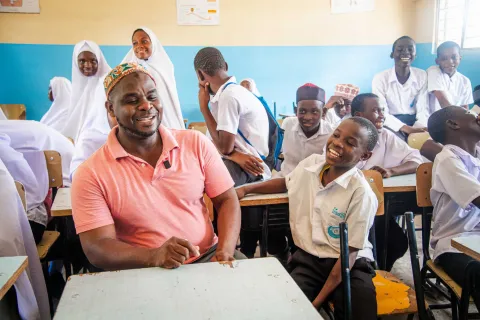
Among the hundreds of social workers gathered was Japhet, who worked side-by-side with UNICEF during the Marburg outbreak in Kagera. Together with other dedicated officers, he walked from house to house, extending care to the hardest-to-reach in the fight against Marburg disease. His work went far beyond sharing information. In a climate of fear, uncertainty, and stigma, Japhet became a trusted face—countering misinformation, reassuring anxious families, and linking them to the support they desperately needed. Around 400 people received services from the MHPSS team during the outbreak.


“One case that stays with me,” Japhet recalled, “was when a mother exposed to the disease was quarantined, leaving her two children with a grandfather who struggled with alcoholism. Often, the children were left alone. Once we learned about the situation, we stepped in, caring for the children, supporting the mother, and eventually reuniting them. We worked with them to make sure their mental health was supported.”
Japhet spoke of the weight this work carries, especially in emergencies. “It’s great to have a week like this to meet with fellow social workers and exchange knowledge. But we still need much more training, especially in professional therapy, so we can better respond to complex cases,” he said.
This call for stronger investment in social welfare was echoed in a panel discussion, where Miranda Armstrong, UNICEF’s Chief of Child Protection in Tanzania, emphasised that social workers must be adequately equipped on the ground—not only with training and tools to respond in high-pressure situations, but also with the resources and budgets to deliver their essential duties. She reaffirmed UNICEF’s commitment to building the capacity of social workers, expanding community outreach, and ensuring timely support before, during, and after emergencies.


Japhet knows that the need for mental health support doesn’t disappear when the crisis ends. “In Tanzania, many people, especially young people, suffer from depression and anxiety, which can sometimes lead to suicide. Anxiety is tricky because one doesn’t always know when they’re going through it,” he explained.
Closing the week, Dr John Jingu, Permanent Secretary of MoCDGWSG, reemphasized that social welfare services are the backbone of a caring and resilient community. “It’s our shared responsibility—government and partners alike—to plan effectively so that every person, especially the most vulnerable, can access the support they need to thrive.”


“As Tanzania advances towards the goals of Vision 2050, a strong and well-resourced social welfare cadre will be critical to ensuring that no one is left behind,” added Elke Wisch, UNICEF Representative to Tanzania. “UNICEF will continue to partner with the Government to strengthen this workforce through capacity building, research, and sharing lessons from around the world.”
For Japhet, Social Welfare Week is a reminder that he is part of something bigger: a nationwide network of professionals and partners committed to protecting and empowering the most vulnerable. “It’s not easy,” he reflected, “but when you see a family reunited, or a child smile again after going through so much, that’s when you know this work matters.”