Baby Lilian’s first battle
How the basics saved her life

In a small hospital in rural Tanzania, just an hour after her birth, Baby Lilian was fighting for survival.
Her tiny chest rose and fell quickly while her mouth gasped for air. The healthy pink of her skin was fading, replaced by a pale, grey hue. Something was very wrong.
In that moment, a nurse noticed what others might have missed. She clipped a small pulse oximeter to Lilian’s footto measure her oxygen levels. The numbers confirmed her worst fears: they were dangerously low. Lilian was critically ill, and her life was slipping away.
The nurse didn’t hesitate. Oxygen tubing was placed in Lilian’s nose. A steady flow of oxygen began. Within minutes, her breathing slowed, her colour returned, and her oxygen levels rose. Over the next two days, she was monitored closely, kept warm in her mother’s arms, and cared for until she was strong enough to go home.
Lilian’s survival wasn’t a miracle. It wasn’t due to an expensive machine. It was the result of a trained nurse, a working pulse oximeter, a simple cylinder of oxygen, and care that was responsive to her needs.
The silent emergency in hospital wards
Every day across Africa, countless patients — newborns, children, adults — slip into critical illness. Some, like Lilian, show signs early. Others deteriorate quietly. Too often, these signs go unnoticed. Or if they do, hospitals often lack the trained staff, equipment, or protocols to respond.
This is the stark reality laid bare by The African Critical Illness Outcomes Study (ACIOS), published in The Lancet in February. It is the first large-scale analysis of critical illness across the continent. And its findings are as urgent as they are sobering.
- One in eight hospital inpatients is critically ill.
- More than two-thirds are treated in general wards, not intensive care.
- Over half don’t receive basic, life-saving interventions like oxygen or fluids.
- One in five will die within seven days.
Many of these deaths are preventable. What’s missing is not high-tech intensive care, but timely recognition and delivery of the basics. ““The problem isn’t lack of knowledge—we know what to do. It’s that the systems aren’t set up to do it, consistently and early enough,” says Dr. Karima Khalid, a Tanzanian specialist doctor involved in the study.
She points to patients suffering from common conditions—pneumonia, sepsis, birth complications. “They don’t need high-tech interventions. They need oxygen, fluids, basic airway support. And they need them fast.”
The power of the basics: Introducing EECC
Essential Emergency and Critical Care (EECC) sounds like a technical concept. But it’s rooted in a simple idea: every hospital should deliver basic life-saving care to the critically ill patients.
EECC is not about ventilators and intensive care; it focuses on the basics — low-cost, high-impact actions such as monitoring vital signs, recognizing danger signs, and giving oxygen or fluids when needed. These basics save lives. It is designed to be practical, affordable and scalable. In Tanzania, it’s already being embedded into the national health system.
From National Plan to Regional Action
In 2023, Tanzania launched its National Strategic Plan for EECC Services, a bold initiative to bring these life-saving interventions into health facilities across the country.
Operationalized through a programme called EECCiT (Essential Emergency and Critical Care in Tanzania), the initiative is led by the government in collaboration with UNICEF, Muhimbili University of Health and Allied Sciences, and with funding from Global Affairs Canada through the CanGive initiative.
EECCiT is being rolled out across Zanzibar and five mainland regions: Dar es Salaam, Kigoma, Katavi, Songwe and Mtwara. It includes practical staff training, systems strengthening, stakeholder engagement, and real-time data integration into the national health information system. The goal is to make EECC a core part of how health services function, building systems that can quickly identify and respond to critical illness.
Nowhere is this more visible than in Songwe.
Vwawa Hospital: A blueprint for emergency care
In the mountainous Songwe Region, Vwawa District Hospital has become Tanzania’s first “EECC Centre,” aiming for 100 per cent provision of EECC to all critically ill patients.
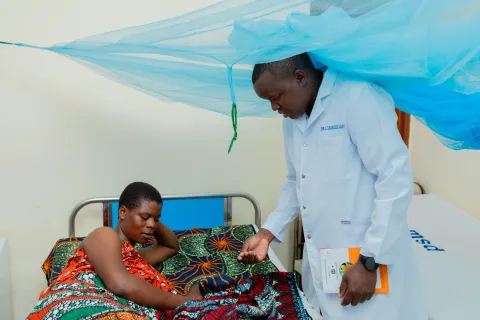
Throughout May and June, teams of clinicians and nurses participated in hands-on, three-day training on EECC. Developed within EECCiT in collaboration with experts at EECC Global, the course focuses on practical, repeatable skills: assessing vital signs, managing airways, delivering oxygen, resuscitating with fluids, responding to unconsciousness, preventing infection, all with clear communication.
The course is open-access and available online, but in Songwe, the emphasis has been on in-person delivery—staff learning together, on-site, with real patients and equipment.

“Training everyone, not just a few champions, creates a culture change,” says Dr. John Manyingili Vwawa’s medical officer in charge. “It means EECC isn’t just something we do—it’s how we work.”
But when it comes to changing a system: training alone does not work. The health managers and leaders in Vwawa have also been capacitated in EECC. Supervision, mentorship, tools, job aids, and system reviews have been introduced to ensure the training translates into practice. The hospital will act as a hub for other facilities and a model for other districts.
The result is a hospital culture where every patient, in every ward, receives early, appropriate critical care — just as Baby Lilian did.
Doing the basics, and doing them well
Lilian’s story could have ended very differently. And for many newborns in similar circumstances, it still does.
But in that moment, thanks to a trained nurse, a working pulse oximeter, a cylinder of oxygen, and a system that knew what to do, her life was saved.
EECC won’t fix every gap in healthcare. But it shows that with the right training, tools and commitment, health systems can respond to the most urgent needs—even in the most under-resourced settings.
It proves that sometimes, the biggest change doesn’t come from building something new—but from doing the basics, and doing them well.
Lilian, and all children, deserve as much.