Public Dialogue explores Roadmap to Ending Child Labour in Tanzania
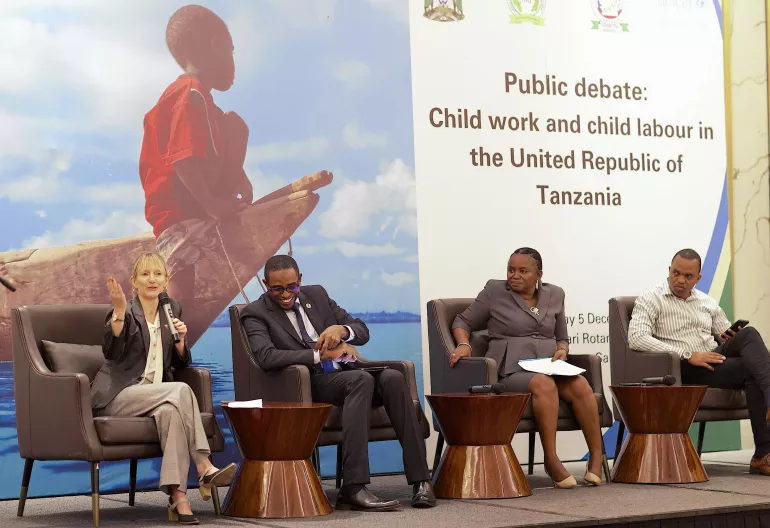
DAR ES SALAAM, 05 December 2024 — A new report, Child Work and Child Labour in the United Republic of Tanzania: Evidence from the Integrated Labour Force Survey (2014–2021) notes significant progress in reducing child work and child labour, while highlighting that persistent challenges jeopardize efforts to eradicate child labour in Tanzania. To tackle these obstacles/challenges, the study recommends key steps to pave the way to ending child labour in Tanzania.
The report, released jointly by the National Bureau of Statistics, the Office of the Chief Government Statistician Zanzibar, and UNICEF, provides a detailed analysis of child labour trends across mainland Tanzania and Zanzibar. Using the latest data from the Integrated Labour Force Survey (ILFS) 2020/21 and tracking changes since 2014, the study assesses Tanzania's progress toward Sustainable Development Goals (SDGs) 8.7 and 16.2, which aim to eliminate child labour, abuse, and exploitation.
“This report provides critical insights into the scope and nature of child labour in our country,” said Dr. Albina Chuwa, Director General of the National Bureau of Statistics. “Reliable data is essential for designing evidence-based policies and accelerating efforts to eliminate child labour in all its forms. The Government of Tanzania is committed to transforming these findings into meaningful action, ensuring every child has access to education, safety, and a brighter future.”
According to the report significant progress has been made in reducing child labour between 2014 and 2021, with rates dropping from 35 per cent to 26 per cent in mainland Tanzania and from 9 per cent to 7 per cent in Zanzibar.
Despite these achievements, the findings reveal that child labour is still a pressing concern. In 2021, more than 5 million children aged 5–17 were engaged in child labour, with a higher prevalence on the mainland (26 per cent) compared to Zanzibar (8 per cent). Gender disparities are evident, with 27 per cent of boys more likely to engage in child labour than 23 per cent of girls. However, girls often bear the burden of unpaid household tasks, highlighting the complex gender dynamics underlying child labour activities.
The agricultural sector remains the largest contributor to child labour, accounting for 84 per cent of children involved in crop farming on the mainland or fishing activities in Zanzibar. These children endure long hours, including night shifts, averaging 23 hours per week. They are often exposed to hazardous conditions, such as toxic fumes and heavy lifting, placing their health and safety at significant risk.
The report further highlights vulnerable groups at greater risk of child labour. These include children in rural areas, out-of-school children, particularly boys aged 15–17, children without birth certificates, and those from the poorest households. These factors reflect the socioeconomic and structural drivers contributing to higher child labour rates within these populations.
To tackle the root causes and drivers of child labour, the report recommends expanding social protection programmes, such as cash transfers to vulnerable families aimed at poverty reduction thereby reducing the necessity for children to contribute to family livelihoods. Expanding and improving the quality of education and skills programmes to keep children in school and learning, and to equip them with the skills leading to non-hazardous livelihoods options. It also emphasizes the importance of awareness campaigns led by local leaders to highlight the dangers of child labour and the benefits of education. The report further advocates for an integrated approach that combines poverty alleviation with education and child protection and calls on businesses and industries to adopt child labour-free certifications and implement regular inspections, particularly in high-risk sectors like agriculture and mining.
"While we celebrate the progress made in reducing child labour in Tanzania, the fight is far from over," said Elke Wisch, UNICEF Representative to Tanzania. "Every child deserves a childhood free from exploitation, the right to protection, education, and the opportunity to thrive. UNICEF remains committed to supporting the Government of Tanzania in investing in and strengthening social protection, education and child protection programmes that empower families to break the cycle of poverty, remove children from hazardous labour, and return them to learning and enabling them to achieve their potential ”
Media contacts
About UNICEF
UNICEF promotes the rights and wellbeing of every child, in everything we do. Together with our partners, we work in 190 countries and territories to translate that commitment into practical action, focusing special effort on reaching the most vulnerable and excluded children, to the benefit of all children, everywhere.
For more information about UNICEF Tanzania and its work for children, visit www.unicef.org/tanzania.