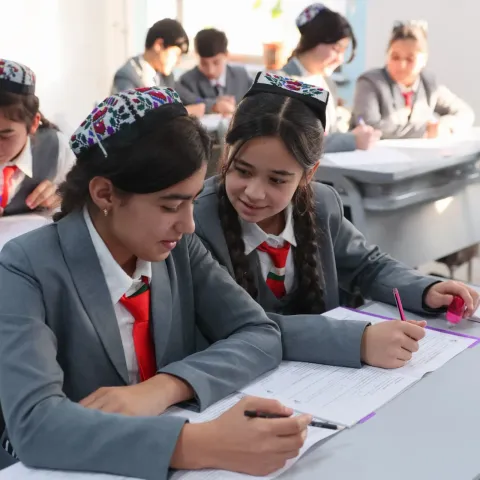
Launch of the 2nd phase of the Quality Education Support Programme
The programme financed by the European Union aims to improve the learning outcomes and employability of Tajik young girls and boys with a special attention to the most vulnerable

- English
- русский
Dushanbe, 3 December 2021 – The European Union, the United Nations Educational, Scientific and Cultural Organization (UNESCO), the United Nations Children Fund (UNICEF) in Tajikistan and the German Development Bank KfW jointly with the Ministry of Education and Science of the Republic of Tajikistan (MoES) launched a new programme “The 2nd Phase of the Quality Education Support Programme” funded by the European Union.
With the generous financial support by the European Union, UNESCO UNICEF in Tajikistan and KfW are implementers of the 2ndphase of the Quality Education Support Programme for Tajikistan (hereinafter – the Programme). This support Programme focuses primarily on poverty reduction and rights realisation of each person in the country by facilitating the sustainable development and inclusive economic growth as well as mitigate the impact of the COVID-19 crisis in Tajikistan. More specifically, this Programme aims at improving the learning outcomes and employability of Tajik young girls and boys with a special attention to the people living in vulnerable situations.
The Programme is designed to support the implementation of the Tajikistan’s National Development Strategy for the period up to 2030 priorities on expanding productive employment as well as enhancing the human capital development. In addition, the Programme is facilitating the implementation of the National Strategy for Education Development until 2030, as well as the commitments of the Government of Tajikistan towards achieving Sustainable Development Goals.
Within this Programme, UNESCO UNICEF and KfW aim to support the ongoing educational reforms of introducing the competency-based education in Tajikistan with a particular focus on ICTs in Education, STEM education development, strengthening of teacher training system and the access to safe, healthy adequate school environment with specific focus on Water, Sanitation and Hygiene (WASH).
“Ministry of Education and Science of the Republic of Tajikistan as a beneficiary of this project gives great importance to its implementation and cooperation with the European Union, UNESCO, UNICEF and KfW. This very timely and significant project will allow us to improve the education sphere which goes hand in hand with the National Strategy for Education Development 2021-2030. This project emphasizes the development of competencies of children in the area of ICT, as well as enhancement of capacity development of teachers around Tajikistan. The Ministry of Education and Science of Republic of Tajikistan took an active participation during development of the project and selection of priority areas. It is very clear that this project is very timely and will have a very positive effect on our young population.” Underlined the Minister of Education and Science of the Republic of Tajikistan, Mr. Imomzoda Muhammdyusuf.
The Ministry of Education and Science of Republic of Tajikistan took an active participation during development of the project and selection of priority areas. It is very clear that this project is very timely and will have a very positive effect on our young population.” Underlined the Minister of Education and Science of the Republic of Tajikistan, Mr. Imomzoda Muhammdyusuf
“The EU remains committed to continue supporting the education sector in Tajikistan as a priority over the coming years. The current Quality Education Support Programme is the second phase of our bilateral support to undertake major reforms under the National Strategy for Education Development 2021-2030. And aimed at improving the learning outcomes and employability of young Tajik girls and boys with special attention devoted to young people living in vulnerable situations. This program builds on the strong partnership between the EU, the Ministry of Education and Science, KfW, UNESCO and UNICEF.”, Ms Marilyn Josefson, Ambassador, Head of Delegation of the European Union to Tajikistan
This program builds on the strong partnership between the EU, the Ministry of Education and Science, KfW, UNESCO and UNICEF.”, Ms Marilyn Josefson, Ambassador, Head of Delegation of the European Union to Tajikistan.
“Quality education is an important foundation for the human capital development. For this reason, within the framework of this joint project with the European Union, UNESCO will be working with the Ministry of Education and Science towards improving the overall quality of education in Tajikistan through developing competency-based learning and teaching materials, capacity building of teachers as well as equipping the teacher training centres in such priority areas as STEM and ICT”, highlighted UNESCO Representative in Kazakhstan, Kyrgyzstan and Tajikistan, Ms. Krista Pikkat.
“This new partnership between UNICEF, the Ministry of Education and Science, and the European Union aims to support the long-term goal of reforming education in line with the strategic objectives of National Education Development Strategy until 2030. In particular, the partnership shows a clear vision and commitment towards achieving the 4th Sustainable Development Goal in order to ensure access to quality and inclusive education for all children in the Republic of Tajikistan” noted UNICEF Representative, Mr. Osama Makkawi.
“KfW is happy to contribute to combined efforts together with EU, UNICEF, UNESCO through provision of quality infrastructure in order to improve the the learning outcomes.” Dr. Andreas Schneider, Director, KfW Office in Dushanbe.
About the Programme
UNESCO’s project component will contribute to strengthening competency-based and ICT-enabled STEM and VET education and teacher-training in Tajikistan
UNESCO will design modern and gender-responsive teaching and learning materials for STEM subjects at secondary education level based on the international standards and competency-based curricula. Within this project, UNESCO will also support the development of the ICT competency standards, curricula and assessment framework for teachers as well as provide the teacher training centres with the state of the art STEM and ICT equipment.
Following results will be pursued by UNESCO within this project:
- Improving national capacities for the development of the high quality of textbooks, teaching and learning materials on STEM subjects of the grades of 7-11 at secondary levels. This will also include rethinking the assessment framework of learning achievements based on new curriculum and competencies on STEM subjects.
- Capacities of teacher trainers and educators will be enhanced to train teachers from pilot schools on delivering the gender-responsive STEM subjects in secondary and VET schools.
- Based on UNESCO’s ICT-Competency Framework for Teachers (ICT CFT), the ICT Competency Framework for Teachers will be developed, which will be integrated into the overall Competency Framework for Teachers in Tajikistan. The teacher training modules on building competencies for the use of ICTs in pedagogical practices will be developed. In addition, the project will prepare at least 56 teacher educators/trainers and develop teacher learning management system for scaling the teachers’ competency development on ICTs.
- UNESCO will also improve the existing infrastructure of the in-service Teachers Training Centres for secondary and VET schools by equipping them with the STEM and laboratory facilities as well as Internet connectivity and ICT equipment. More specifically, UNESCO will refurbish and equip six Teacher Training Institutions under the MoES and eight Teacher Training Centres under MoLME with upgraded STEM and ICT equipment.
Within the scope of its project, UNICEF in Tajikistan will enhance continuous access to quality education and employability of the youth in Tajikistan by:
- Increasing national institutional capacity towards providing adolescent boys and girls with relevant competencies and skills needed for meaningful engagement in school, at home, at the work place, and society at large, further ensuring continuity of learning and skills development opportunities in case of school closure due to COVID-19 and other emergencies.
- UNICEF will be supporting the national education system through empowering schools’ communities in supporting learning and skills development, through: a) extra-curricular competency-based education (targeting secondary school age), b) the development of a new model for personal empowerment and career counselling, using the existing UNICEF supported platform of student councils, c) Career Guidance Programme Development for grades 5-11, d) Development of TV education lessons, e) Development of national Digital Platform and Roadmap and f) Promote skills for employability and school-to-work transition.
- Using centers for additional education for providing skills-building opportunities and informal vocational training, focus will be on core competencies and innovation. Innovation Labs at Centres for Additional Education represent an essential part of non-formal education system under the Ministry of Education and Science. This pathway is a space where students and out-of-school adolescents will receive 21st century skills through skills development and social entrepreneurship programmes “UPSHIFT” and “Adolescent Kit for Expression and Innovation” coupled with ICT skills training.
- Continuous technical support to crisis management, coordination and communication of activities will be embedded across all programme interventions. Additional needs including ICT capacity will be developed, enabling the possibility to adopt blended and e-learning approaches across all programme components.
Within the scope of the Programme, KfW will support the improvement of the access to safe, appropriate and healthy environment.
For this purposes more than 35 schools in the Khatlon area and Zarafshan region will be supported with rehabilitation and construction works in order to meet the needs of the growing population in the region. A special focus will be put also to the access to WASH facilities and raising awareness on the WASH practices. A Parent-teacher association to every school will be established in order to continue the functioning of the supported schools.
Within the scope of the EU QESP II programme, a Technical assistance support to the Ministry of Education and Science, the Ministry of Labour, Migration and Employment of the Population and the Ministry of Finance will be provided.
The purpose of the project is to strengthen the quality and relevance of competence-based general secondary education and VET for the needs of learners and the labour market, to improve the labour market information system connecting skills demand and supply and informing skills development and matching policies, to improve governance of the education sector in terms of new financing schemes, strengthened policy development, monitoring and evaluation capacity and coordination with stakeholders and the public finance management. The project will be implemented by technical assistance company, which is to be selected following a procurement procedure. It is expected the implementation of the project to start in the first quarter of 2022.
Beneficiaries and partners
Main beneficiaries and partners of this project are the Ministry of Education and Science (MoES) and the Ministry of Labour, Migration and Employment (MoLME) of the Republic of Tajikistan. In addition, teachers and young people (students), especially women and girls throughout the country will benefit from the project results by having access to high quality education programmes and skills development that are relevant for the labour market.
###
For media inquiries:
UNICEF: Mr. Daler Dodojonov, Communication and visibility Officer, UNICEF, [email protected]
UNESCO: Ms. Meirgul Alpysbayeva, UNESCO Almaty Cluster Office, email: [email protected]
KfW: Ms Farzona Noyobshoeva, KfW Dushanbe Office, e-mail: [email protected]
Media contacts
About UNICEF
UNICEF promotes the rights and wellbeing of every child, in everything we do. Together with our partners, we work in 190 countries and territories to translate that commitment into practical action, focusing special effort on reaching the most vulnerable and excluded children, to the benefit of all children, everywhere. UNICEF operates in Tajikistan since 1993.
To receive more information about UNICEF and our work in Tajikistan, please visit https://www.unicef.org/tajikistan/
Follow UNICEF on Facebook, Instagram and Twitter