Strength beyond the scars: Cidra's journey of resilience and hope
How a young girl from Aleppo overcame loss and found strength through UNICEF's support, inspiring Syria’s youth to pursue their dreams despite the odds

Aleppo, Syria – “My message to every young girl and boy, whether my age or older, keep pushing forward with your studies, no matter the challenges or difficulties you face,” says 16-year-old Cidra from Aleppo, Syria. Cidra’s journey is one of resilience and determination. She has lived through 14 years of conflict, overcoming unimaginable loss and hardship. Her story is a testament to the strength of young people striving for a better future.
In 2016, when Cidra was just six years old, she and her younger brother Ahmad, then five, went out to buy bread for their family. On their way back, a missile struck. Cidra lost consciousness. When she woke up in the hospital, she was confused and frightened. “I told my mother that I could feel my hand, but I could not find it,” Cidra recalled. Her mother had to break the devastating news. The damage to her arm was so severe that it had to be amputated. “I was shocked. They gave me a sedative, and I went back to sleep,” Cidra said, sadness lingering in her eyes.
The tragedy did not end there. Ahmad, her beloved brother and closest companion, did not survive the explosion. “When I left the hospital, they told me that my brother had passed away. His death was a big shock for me,” she shared. Ahmad and Cidra had been inseparable. “He was my soul mate, my brother Ahmad,” Cidra said with despair.


Throughout these painful years, Cidra’s mother has been her unwavering support. “My mother has been my pillar of strength, supporting me every step of the way,” Cidra said. “My mother is an amazing person.”
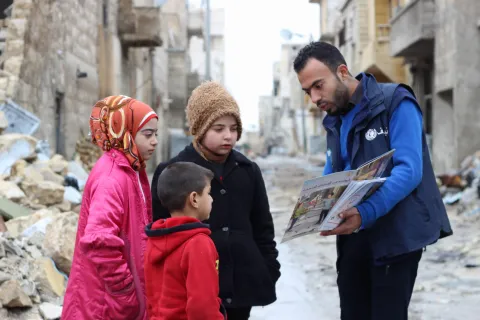
In 2023, Cidra joined a UNICEF-supported adolescent development and participation (ADAP) centre in Aleppo City. The centre provided her with vital support, helping her rebuild her confidence and acquire essential skills. Cidra learned computer skills, new languages, and life skills that empowered her to envision a brighter future. “It was very helpful and made me a stronger person,” she said. The centre gave her the confidence to move forward. “It helped me move forward in life with greater confidence,” Cidra reflected.


But Cidra’s story is not unique. Across Syria, explosive remnants of war continue to claim lives and injure children. In the past three months alone, at least 188 children have been killed or injured by landmines and unexploded ordnance. As more than a million people return to their homes, children face grave risks, particularly as they play outdoors or help their families with farming. Nearly 300,000 explosive devices are estimated to remain scattered across Syria, threatening the lives and futures of millions of children.
Centres like the one Cidra attended are crucial in helping young people overcome the trauma of conflict and build the skills they need to thrive. These safe spaces offer educational and recreational activities, psychosocial support, and vocational training, helping adolescents transition from learning to earning.
Despite her loss and challenges, Cidra is determined to continue her education and encourage others to do the same. Cidra’s strength is a beacon of hope for Syria’s young generation, a testament to resilience, and a reminder of the importance of support and opportunity in rebuilding lives torn apart by conflict.
In 2024, over 600,000 young people aged 10–24, including more than 300,000 young women and adolescent girls—over 21,000 of whom have disabilities—benefited from UNICEF-supported ADAP centres across Syria. These centres provide inclusive, gender-transformative opportunities aimed at enhancing their skills, self-confidence, and resilience. These initiatives were made possible through funding from the Global Humanitarian Thematic Fund, the European Union and Government of Norway under the UN Joint Programme to Build and Strengthen Urban and Rural Resilience and the Conditions for Recovery in Syria, the German Federal Ministry for Economic Cooperation and Development (BMZ) through the KFW Development Bank, the Governments of Japan, Canada, and Australia, and UNICEF National Committees for Germany.