The journey of protecting every child: a story from the frontlines of immunization
UNICEF helps to reach more children with lifesaving vaccines

Deir-ez-Zor, northeast Syria - “We’re on a mission 24/7 to increase people’s awareness of the importance of vaccination,” said Khaled about his team of volunteers. He is the coordinator of a UNICEF-supported health and nutrition project in Deir-ez-Zor, northeast Syria.
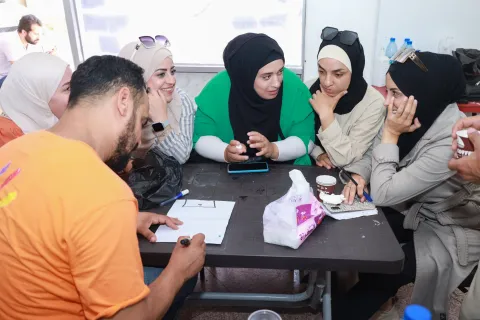
He supervises three fixed health and nutrition centres in the governorate, two mobile teams working in the rural areas in the governorate and a social behavioural change team of volunteers engaging with different community members to enhance good health-seeking behaviours and attempt to correct misinformation and negative practices.

“During the past years, an increased number of children in Deir-ez-Zor have missed out on some or all of their vaccines. Working with UNICEF and partners, we have been able to make an exerted effort and change on the ground,” said Khaled.
More than 13 years of conflict in Syria and recurrent displacements have forced many families to move from one place to another. This has taken a toll on children’s vaccination rates. During the conflict, numerous health facilities have been damaged. This has doubled the pressure on functional centres and immunization services and resulted in overcrowded health centres. The deepening economic crisis has aggravated the hardship for many families in Syria, unable to prioritize vaccinating their children. Khaled and his team navigate these complex circumstances and strive to overcome them to reach more children in need.

“Our teams do their utmost to reach children in areas lacking vaccination facilities. We engage with families encouraging them to respect the vaccination schedules of their children. With them grappling to earn a living, prioritizing children’s vaccines has become a real challenge,” Khaled explained.
Misinformation is another contributing factor to the backslide of children’s vaccination rates. Khaled and his teams provide caregivers with facts and accurate information about vaccines to reassure and encourage them. Sham’s mother is one of them.
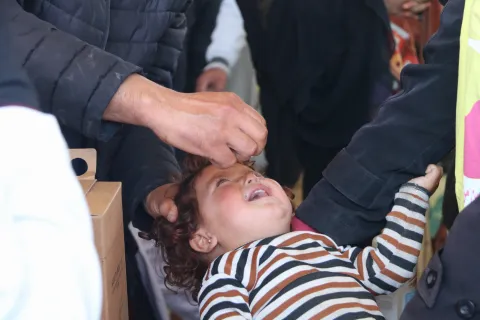
“I used to think that vaccines weren’t safe and that they might cause paralysis to my daughter,” said the mother of Sham, 4. “But after discussing my concerns with the volunteers, I found out that I had been risking my daughter’s safety because of misinformed ideas I had,” she added. After a visit from Khaled’s team, the mother accompanied Sham to a nearby health centre, where she received her first-ever vaccine.
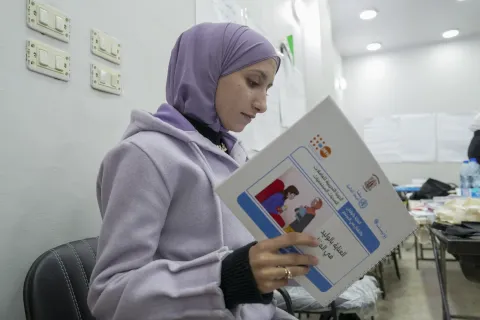
“Our work does not stop at fighting misinformation. We follow up with caregivers through phone calls, home visits and mobile phone messages to remind them about their children’s immunization schedule and the importance of adhering to it,” Khaled said.

Khaled’s team has been able to change people’s minds and at times, turn them into supporters of immunization. Noura, a mother of five is one of them. Most of her family does not believe in vaccines, so, initially, she refused to vaccinate her children. When she took her daughter, suffering from bad flu, for a check-up in the health and nutrition centre in Deir-ez-Zor city, Khaled’s team heard about her firm beliefs against vaccines. They engaged with her several times, including through home visits, until they managed to convince her of vaccine efficacy. “Noura became a big supporter. She’s helped us to spread accurate information about vaccines in her area. We are proud of her!” said Khaled.
The UNICEF-supported teams continue to work daily to trace children who have never been vaccinated and engage their caregivers and communities to encourage them to follow their children’s vaccine schedules. “Despite the challenges we face on the ground, I believe we will reach a time when all children in the governorate have been vaccinated,” Khaled said.
“Despite the challenges we face on the ground, I believe we will reach a time when all children in the governorate have been vaccinated.”
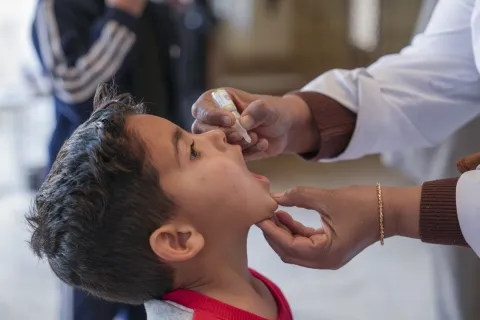
On 21-30 April 2024, UNICEF with WHO and the Ministry of Health launched a nationwide immunization campaign. The ‘Big Catch-up Campaign’ aims to assess the immunization status of 2.8 million children under the age of five across Syria. It will also boost routine immunization of children who missed out on any or all of the required doses. Also, vitamin A will be given to all eligible children, aged between 7 months and 5 years, while the oral polio vaccine will be provided to all children under the age of five.
More than 1,300 health centres and mobile teams will take part in the campaign. The mobile teams aim to reach approxiamately 21 per cent of the children living in remote areas with little or no access to health services. To keep the vaccines safe at the required temperature, UNICEF provided cold chain equipment to support the rollout of the campaign. The activities are funded by GAVI, the Vaccine Alliance.
In tandem with the immunization campaign and as part of the ‘Big Catch-up’, a communication campaign was launched to increase communities’ awareness about the importance of immunization and prioritizing children’s vaccination schedules to mitigate the spread of preventable diseases and outbreaks. As part of the communication efforts and engagement with the community, more than 2,000 UNICEF-supported workers and volunteers met with health professionals, community and religious leaders, and NGO partners before the immunization campaign. During the campaign, they will engage parents and caregivers across the country, through household visits, school visits and activities as well as community group awareness sessions. The activities are funded by GAVI, the Vaccine Alliance.