Hasan regains his motivation
Skill building and access to services empower children and youth with disabilities

Rural Damascus, Syria - “Hasan and I had just returned home from buying him a new outfit for Eid holiday when his friend called for him to come out. He had seen a strange object near our house,” said Ola, 33, the mother of Hasan. “When I heard the sound of an explosion, I knew that something terrible had happened to my son,” she added. The boys had approached a car, parked outside Hasan’s building. Underneath it was a box with a flashing light attached to it. As soon as Hasan pulled out the box, an explosive device went off.
“I woke up in a car, covered in blood and dust. I was shocked when I saw that I had lost my right hand,” said Hasan, now 17. Different parts of Hasan’s body were injured by shrapnel. The shrapnel near his heart and liver caused him pain attacks from time to time, and those in his knee damaged his bones. He underwent several surgeries on his arm and knee.
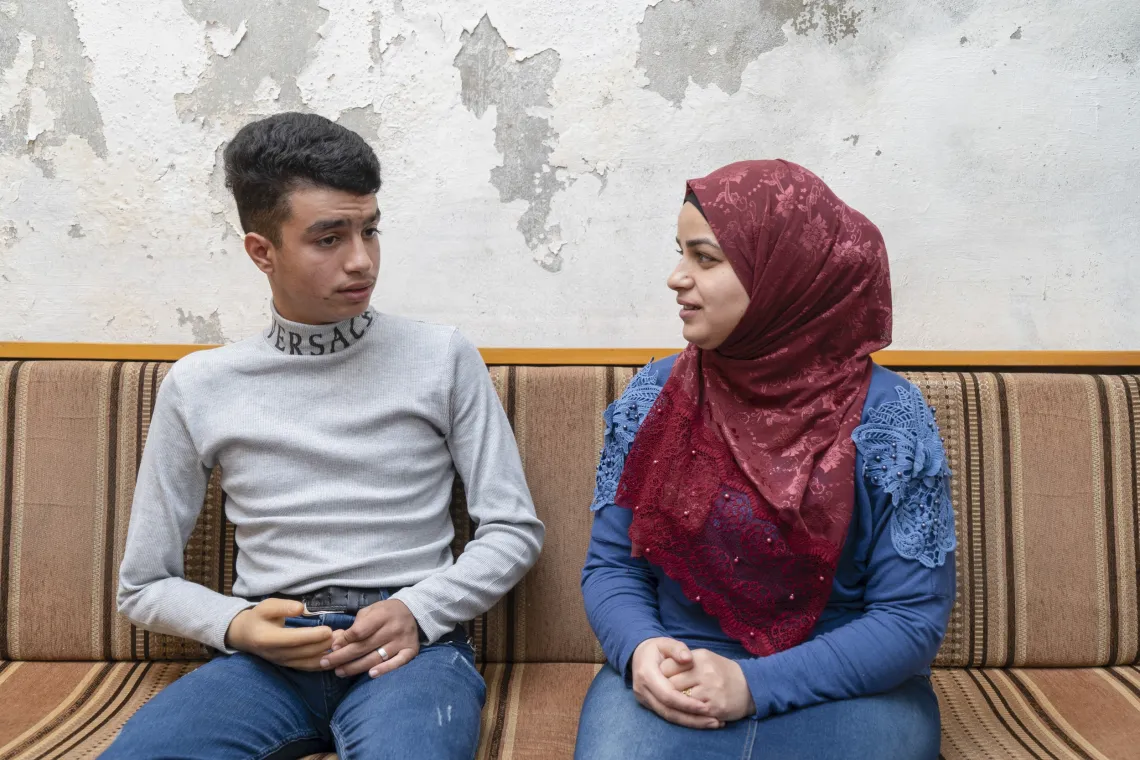
He refused to talk to anyone, me included. The fact that he couldn’t walk because of his knee injury, made things worse. He was devastated.
After going back home, Hasan would not leave the house. He wanted to avoid people’s comments about his missing hand. “I didn’t want to see pity in the eyes of my friends and neighbours, so I preferred to stay at home, surrendering to depression and sorrow,” he said.
In May 2022, UNICEF-supported partner in Al-Kisweh, Hasan’s city, heard of him and sent him Atef, a case manager. After visiting Hasan at home, Atef enrolled Hasan in UNICEF’s integrated social protection programme for children with disabilities. The programme, initiated in 2016, combines regular and unconditional cash transfers with referrals and case management services. To date, it has helped 8,150 children with disabilities, in the Rural Damascus governorate, to reach their full potential.
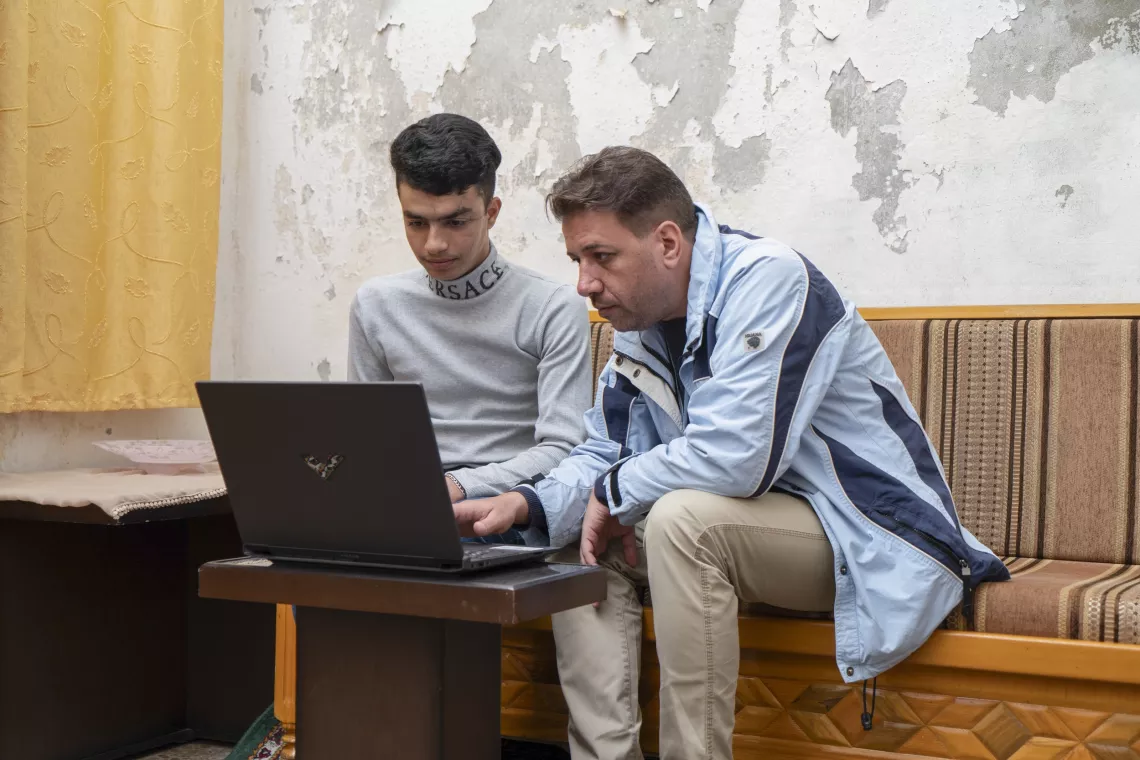
Atef also referred Hasan to a mobile team providing psychosocial support sessions at a local charity in Al-Kisweh. Five months into frequenting the sessions, Hasan started to make progress. He was able to walk again - thanks to the physiotherapy.
Referring Hasan to a hospital, where he got a prosthetic hand, made a big difference. Hasan regained his self-confidence and the desire to keep on living.
Hasan has also helped to raise the awareness about the dangers of explosive ordnance among the children in his local community. He was invited by a local charity, as part of a project by UNMAS, to speak during an awareness-raising session.
I was hesitant to share my painful story, but I wanted the children to be careful. When I saw them eagerly waiting to hear me, I found the courage to speak. I’d like to believe that I helped to protect many lives that day.
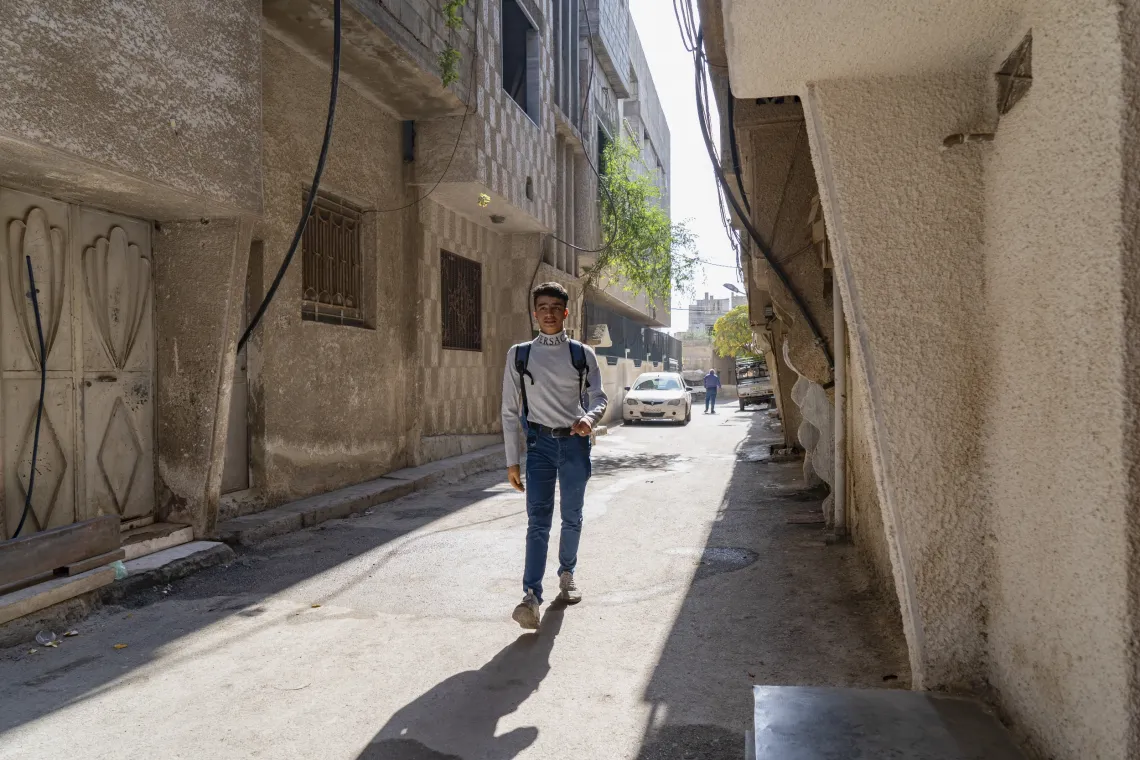

Hasan was in Grade 8 when the accident happened, and he was forced to drop out of school for a year to receive the treatment. With some encouragement from his family and case manager, Hasan resumed his education at the beginning of the 2023 – 2024 school year. He enrolled in a private institute and started preparing for the Grade 9 national exams. He also enrolled in an accounting course, a field he has always admired. The cash transfers supported the costs of both courses, helping Hasan to continue learning.
Hasan similarly benefitted from an employability skills course at a UNICEF-supported youth-friendly centre, he learned life skills and advanced accounting. “The trainer noticed that I have a good amount of information in accounting, so she asked me to assist her in class. It enabled me to enhance my skills and engage fully in the subject,” Hasan said. He wants to study economics at the university and major in accounting. He dreams of owning an accounting company.
In 2023, UNICEF supported more than 10,300 children with disabilities in Syria through its Integrated Social Protection programme. The activities were funded by EU Humanitarian Aid; the European Union and the Government of Norway under the UN Joint Programme to Build and Strengthen Urban and Rural Resilience and the Conditions for Recovery; the Governments of Austria, Australia, Canada, Finland, Italy, Japan, Norway, Spain, and Sweden; Luxembourg National Committee for UNICEF; Swiss Agency for Development Cooperation; and UNICEF’s Global Humanitarian Thematic Fund.
Some 235,400 adolescents and young people benefitted from employability skills, including life skills and citizenship education, entrepreneurship skills, as well as technical and vocational education and training in the country. UNICEF provided more vulnerable and disadvantaged young people with skill development opportunities, focusing on supporting adolescent girls and young women, through 40 adolescent-friendly spaces and integrated centres and 156 mobile teams in 14 governorates, to help them to transition from learning to earning smoothly. The activities were funded by the German Federal Ministry for Economic Cooperation and Development through the KFW Development Bank, the Global Humanitarian Thematic Fund, the Governments of Canada and Japan, UNICEF National Committee for Germany, and the European Union and Government of Norway under the UN Joint Programme to Build and Strengthen Urban and Rural Resilience and the Conditions for Recovery in Syria.