Amneh triumphs over malnutrition, nurtured with love and support
UNICEF programmes help children and women on their road to recovery from malnutrition

Deir-ez-Zor city, northeast Syria - “Hurry up Amneh. You are a big, beautiful girl now. We want to share the great news with your parents! I bet they will be very happy and proud of you,” said Safaa to her niece Amneh as they left the health centre in Deir-ez-Zor city.
Amneh, now 3, was diagnosed with severe acute malnutrition a year ago, when a UNICEF-supported health and nutrition mobile team visited the area her family lives in, the remote outskirts of Deir-ez-Zor city. The health workers explained Amneh’s situation to her parents, Zouhour and Ahmad, and asked them to go to a UNICEF-supported health and nutrition centre in the city for treatment.
“I want to tell mom and dad that I am big now, bigger than Maha,” responded Amneh to her aunt, smiling as she referred to her baby sister Maha. Zouhour recently gave birth to Maha, so Amneh’s aunt took Amneh to the health centre to help the mother out.


Before Amneh, the parents lost a baby in 2015, hours after birth. “I was seven months pregnant when a shell fell near our house. The baby must have been hurt because of the terrible explosion. We fled to Damascus for safety and shortly after giving birth to our firstborn, she passed away,” the mother said.
In 2018, with respite in violence, the family returned home to Deir-ez-Zor. During the years of conflict, they lived through multiple displacements and had their livelihoods depleted. Ahmad, Amneh’s father, works as a street vendor nowadays and is barely able to make ends meet. He struggles to support his family, the family of his widowed sister Safaa and his mother.

“I believe Amneh became malnourished when she was in my womb. We’re surviving only on bread and potatoes,” said Zouhour. “During my pregnancy, I’d feel weak and dizzy most of the time. When Amneh was born, she was tiny and as she grew up, she wasn’t as active as other children her age,” added the mother. The country’s worsening economic crunch further weighed on the family, already grappling to get by.
“My Amneh was often tired and would ask us to carry her when going anywhere. I wanted to take her to a doctor as soon as we had enough money to pay for a consultation. Still, it took too long, until one day a mobile team knocked on our door,” said Zouhour about the lifesaving visit she received from the UNICEF-supported health and nutrition team in 2023.

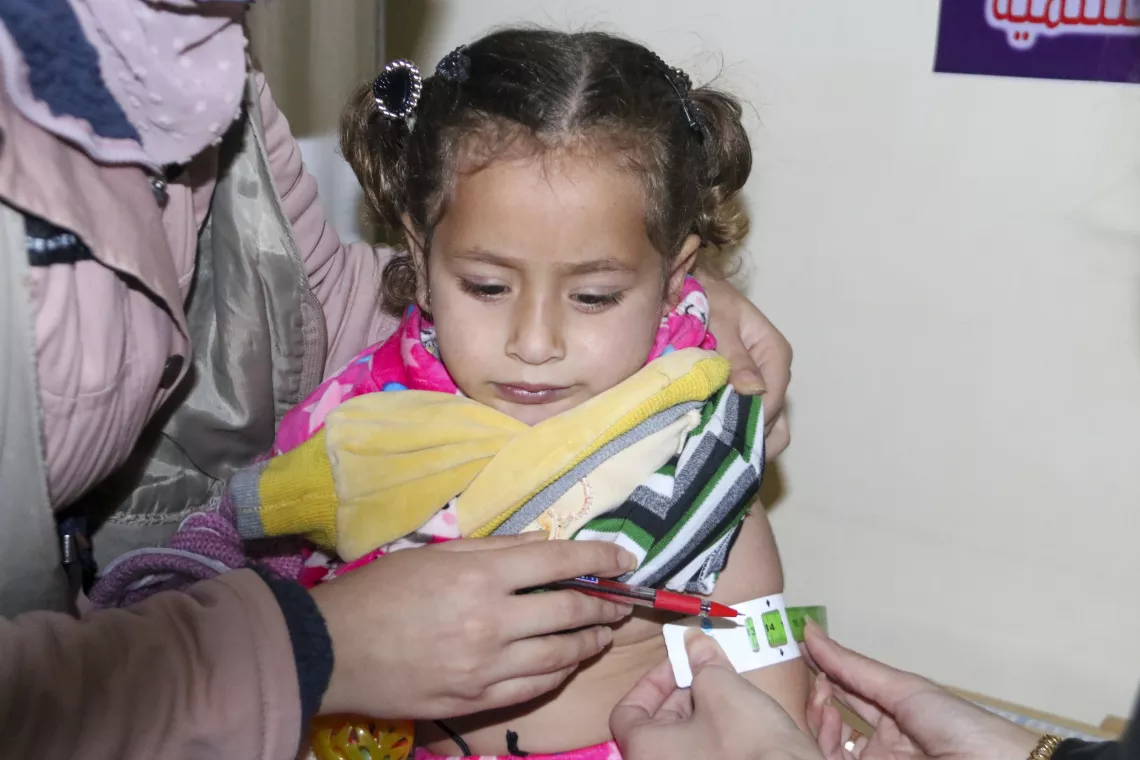


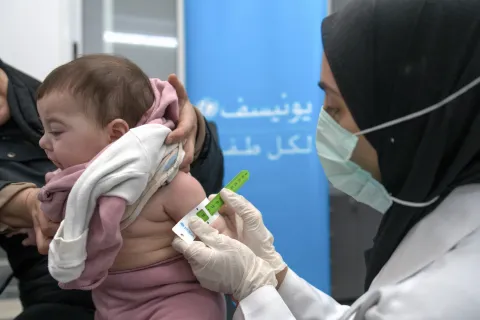
Last year, Amneh started her two months of treatment for malnutrition at the UNICEF-supported health centre. She received ready-to-use therapeutic food (RUTF) regularly as per her treatment plan. “They followed up on Amneh’s situation closely,” said the mother about the support she got from the team at the centre. “They’d call to remind me of her appointments. They wanted her to get better as much as I wanted to see her as a healthy child,” added Zouhour. “I’ve impatiently waited for this moment to come. I’m the happiest mother in the world,” she described her feelings about Amneh’s recovery.

Amneh’s energy has drastically improved after the treatment. She has made new friends with whom she plays and runs in the neighbourhood all day long. “She never stops talking,” said her mother jokingly. Zouhour, who is grateful for how Amneh is doing, plans on taking her newborn baby girl Maha for a check-up at the centre. “I don’t want to relive the tough experience Amneh and I have had with Maha. I want her to be healthy as well,” said Zouhour. “Yes, but I’m the most gorgeous one,” little Amneh interrupted her mother playfully.
In 2023, UNICEF reached 1.88 million children and more than 171,000 women in Syria with primary healthcare services. Also, 1.17 million children and some 401,700 women benefited from nutrition services. This support was provided through 62 mobile teams and 86 fixed clinics across the country. This assistance was possible thanks to contributions from the Bureau for Humanitarian Assistance (BHA/USAID); Central Emergency Response Fund; UNICEF’s Global Humanitarian Thematic Fund; Governments of Australia, Canada, Greece, Norway and New Zealand; Syria Humanitarian Fund; UNICEF United Arab Emirates; UNICEF National Committees for Austria, Belgium, Canada, Germany, Finland, Hong Kong, Italy, Japan, Spain and the UK.