The conversation that changed one mother's journey
Promoting optimal nutrition during a child's earliest months, UNICEF is helping mothers practice exclusive breastfeeding

Beit Sawa, Rural Damascus - "I want to stop breastfeeding." Those were the first words Fatma shared when she arrived at the UNICEF-supported Health and Nutrition Centre in Beit Sawa, Rural Damascus, in May 2026. Her youngest son, Zain, was only six weeks old.
"He kept crying after feeds," Fatma said. "I wasn't sure what to do."
A mother of six, Fatma faces daily financial challenges. Her husband works in construction, and the family's income is often only enough to cover basic needs.
"Sometimes we even skip dinner," she said. "My husband works hard just so we can put food on the table."
Like many mothers living under financial strain, Fatma believed she needed expensive foods to produce enough breast milk.
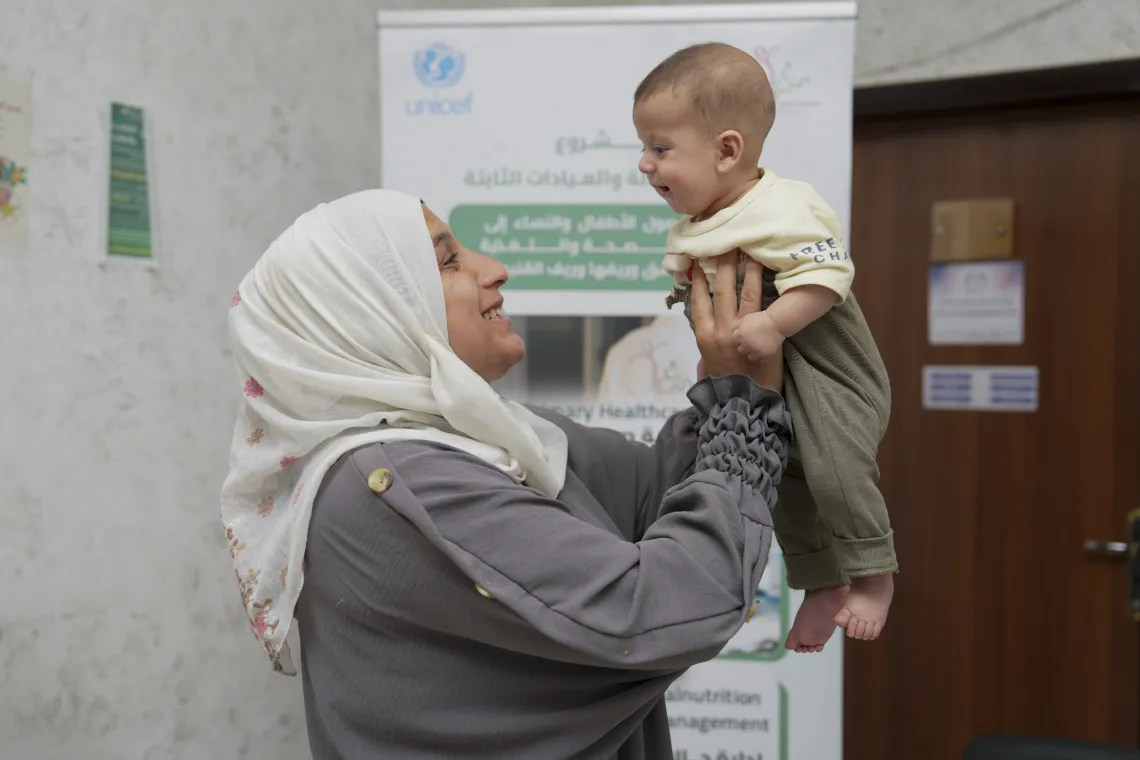
At the health centre, Fatma learned that a balanced diet, using available foods, can help support breastfeeding. "Before anything else, we had to reassure her that she could do it," explained Dr. Sabah, one of the centre's physicians.
Through individual and group counselling sessions, UNICEF supports mothers with the knowledge, skills and confidence needed to practice exclusive breastfeeding and improve child nutrition. In Beit Sawa centre, Fatma received tailored support to overcome breastfeeding challenges. During a series of counselling sessions, Dr. Sabah identified difficulties with positioning and attachment. "We worked together on positioning, attachment and feeding practices," she said. "Every few days Fatma came back, and with each visit she learned more."


Gradually, the changes began to show.
When Zain first visited the centre, he weighed 4.5 kilograms. Two months later, after exclusive breastfeeding, his weight had increased to 6.3 kilograms.

For Fatma, however, the greatest change was not measured on a scale. Looking back, she realised that none of her older children had been breastfed for longer than five or six months.
Like many mothers, Fatma had followed advice passed down through generations and was unaware that breast milk alone provides all the nutrition a baby needs during the first six months of life.
"Now I understand what exclusive breastfeeding really means," she said. "My baby doesn't need water or any other food before six months. Breast milk gives him everything he needs."
Today, Fatma speaks about the benefits of breastfeeding.
"It protects him from illness by strengthening his immunity," she explained.

Beyond its health benefits, breastfeeding has strengthened the bond between mother and child. Inspired by her experience, Fatma now shares what she learned with other mothers in her community.
For Dr. Sabah, stories like Fatma's demonstrate the importance of breastfeeding support.
"Many mothers need only accurate information, practical guidance and encouragement. With the right support, they can give their children the best nutritional start in life."
Since the beginning of 2026, UNICEF’s nutrition programme in Syria has engaged nearly 250,000 caregivers on optimal infant and young child feeding practices. Through this programme, 536,938 children under five, as well as pregnant and breastfeeding women, benefited from early screening for malnutrition. Additionally, almost 700,300 mothers and children were reached with essential micronutrients, and approximately 3,400 children under 5 affected by life threatening form of malnutrition received care and treatment.
These vital activities were possible because of the support of the Governments of Australia; and Canada; the European Union; the Foreign Commonwealth and Development Office (FCDO); the Government of France through the French Ministry for Europe and Foreign Affairs (FIFSAN); the Governments of Japan and Korea; The Swedish International Development Cooperation Agency (Sida); the Syria Humanitarian Fund; UNICEF National Committee for the United States; and the United States Government.