"Smell the rose, blow the candle": Hiba finds her way back to learning
After five years out of school, 14-year-old Hiba is catching up on lost learning and bringing calm and hope back to her family.

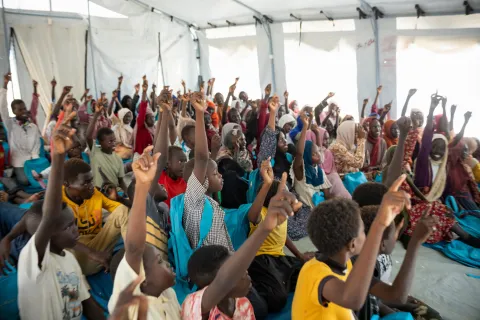
In a classroom in Goz El Salam camp for displaced families, students are asked how long they have been out of school. One year, say some. Two years. Three.
When the teacher reached four years, the question pauses.
Then a hand goes up.
"Five years," says 14-year-old Hiba.
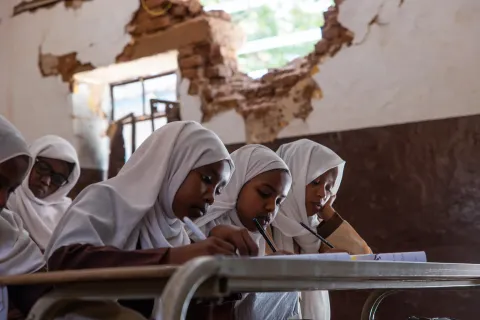
Hiba last sat in a classroom in West Kordofan, where she was in grade four. Before she could finish the school year, insecurity forced her school to close, about two years before the war that erupted in April 2023. For five years, formal education was out of reach.
Her mother never let go of the belief that education could give her daughters a better future. When the school closed, Hiba joined the local khalwa, a Quranic school, where she continued learning to read and write. It was not the full school curriculum, but it helped her continue learning.
"I thought that was it," Hiba says.
Last year, as fighting intensified, the family was forced to flee. Hiba, her mother and her four younger sisters made their way to Kosti and settled in Goz El Salam camp.
A second chance
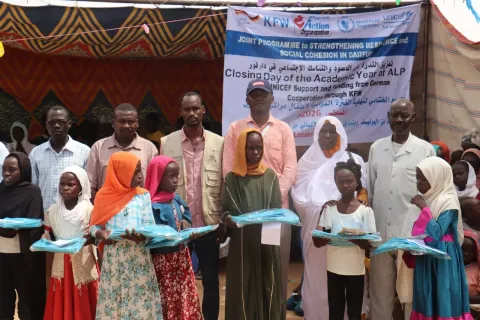
Three months ago, an Accelerated Learning Programme (ALP) centre opened in the camp. It is supported by UNICEF in coordination with the White Nile State Ministry of Education.
The programme follows the formal curriculum at an accelerated pace, helping children who have missed years of schooling catch up and work towards re-entering the formal education system.
Hiba quickly registered and encouraged her sisters to join too.
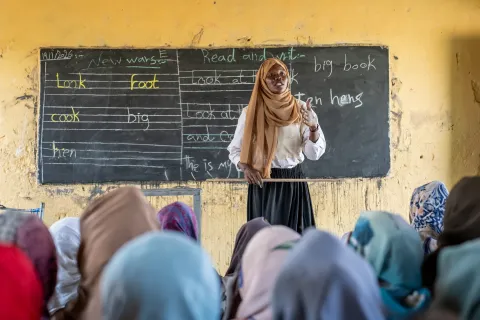
She is working hard to catch up, especially in mathematics. When her classmates are asked about their favorite subjects, they name mathematics, Arabic and Islamic studies. Hiba is the only one who chooses English.
And when they are asked what they want to become, the answers include doctor, engineer, pilot and teacher.
Hiba's answer is different.
"I want to work for UNICEF."
Yet what Hiba enjoys most at the centre is not English. It is the psychosocial support sessions.
"We learn to respect other people's feelings," she explains. "I have seen many problems between people because they don't think about the feelings of others. If they had, they wouldn't have those problems."
Now, she says, when she argues with her sisters or with other children, "I stop and think about their feelings, and then everything is resolved."
She has brought something else home, too.
During the sessions, children learn a breathing exercise called "Smell the rose, blow the candle": breathe in slowly as if smelling a flower, then breathe out as if blowing out a candle. The exercise helps children manage stress and feel calmer.
Hiba now practices it every day with her sisters, and her mother joins them.
"When I come home, my sisters say, 'Yalla, let's play the game,'" she says, smiling. "It makes us feel good."
For a family that has lived through conflict and displacement, these few minutes of breathing together have become a simple way to reconnect and find calm.

UNICEF/2026
More than learning at the UNICEF safe learning spaces.
More than learning
Education in emergencies is about more than recovering lost learning. Safe learning spaces can also provide children with routine, social connection and psychosocial support.
For Hiba, returning to the classroom has brought back a sense of normalcy and hope. What she takes home each day is not only what she learns in class. It's calm, but also new ways to manage stress, connect with her family and imagine a different future.
Hiba is one of nearly 8 million school-age children estimated to be out of school in Sudan at the start of 2026.
In White Nile State alone, more than 355,000 of the state's approximately 1 million school-age children are out of school. Children displaced from West Kordofan are among those whose education has been severely disrupted. Like Hiba, many saw their schools close years before they were forced to flee, leaving them with significant learning to recover.
Asked why she wants to work for UNICEF, Hiba answers without hesitation.

"UNICEF has helped us a lot. I never thought I would be able to go back to school,” she says. “They helped us with everything. They gave us school bags and pens and built this classroom for us. I would like to work with UNICEF one day and help others.”
Five years after her school closed, Hiba is back in a classroom.
And each evening, in Goz El Salam, she shares with her sisters and mother something she learned there: breathe in slowly, as if smelling a rose, and breathe out, as if blowing out a candle.