On the frontlines of health: A day with a UNICEF Health Officer in Sudan
How house-to-house immunization efforts protect children in conflict zones

The ongoing war in Sudan has severely disrupted routine immunizations and vaccination campaigns, especially in conflict hotspots. This has created ripe conditions for disease outbreaks- including polio.
When a polio outbreak was confirmed in early 2024 through environmental surveillance, every child- especially the youngest – was at risk. Just one case of polio poses a danger, particularly to the millions of children who missed their vaccinations while on the move, or who were never vaccinated at all.
Vaccination is one of the most cost-effective interventions to protect children from life-threatening diseases and prevent avoidable deaths. Yet during times of conflict, these lifesaving services are often interrupted, leaving millions vulnerable. In Sudan, more than 70 per cent of hospitals in conflict-affected areas non-operational, and vaccination coverage has sharply declined, particularly in areas hardest hit by the war.
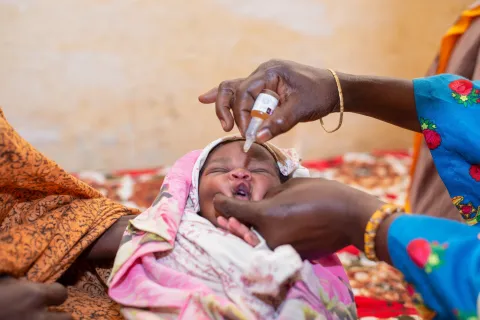
But when disease outbreaks occur, UNICEF moves quickly to support the Ministry of Health in reaching children wherever they are- saving lives in the process. House-to-house campaigns are essential to ensure that no child, no matter where they are, is left behind.
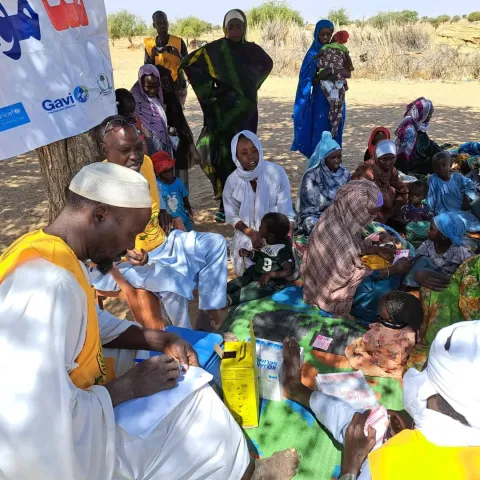
With UNICEF’s support, the Federal Ministry of Health continues to launch nationwide vaccination campaigns, delivering lifesaving vaccines even in the most challenging areas. These efforts are underpinned by strong community mobilization. Mothers and caregivers are engaged in discussions to raise awareness about the dangers of vaccine-preventable diseases and the protection that vaccines offer. After all, a vaccination campaign without community participation is no campaign at all.
UNICEF staff and partners are deeply involved in both the planning and implementation of these campaigns. Their work ranges from transporting vaccines and managing cold chains to monitoring progress and addressing vaccine hesitancy. We followed Mohamed Almugtba Khider, UNICEF Health and Nutrition officer in Kosti, White Nile state, during a four-day house-to-house polio vaccination campaign to understand what it takes to make these efforts succeed.

From planning to execution: the daily routine
On day four of the campaign, Almugtba begins his day at the State Ministry of Health. With over 600,000 children under the age of five targeted for polio drops, success depends on seamless coordination.
“In addition to pre-campaign meetings, we engage in discussions on the technical challenges encountered by teams and locality supervisors, both during and after the campaign,” Almugtba explains.


At Satti Health Centre, he inspects vaccine stocks and monitors the cold chain. Since the onset of the conflict, UNICEF has worked to ensure that vaccines are consistently available and safely stored, strengthening cold chain infrastructure across the country.
Alongside vaccination teams, Almugtba helps plan the day’s operations.
“These interactions ensure that children are vaccinated safely and according to protocol,” he says.

Getting vaccines where they're needed most
To address stockouts and improve vaccine access, UNICEF delivers vaccines across various states. Thanks to refrigerated trucks procured with support from Gavi, the Vaccine Alliance, the German Cooperation, and the governments of Japan and the Netherlands, vaccines are now transported more efficiently and safely.

Once vaccines are tallied against catchment area targets, packed in cooler boxes, and double-checked, teams set off—boxes on shoulders and records in hand. Almugtba joins them on their door-to-door rounds.

He assists in administering vaccines—just two drops offer vital protection—and the team moves from one house to the next. Their group is one of more than 1,000 deployed across the region, including mobile teams and staff stationed at health facilities for walk-in cases.

Why it matters
So why do UNICEF teams go to such lengths?
“Through our participation, we can ensure children are immunized and parents and caregivers aware of the campaign,” says Almugtba.
“We also oversee vaccine management and geographic coverage.”
This campaign, built on meticulous planning and dedication, successfully reached over 740,000 children under five—including refugees and displaced children—with lifesaving vaccines.
Today, many children in Sudan continue to miss out on immunizations due to conflict, displacement, and the collapse of the healthcare system. Even before the war, national vaccination coverage had declined from 85 per cent to about 50 per cent. In active conflict zones, rates are now as low as 30 per cent.
“We want to ensure every child is vaccinated during these difficult times,” Almugtba says. “Because we’re facing serious challenges to routine immunizations.”