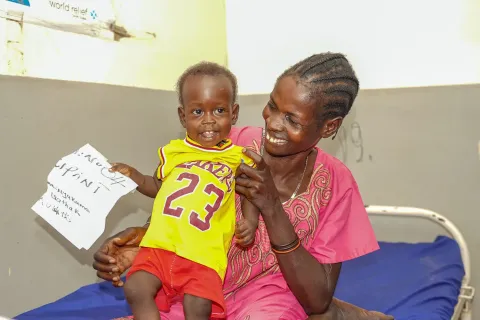
Striving to keep her family safe
Nyaruon Riak’s Story Amid South Sudan’s Cholera Outbreak

Life in Delmet: Unsafe Water, Poor Sanitation and a battle with Cholera
In November 2024, Nyaruon Riak, a 28-year-old single mother of three, moved to Delmet, an area within Bentiu’s internally displaced persons (IDP) community. Upon arriving in Delmet, Nyaruon relied on unsafe floodwater for drinking, cooking, and daily household chores. She even cooked and ate food found in the bushes near by the flood water. Unfortunately, as cholera spread in the area, she fell ill.
I was badly ill, couldn’t do any household chores and take care of my children.
For two days, she suffered from severe illness before her brother and Neighbours took her to the cholera treatment centre in Bentiu State Hospital, where she was cared for and received life-saving treatment over the next three days. During her hospitalization, despite not knowing her well, her community stepped in to care for her children.

Nyaruon’s situation is made more difficult by the absence of her husband, who left the family years ago and stopped supporting them. She struggles to care for her children, depending on monthly food rations from the World Food Programme (WFP) to feed herself and her two youngest children. Her eldest child, an eight-year-old boy, now lives with his grandfather so he can attend school, as the nearest school from Delmet is at least an hour’s walk away. Her four-year-old daughter attends an informal school under a tree in the IDP camp.

Improved Access to Clean Water and Hygiene Practices
in December 2024 after recognizing the problems in Delmet, a new water point, was established by UNICEF and Concern Worldwide with funding from the Central Emergency Response Fund (CERF). This system now provides clean water to over 5,000 people in Delmet. The water, pumped from the flood waters, is treated with aluminum sulphate and chlorine before being distributed through communal taps.

With access to clean water, Nyaruon has been able to improve hygiene practices in her household.

I only use water from the water point for drinking and cooking. I clean utensils, water containers and clean my house time to time. I wash my children with the clean water. But I am still worried as people are still openly defecating in the open areas and children play in the open areas, I don’t allow my children to play in the open areas anymore.


Despite the challenges, initiatives like the new water point in Delmet offers a hope for Nyaruon and many others. However, sustained efforts are needed to ensure safe water access, improved sanitation, and stronger cholera prevention measures to protect vulnerable communities across South Sudan.
Background
South Sudan’s Worst Cholera Outbreak in Two Decades
South Sudan is experiencing its worst cholera outbreak in its history. Since September 2024, there have been 39,932 suspected cases and 691 reported deaths across 41counties across 9 states up to mid-March 2025.
Alarmingly, 50% of cases involve children under 14. Malnutrition, lack of access to safe drinking water, and inadequate sanitation further increases the risk, particularly for children under five.
UNICEF’s Response and Ongoing Challenges
On top of the existing challenges, Rubkona county in Unity State has faced severe flooding for four consecutive years, forcing thousands of people to live with risks to several health challenges.
UNICEF is actively supporting cholera prevention and treatment efforts. This includes the procurement of Oral Cholera Vaccinations, the provision of supplies to ensure the provision of clean water and the establishment of water points. UNICEF has further supported communication campaigns to prevent Cholera and other waterborne diseases, signs and symptoms of Cholera and where to seek help.
UNICEF is looking for 19 million USD to provide safe and clean water and sanitation systems, as well as treatment and vaccination for cholera.