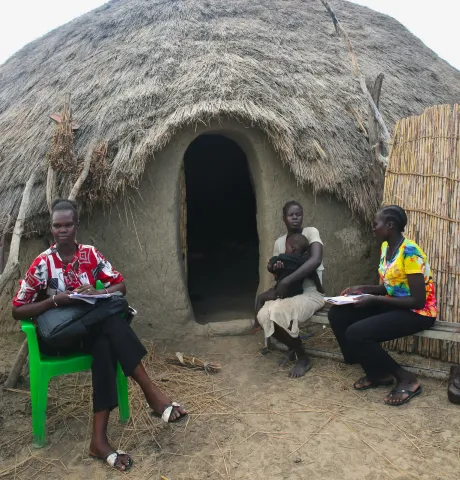
Counting more than data: Stories of growth from MICS enumerators in South Sudan
How data collection became a journey of empowerment, resilience, and change

In South Sudan, the Multiple Indicator Cluster Survey (MICS), led by the National Bureau of Statistics with financial and technical support from UNICEF is playing a groundbreaking role in gathering essential information about the situation of children and women. Behind every data point are dedicated enumerators who have travelled across the country, often under challenging conditions, to collect data and information.
Among these committed individuals are Adior Nyuol and Awel Mijok, two enumerators from Pariang whose experiences demonstrate how the MICS survey is not only collecting vital data but also creating opportunities for young people to learn new skills, gain confidence, and become empowered within their communities.

At 27, Adior Nyuol first learned about the enumerator vacancy with the National Bureau of Statistics from a signboard outside their local office in Pariang. She submitted her documents and was later selected and invited to Juba for a month-long training.
I have done many jobs before, but this is the first time I feel so confident speaking to people and convincing them.
Married and a mother of two, a five-year-old girl and a two-year-old boy, Adior relied on her family to care for her children while she conducted surveys in remote communities. “We always travelled in groups and carried mosquito nets with us. Still, when it rains, it becomes difficult to reach some areas,” she explains. As the assignment comes to an end, Adior reflects on the friendships built along the way. “We have become good friends, and I’ll miss everyone as we go home.”
Having completed Senior 2, Adior now hopes to find new employment opportunities after the survey concludes.

While heading to the market, Awel Mijok, 24, noticed the enumerator vacancy posted outside the National Bureau of Statistics office in Pariang. She was inspired to apply, knowing that other women have also applied for the role. She gathered her certificates and submitted her application the same day. When she later received a call for an interview, she was both nervous and excited. “The most difficult question was whether I could travel to different locations. I was scared because I hadn’t traveled much and was worried about safety but during the interview, I smiled and said yes without hesitation,” she recalls.
After being selected, Awel joined the training in Juba, where she gained valuable experience engaging with diverse communities.
I’ve learned so much about my country, about access to water, nutrition, schools, and hospitals. It’s been an eye-opening experience for me.
With her enumerator work now complete, Awel plans to return to school to continue her education. “I hope more data collection will happen so the government and organizations can build more schools and hospitals in our communities.”
___________________________________________________
Background on MICS 2025:
A total 94 female enumerators were recruited and trained for the data collection in Juba from 10 February 2025 to 09 March 2025 with leadership of National Bureau of Statistics and supported by UNICEF.
The MICS programme is UNICEF’s Global flagship survey programme and the largest source of internally comparable statistical data on children and women. MICS fieldwork teams conduct face-to-face interviews with household members on a variety of topics that affect the lives of children and women. As the major data source of 40 Sustainable Development Goals (SDGs) indicators, Governments globally use MICS for planning and policy guidance. With 28 years in existence and implementation in over 118 countries, MICS is now in its seventh round of implementation.
South Sudan has implemented the seventh round of the MICS in 2025. The objectives are to generate globally comparable statistics to assess the status of children and women in South Sudan. The South Sudan MICS has established baselines for the Sustainable Development Goals (SDGs) indicators and thus with provide critical data to inform the United Nations Sustainable Development Cooperation Framework 2023-2025 and monitor progress towards the achievement of the SDGs and international goals including the Africa Agenda 2063 and the UNICEF CPD 2026–2030.
South Sudan MICS is funded by UK aid from the UK government, World Bank, The Kingdom of Netherlands and the World Food Program and would be launched in November 2025.