Becoming a mother in Gaza
Amira and Bana are both expecting to deliver their babies in Gaza. They share the daily life of more than 50,000 women, a reality threaded with fear and uncertainty, and the weight of giving birth in the midst of a war.
- English
- العربية
Amira is a 35- year-old woman from the Gaza Strip. Alongside her five children and an impending arrival, she lives in constant fear of giving birth amid the bombings that shattered the Strip.
Before the war, Amira already grappled with health issues that needed medication to prevent complications during pregnancy. Now, she finds herself with no access to medicines or treatment, and she has become her own caretaker. “I've become my own doctor now, monitoring my baby's every kick and movement. Each reassuring sign is a bittersweet relief”, she says.

“The war had forced us out of our home during that first week. I remember thinking it would be just for a short while, maybe a week or so, as I grabbed a few essentials. Little did I know that our lives would be forever changed”, Amira explains.
More than 1.7 million persons are estimated to be internally displaced (IDPs) in the Gaza Strip – half of whom are children. They are in shelters or tents where the poor sanitary condition, the lack of food and water are making their life particularly difficult.
Despite the challenging situation, Amira tries to remain strong and resilient for her children, trying to keep their hope alive. “My youngest child asks me when we can buy beautiful clothes, toys, and gifts for their little brother. To those questions, I offer some hope, even if it's a faint glimmer.”

Bana is a 20-year-old girl from the Gaza Strip awaiting the arrival of her first child. However, for her, the anticipation of motherhood is shadowed by the deafening sounds of explosions.
Bana, is in a constant state of fear, worried about her family and investing all her efforts in finding food for the well-being of her future child. “My fear is not for myself alone; it's for the tiny life growing within me.”
“Will I be able to get to the hospital in time? Will someone be able to help me? Will I be able to deliver my precious baby safely I am terrified of losing my baby, of bringing a child into this fractured and brutal reality” she says with a heavy heart.

Similar to Amira and thousands of women in the Gaza Strip, Bana, draws strength from the gentle touches of their unborn child. “The only solace I find is in the gentle kicks and movements of my unborn child. Each flutter is a tiny reassurance, a whisper that my baby is still with me, fighting to be born”. She further emphasizes “I am tired, but I am not ready to give up, for the love for my unborn child is my anchor in this storm.”
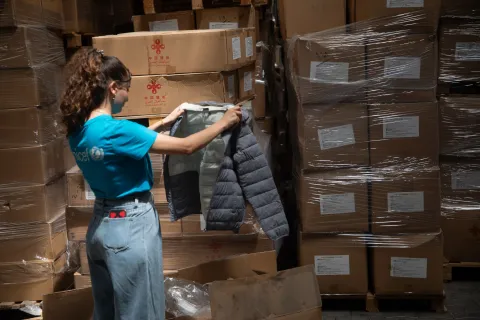
UNICEF makes everything possible to bring medical supplies, food, water, but also warm clothes for babies and children as winter is fast approaching. These efforts are made possible thanks to the contributions of the Governments of Australia, Germany and Norway, the French Development Agency (AFD), the EU Humanitarian Aid, the UN Emergency Fund (CERF), and other UNICEF Regular Resources. But for Amira and Bana to be able to properly take care of their babies and children, we need to start with a humanitarian ceasefire as the first step on the path to lasting peace.