Powered to Teach
A solar-powered tablet and a determined teacher are changing how children learn in a rural ABE classroom in Somaliland — a preview of what the Somaliland Blended Learning Programme hopes to achieve as it scales up across 56 schools.

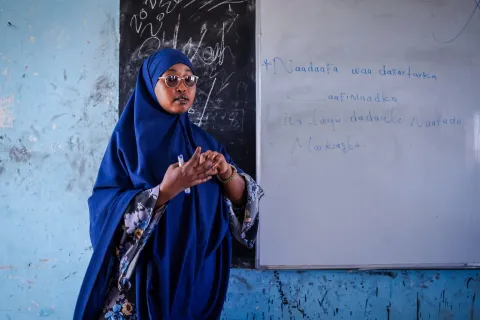
In a small Accelerated Basic Education (ABE) classroom at Geedbalaadh Primary School, in Geedbalaadh village, Gabiley District, Somaliland, a solar panel on the school roof and a compact solar unit called a Tespack quietly do work that used to be impossible here: they keep a single tablet charged, lesson after lesson, for a teacher determined to reach every child in her room. Khadan Cabdi Bade, 23, stands at the front of the class, a marker still in hand from the numeracy lesson chalked in blue and red on the board behind her, and begins, as she often does, by grouping her roughly thirty learners according to how much each of them already knows.
Khadan is one of the original pilot teachers behind the Somaliland Blended Learning Programme, an ECW-supported initiative testing whether solar-powered tablets and Tespack units can improve teaching and learning in low-resource schools. The pilot ran in just five schools in Gabiley District — including Geedbalaadh Primary — with fifteen teachers in total, Khadan among them, before the programme moved toward a wider Somaliland-wide scale-up. The pilot found reliable technology performance, strong student engagement, and rising teacher confidence wherever the tools were paired with training and ongoing support. A baseline survey conducted ahead of that Phase 2 expansion covered 178 teachers and school leaders across 56 schools — roughly three teachers per school, or about 168 teachers in total, plus a smaller number of head teachers and other school leaders — and found the same enthusiasm almost everywhere: 98% of respondents believe digital tools can improve learning. But it also found a workforce still largely new to the technology — more than half had never used digital tools in teaching before, despite an average of over 13 years in the classroom.
As the programme scales beyond the original pilot, Khadan also represents a small minority. Of the 168 teachers and school leaders surveyed for the Phase 2 baseline across the incoming 56 schools, only 7% were women. The programme's own review of that data flagged the low number of female teachers as a systemic structural challenge that we are seeking to address rather than it just being an unfortunate statistic and treating this as a priority and finding ways to bring more women like Khadan into the programme as it grows.
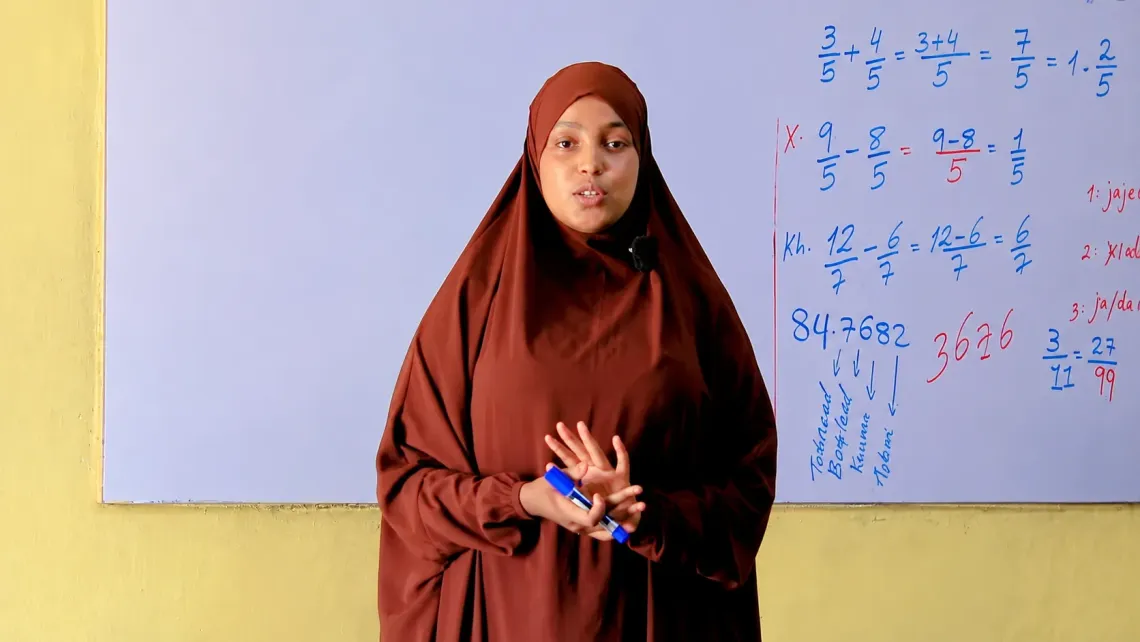
For Khadan, teaching was never a fallback. “The reason why I became a teacher was my ultimate motivation, and it was one of my priorities,” she says. She has spent the last two years teaching Somali language and science to Grade 1 and 2 ABE learners in Geedbalaadh — and, since January 2026, doing it with a tablet in the classroom for the first time.
“The students have seen the tablets as one of the tools that will help them learn better, in terms of digital content and facilitating their learning easily.”
~ Khadan Cabdi Bade, ABE teacher, Geedbalaadh village, Gabiley District
With only one tablet and one Tespack for the whole classroom, Khadan has built her lessons around the TaRL (Teaching at the Right Level) approach — grouping learners by ability rather than age or grade, and rotating the device between groups as she moves around the room. “Since the tablet is not [available for] every learner, and the Tespack is the only projector I have in my classroom, I group the learners by their levels, and based on those groups I'm able to go around and give them this,” she explains.
Electricity, often assumed to be the first barrier to digital learning in rural Somaliland, has not been one in Geedbalaadh: solar panels power the school itself, and the Tespack carries its own solar charging system. “From the time we received [the tablets], there were no technical issues... everything was working well for us,” Khadan says.
As one of the original fifteen pilot teachers, Khadan's account reflects exactly what the programme's own pilot evaluation recorded. Teachers approaching the wider scale-up flagged charging, device security and technical complexity as major concerns at baseline — yet among the pilot's fifteen teachers, none of those problems showed up in practice: equipment reliability was rated extremely high, and confidence in troubleshooting the devices rose sharply after training. Pilot participants also reported real gains in the classroom — 93% saw improved student engagement, 87% saw improved participation and understanding, and 93% reported feeling more confident in their own teaching.
The change, she says, shows up most clearly in her own teaching. “Having the digital [tools], having the grouping style, having the TaRL training — all these available resources — my teaching becomes easier, and I can invest more in my learners, in their discipline and other skills,” she says. She believes the teachers who follow her in Geedbalaadh will benefit even further, arriving into classrooms where digital tools and TaRL grouping are already part of daily practice rather than a new experiment.
The response from families has encouraged her to keep going. “The community has welcomed the use of these materials... and they really supported us,” she says, adding that parents in particular have embraced the shift: “The parents have welcomed the new mode of teaching using technology as one of the good innovations in this area, and they are always encouraging me on using this improved teaching in the classroom.” For many families in Geedbalaadh, this is their first encounter with audiovisual learning tools of any kind — a fact Khadan sees as a step toward closing the gap between what rural and urban children get to experience in the classroom.
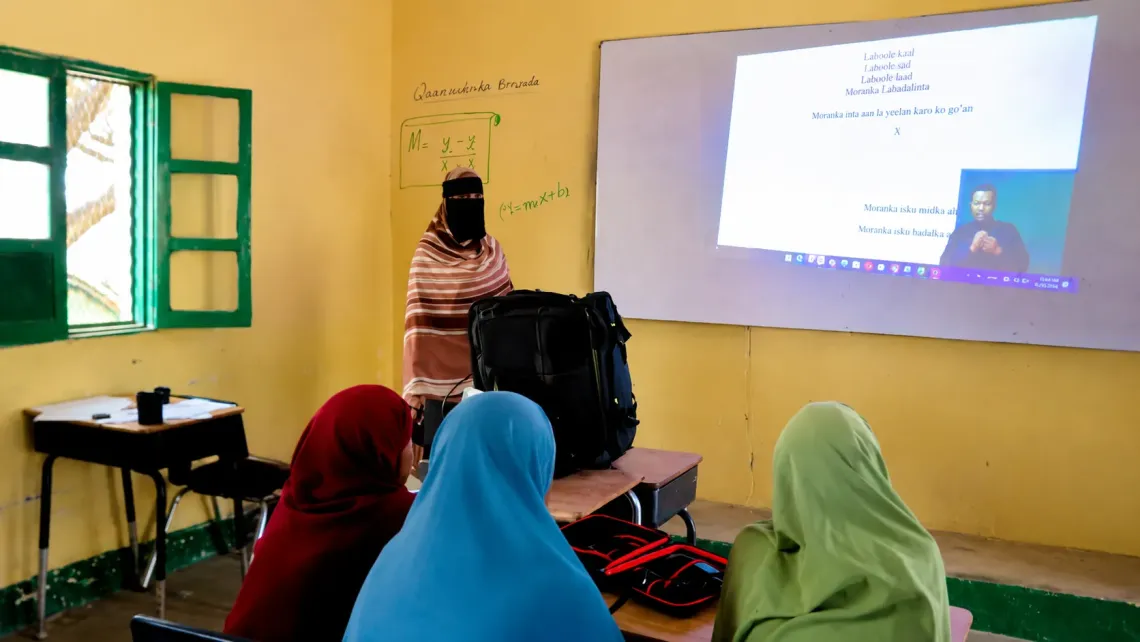
Perspectives from the Parents of Geedbalaadh
For Khadan and the families of Geedbalaadh, the Tespack has become more than a tool for teaching—it is a symbol of community resilience and innovation. While it helps Khadan prepare lessons and enrich classroom learning, its impact extends far beyond school hours. Recognizing its potential, the community began using the device to charge mobile phones, eliminating the need for long journeys in search of electricity. “Seeing our teachers use these digital tools to make their daily work easier brings us so much joy as parents,” says the chairperson of the school's Community Education Committee (CEC). “The Tespack has completely transformed our daily lives. We used to travel long distances on foot just to find a power source, but now our community has found a practical solution that saves time and eases that burden.” This simple yet innovative use of Tespack demonstrates how an investment in education can spark wider community-led solutions, strengthen resilience and improving daily life beyond the classroom.
As a community, we are fully committed to taking true ownership of this technology. It keeps our pastoral and livestock community connected to one another, helps us receive regular school updates from teachers, and even allows us to hold live digital meetings with the Ministry of Education in Gabiley.”
~ CEC Chairperson, Geedbalaadh Primary School
A second CEC member describes the device's role in bringing the wider community together. “The Tespack is truly a wonderful device that has exceeded all of our expectations. Its audiovisual capabilities have been incredible for our community gatherings,” he says. “For instance, during a recent parent-teacher meeting, the Geedbalaadh headteacher used it to show us a video of Fadxiya, the head of the Gabiley Education Ministry. Hearing her share words of encouragement and positive talks directly with us was incredibly motivating.”
That combination — reliable technology and a well-supported teacher — is exactly what the programme is now trying to reproduce well beyond Gabiley District. Having proven the model with fifteen teachers in five schools, Phase 2 will bring tablets and Tespacks to 56 schools across Somaliland and a far less experienced group of roughly 168 teachers, most of them men, many of whom have never used a digital device in a classroom before. Programme plans call for heavier investment in foundational training, coaching and peer support networks "and a deliberate focus to invite more female teachers to the programme— the same ingredients that, in Geedbalaadh, turned one shared tablet into a working, level-grouped classroom rather than a stalled experiment.
Khadan's classroom is a small, concrete example of what that investment is meant to achieve: reaching children who have been underserved — by displacement, by distance, by a system that has never quite reached them — with the same tools of quality basic education, including solar-powered digital devices, that are so often reserved for schools with easier access to power and infrastructure.
“I want to thank this ABE project and the ECW project for how they're supporting us in terms of the use of digital tools to improve our teaching, and our learners' learning. It's a massive thank you for helping us.”
~ Khadan Cabdi Bade, ABE teacher, Geedbalaadh village, Gabiley District
For a rural classroom in Geedbalaadh, a single tablet and a solar-powered charging box have done more than keep a screen switched on. They have kept thirty children learning, one small group at a time, in a place the national grid has never reached — and given a teacher who chose this profession on purpose one more reason to believe her students are not being left behind.