Let me Learn: A visual story of an education journey
The importance of education for displaced children in Dollow

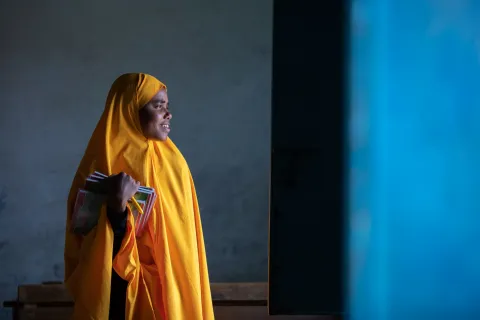
Fatuma is a 11-year-old girl from Kaharey internally displaced people’s (IDP) camp in Dollow. She appears quiet, shy and slightly reserved when you first meet her. However, in the classroom is where you will get to see the real Fatuma, she is very active and is among the best pupils in the class. Sitting comfortably with her classmates on a small desk; she is happy and very much eager to participate in the class. She always raises her hand when it comes to answering questions or seeking clarification from her very accommodating teachers.

Fatuma lives with her parents in Kaharey IDP camp located in Dollow town. She dreams of one day becoming a teacher and believes all children have the right to an education. She has been inspired by her teachers who have dedicated their time and resources to give their students the best education possible, no matter the challenges they face. “My teachers are my heroes; every day I look forward to coming to school to be taught new things and interact with my friends as well.”

Children like Fatuma, who have been out of school for some time, are taught essential reading, writing, math, Arabic and Somali language to create a bridge into formal school. Fatuma believes every child should have these kinds of opportunities. “I want all children to go to school, especially girls who are told that they should stay home,” she says.

In Dollow, most IDP families live in informal tent settlements. It is difficult for them to be safe from the adverse weather conditions of the area. Fatuma lives with her parents in a fragile shelter made up of orange plastic sheets and fabric lashed with cord and stripped branches. It is one of the thousands scattered over the dry bare land.

UNICEF, supported by the EU Civil Protection and Humanitarian Aid Operations (ECHO), the Government of Germany through KfW Development Bank, the Government of Finland and US Agency for International Development (USAID), partner’s with Himilo Relief and Development Association (HIRDA) to get children into the classroom, specifically through the construction of Temporary Learning Spaces (TLS) in Dollow and Luuq.

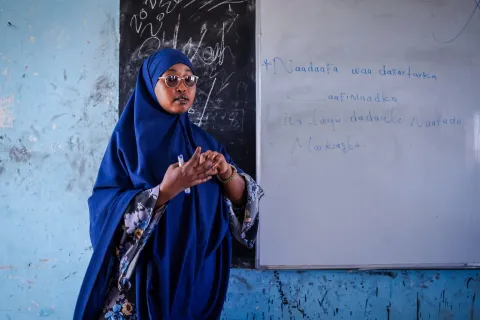
Sureer Farah, a 19-year teacher, is teaching her students, of which many of them are IDPs that reside in Kahary IDP Camp. She tries to teach the children to read, explaining the rules of pluralization, punctuation, and spelling. She patiently repeats and explains, but keeping the learners engaged is not an easy task.

UNICEF has been active in addressing the educational needs of children, specifically through the construction of Temporary Learning Spaces (TLS) like this one. This has been made possible through the education in emergencies programming supported The Government of Germany through KfW Development Bank, the Government of Finland and US Agency for International Development (USAID). The programme provides students with clean, safe drinking water for daily consumption and learning materials. It also provides 50 teachers with monthly incentives.

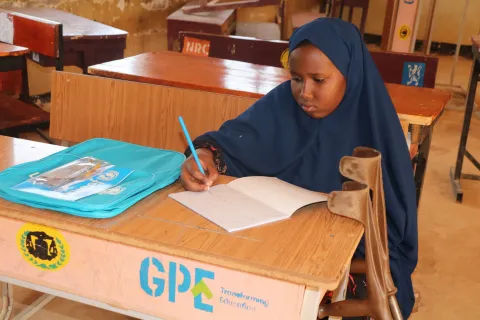
“I like going to school because school is good. If you study hard, you will have a bright future,” says Rahma, a primary student at the temporary learning space. She is determined to read and write well so that she can become a nurse in the future. As a pupil of the learning space, she’s on the path to work towards her goal.
Every child aspires to be seen as a ‘somebody’ in society, and displaced children in Somalia are no different. They desire to become nurses, pilots, teachers, and doctors and they want to live in a society that values them for who they are, no matter what path their career takes. Most of the children in displacement live on the fringes of society in faraway camps and therefore their biggest motivation to succeed and become a good person in the community comes from the hope to better their lives and those of their parents and most of all to be seen, heard and valued.