Building Bridges of Knowledge among children displaced by climate change
UNICEF has constructed 134 Temporary Learning Centres across Somalia to provide access to education for children.

In Somalia, where drought and displacement has become a harsh reality for many, there lives a young boy named Abdullahi Mohamed. Abdullahi was just eight years old when his family decided to flee their home on the outskirts of Baidoa due to a prolonged drought that had ravaged their small village and wiped out all their livestock. His family became internally displaced, seeking refuge in a makeshift camp in Baidoa town. Their story, from being self-sufficient livestock farmers to relying on handouts, was microcosmic of many in Somalia that had been affected by decades-long cycles of droughts and floods.
Now aged 11, Abdullahi finds life in the camp far from easy. The conditions are harsh, resources are scarce, and hope seems distant. But his parents were determined to give him an education, believing that it would be key to a better future for him and the family.


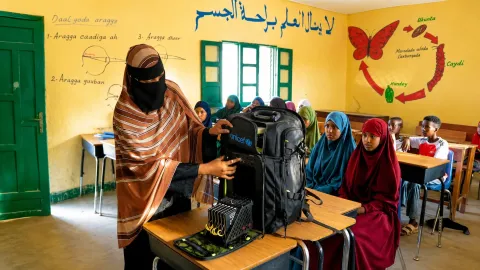
With the help of the Bay Regional Education Committee (BREC), a UNICEF partner, a learning center was set up in the camp. It was a humble structure made of corrugated iron sheets and wood, but it held the promise of a brighter tomorrow. Abdullahi’s eyes sparkled with excitement as he stepped into the makeshift classroom for the first time.
His teacher, Maryan, welcomed him and his fellow classmates with open arms. She understood the difficulties the children had gone through and the importance the chance of an education held for them and their families. She was determined to make a difference. Despite working with limited resources, Maryan was dedicated to the children, ensuring that no child was left behind.
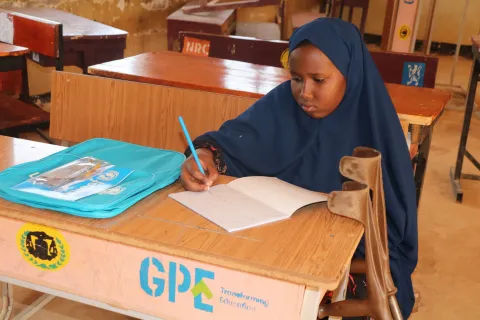
Abdullahi quickly adapted to his new routine, eagerly absorbing every bit of knowledge. The classroom became his sanctuary, a place where he could momentarily forget the hardships of the outside world. Every day was a new and thrilling experience. “This school is my second home, and my teacher is my role model who is guiding me towards success. She inspires me to do my best all the time and to always keep dreaming and aiming for success. I hope to become a doctor when I grow up.”

Abdullahi’s thirst for knowledge inspired his fellow classmates, and together they formed a tight-knit community within the camp. They support and encourage each other, forming friendships that transcend their shared circumstances. They go out of their way to encourage other children in the settlement to join their class and on weekends, you see them teaching other young children in the camp what they have learnt at school.
Abdullahi’s story is a testament to the resilience and strength of internally displaced children in Somalia. Despite the challenges they face, they continue to strive for education, knowing that it holds the power to transform their lives. Through their unwavering spirit, they become beacons of hope, inspiring others to believe in the transformative power of education, even in the most difficult of circumstances.

Addressing the education needs of children affected by emergencies is one of UNICEF’s priorities. Working with partners, UNICEF has constructed 134 Temporary Learning Spaces in 12 drought-affected districts across Somalia, thanks to funding from the Global Partnership for Education and the United States Agency for International Development (USAID). The children are provided with clean, safe drinking water and learning materials and the teachers are given a monthly incentive allowance.
Widespread flooding across Somalia has affected more than two million people and displaced half a million children. An estimated 200 schools have reportedly been damaged and close to 300,000 school aged children left with no access to education. Restoring these schools and getting the children back to school will be a mammoth task complicated by inadequate funding. The Somalia Education Cluster, for example, reports that only USD 600,000 of the USD 15.2 million needed to address education in emergencies has been secured.