The Government of Somalia, WHO and UNICEF amplify World Breastfeeding Week as a call for increased breastfeeding support with equal access

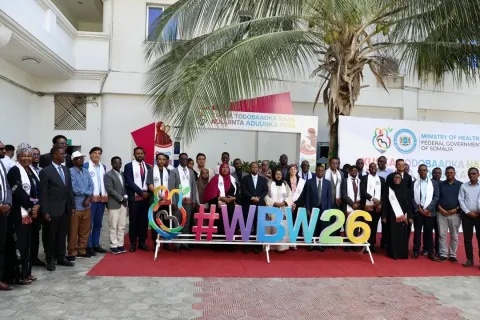
Mogadishu, 01 August 2024 – The Federal Ministry of Health in Somalia, together with the World Health Organization (WHO) and the United Nations Children’s Fund (UNICEF), is coordinating efforts during World Breastfeeding Week to "Close the Gap - Breastfeeding Support for All." The aim is to ensure that all mothers across the country receive protection and assistance to promote breastfeeding in all environments, including internally displaced persons (IDP) camps, remote areas, health facilities, workplaces and communities at large. In Somalia, this translates to around half a million infants benefiting from a healthy start in life and thousands of babies whose lives are being saved by breastfeeding.
"Breastfeeding is a vital act of love and nourishment that benefits both mother and child. By closing the gap in breastfeeding support, we ensure that every mother has the resources, encouragement and environment she needs to provide the first and best nutrition for her baby," says H.E. Dr Maryama M. Hussein, Minister of State for Health.
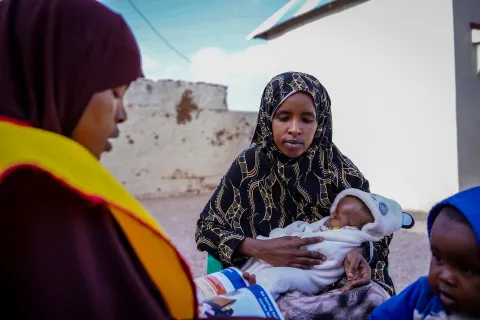
Breast milk is essential for child survival, healthy growth, and adequate development. It carries essential antibodies that protect children against diseases and help them form stronger bodies. Breastfeeding can act as an equalizer in our society, and efforts must be made to ensure everyone, especially vulnerable and marginalized groups, has access to support and opportunities.
"All mothers should be aware of the benefits of breastfeeding for the health of their babies, and they should never feel ashamed to breastfeed, even in emergencies. Breast milk is the ideal first food, safe, clean, and nutritionally complete to prevent malnutrition. All mothers should be supported in health facilities and community to start breastfeeding immediately after birth, exclusively for the first six months, and continue until the baby is two years old," remarked Dr Marina Madeo, WHO Somalia’s Health Policy Advisor.
Yet despite the known benefits, millions of children around the world continue not to be exclusively breastfed with no other foods or liquids in their first six months of life, putting them at increased risk of illness and reduced learning potential as they grow.
“In Somalia, six in ten children are breastfed within an hour of birth, just as they should be. However, only one in three children is exclusively breastfed for the first six months of life. This is the time to congratulate those mothers following best practices and to encourage those who are still facing challenges. Let’s work together to put the required mechanisms in place to ensure all mothers get the support they need,” says Nisar Syed, UNICEF Somalia Deputy Representative.
Despite progress, many women face barriers, such as harmful marketing practices, lack of access to quality healthcare, and weak family-friendly policies, when making infant feeding decisions. To scale up the number of children in Somalia who benefit from recommended practices, together with the governments and partners, we must strengthen monitoring systems, increase funding, and improve policies that support and protect breastfeeding. Everyone has a role to play:
- Restricting marketing of breast milk substitutes with national monitoring mechanisms;
- Establishing country-level monitoring of breastfeeding programs and identifying gaps to inform further improvement in breastfeeding rates;
- Providing skilled breastfeeding counselling to all mothers as part of routine health service;
- Implementing friendly workplace policies such as paid maternity leave and breastfeeding breaks;
- Ensuring that at-risk mothers and infants, those in marginalized communities, and those in emergencies receive equitable provision of breastfeeding protection and support to address their unique needs.
We applaud the donors who support these endeavours, such as the European Union’s Civil Protection and Humanitarian Aid Operations (ECHO), the German Government through KFW, the UK's Foreign Commonwealth and Development Office (FCDO), and USAID’s Bureau for Humanitarian Assistance (BHA).
It is imperative that we all step up to ensure that every child benefits from breastfeeding's extraordinary power. When mothers receive the proper support to breastfeed properly, their babies are not the only ones who benefit from it; everyone does.
Media contacts
About UNICEF
UNICEF promotes the rights and wellbeing of every child, in everything we do. Together with our partners, we work in 190 countries and territories to translate that commitment into practical action, focusing special effort on reaching the most vulnerable and excluded children, to the benefit of all children, everywhere.
UNICEF has been working in Somalia since 1972 when its first office opened in Mogadishu. Today UNICEF has over 300 staff working in Mogadishu, Baidoa, Dollow, Garowe, Hargeisa and also Nairobi, Kenya. Together with 200 international and national NGOs and community-based organizations, UNICEF delivers services in Health, Nutrition, WASH, Education and Child Protection, and responds to emergencies and supports peace-building and development.