New national learning assessments call for accelerated action so every child in Sierra Leone can learn
Only 23.3 per cent of Class 2 learners meet the national literacy benchmark, highlighting the need for sustained investment and targeted support
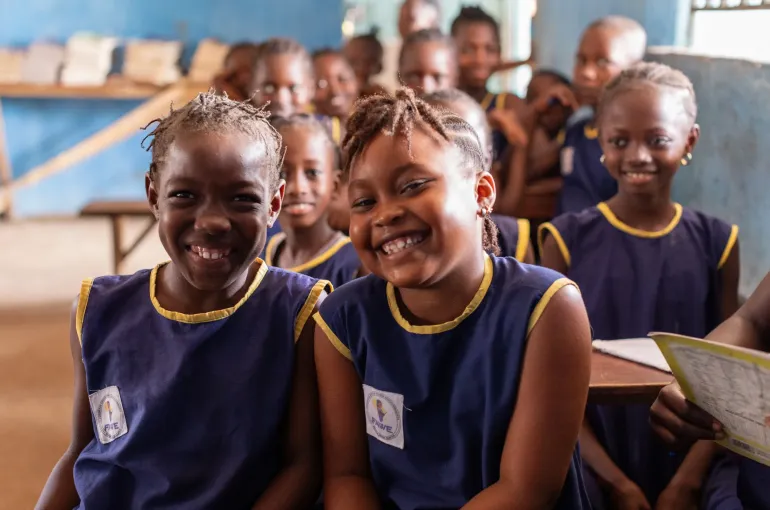
FREETOWN, 20 October 2026 – New national learning assessments launched today by the Government of Sierra Leone show that too many children are not acquiring the foundational skills they need to learn and thrive, underlining the urgent need for equitable and sustained action. The two nationally representative reports provide new evidence on children’s development in pre-primary education and foundational literacy and numeracy among learners completing Class 2, the second year of primary school.
Conducted in 2025 by the Government, in partnership with UNICEF and with funding from the Global Partnership for Education, the assessments establish national baselines for children completing pre-primary education and for learners completing Class 2. The findings will help guide more equitable allocation of resources.
Nationally, 39 per cent of children who completed pre-primary education met the national learning and development benchmark, with substantial differences across districts. Physical development recorded the strongest result, with a 93.1 per cent correct response rate, while language development was the weakest area, at 45.5 per cent. The findings underline the need to strengthen early learning so that every child starts primary school with a fair chance to succeed.
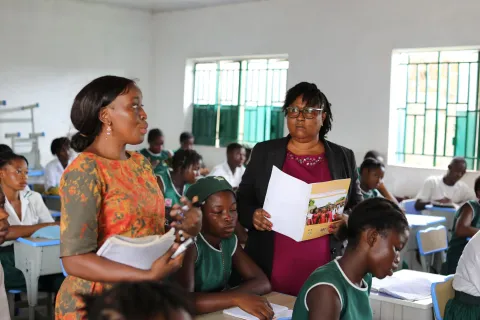
The pre-primary report also identifies factors associated with children’s readiness to learn. Children enrolled at the appropriate age for their grade performed better than those who were underage for their grade. Schools with better access to textbooks and other teaching and learning materials also recorded stronger results, reinforcing the importance of timely enrolment and equitable access to quality learning resources.
In Class 2, only 23.3 per cent of learners met the national literacy benchmark, with many struggling to sound out and read words, and to understand written text. In numeracy, 50.2 per cent met the national benchmark, although many learners struggled to apply basic mathematical concepts and reasoning. These gaps can widen as children progress through school.
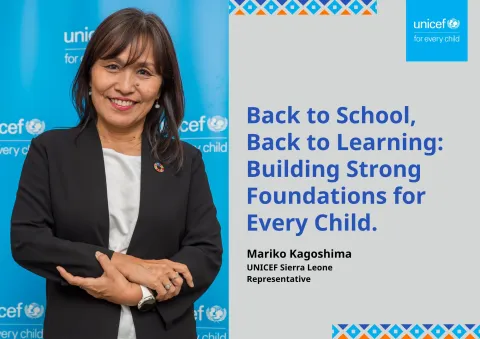
“Too many children are progressing through school without the foundational skills they need to succeed,” said UNICEF Sierra Leone Representative Mariko Kagoshima. “Closing this gap requires sustained and predictable investment in teacher preparation and support, classroom resources and quality learning materials, alongside targeted support for the children and districts furthest behind. Every child has the right to learn, and this evidence must now lead to measurable progress in every classroom.”
The assessments also reveal substantial disparities across districts. The Class 2 findings show differences between girls’ and boys’ results, particularly in numeracy.
The evidence will help the Government and partners develop a national action plan and guide the equitable allocation of education resources. The national baselines will enable progress to be tracked over time.
ENDS
Media contacts
About UNICEF
UNICEF works in some of the world’s toughest places, to reach the world’s most disadvantaged children. Across more than 190 countries and territories, we work for every child, everywhere, to build a better world for everyone. In Sierra Leone, UNICEF supports government efforts to improve child survival, education, nutrition, social protection, child protection and youth development while promoting innovation and digital solutions that benefit children and communities.
For more information about UNICEF and its work for children in Sierra Leone, visit https://www.unicef.org/sierraleone and follow UNICEF Sierra Leone on X, Facebook, Instagram and YouTube.