

From blackboard to play, GPE support is transforming early learning in Sierra Leone
Through teacher training educators are changing the way they teach and connect with children in the classroom

Konsho, Sierra Leone - At Konsho Early Childhood Development Center, a community-based center in Bombali District, northern Sierra Leone, learning is becoming more than sitting in front of a blackboard and listening to lessons. Through play-based activities, children can participate, interact, and learn by doing. For Mbalu Kalisha Koroma, who has taught at the centre for eight years, this represents an important change in how she approaches early childhood education.
When Mbalu started teaching, she had no formal training in early childhood education. She was motivated by the desire to help children in her community access education. A community-based facility for young children existed, but a teacher was needed, and she stepped forward to fill that gap.
“When I started teaching, I did not have any training. I mainly depended on what I knew and used the blackboard to teach the children,” Mbalu recalls. “I wanted the children in my community to have the opportunity to learn. There was a facility, but a teacher was needed, so I decided to help,” she adds.
Over time, Mbalu has benefited from a series of training opportunities that have strengthened her teaching skills and helped her better understand the needs of young children. Through refresher training led by the Ministry of Basic and Senior Secondary Education and the Teaching Service Commission and supported by the Global Partnership for Education (GPE) and UNICEF, she has gained practical play-based and developmentally appropriate learning approaches to making lessons more engaging and responding to children's different learning needs. This year, almost 5,000 pre-primary (P0) teachers have been trained. By equipping teachers with practical skills and approaches that meet young learners' needs, the initiative aims to improve the quality of early learning pedagogies and help children build a stronger foundation for their education.
“I have learned that children do not only learn by sitting and looking at the blackboard. They learn through play, interaction and activities,” Mbalu says. “I am more patient with the children now. I understand that every child learns differently, and I know how to respond to them better,” she adds.

Making learning practical and engaging
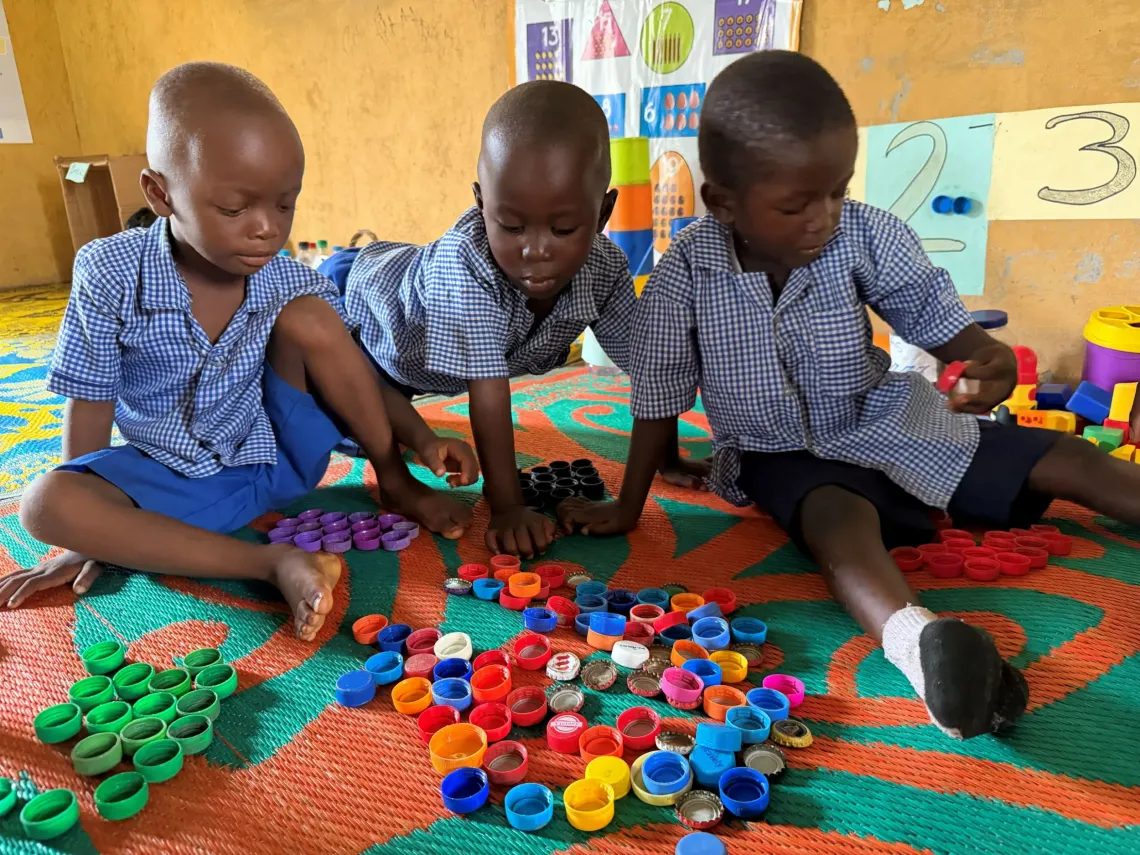
The training has introduced teachers to play-based and developmentally appropriate approaches such as outdoor circle sessions, learning through play, choice play and using locally available learning materials. These methods encourage young children to participate actively in lessons and explore concepts through activities rather than relying only on verbal instruction or the blackboard.
They also show how teachers can create meaningful learning experiences using resources available in their communities, without relying on expensive materials.
“During the training, we helped teachers understand how to make learning more practical and engaging for young children. We introduced approaches such as outdoor circle sessions, the use of locally available learning materials, and learning through play,’ says Edna Sannoh, a training facilitator. “These methods encourage children to participate actively rather than simply listen to the teacher. They also show teachers that effective learning does not always require expensive materials; resources available in their communities can be used creatively to support children’s development,” she adds.
At Konsho, Mbalu is putting these approaches into practice. Through play-based activities, she is creating opportunities for children to learn through participation and interaction. This reflects her growing understanding that effective early childhood teaching requires creativity, patience, and an sensitization on how young children learn.
For the children, these approaches can make learning more engaging and help them develop important skills as they prepare for the next stage of their education.
Building a strong foundation for every child
Early childhood education matters beyond the classroom. Quality early learning helps children develop the knowledge, confidence, and skills they need for future learning. Teachers who understand how young children learn are better equipped to provide experiences that support their development.
“Early childhood is a critical period in a child's development. When teachers have the knowledge and skills to make learning engaging, inclusive and appropriate for young children, they help build the foundations children need for success throughout their education,” says Paola Ripamonti, UNICEF Chief of Education.

For parents, a teacher's patience and ability to engage children can also shape how they experience school and develop an interest in learning.
“I am happy to see that Samuel looks forward to going to school, and I have noticed that when he comes home, he talks more about school, sharing what was learned in class and reciting lessons,” says Samuel’s mother. It makes me happy to see my child remembering what the teacher taught and being excited to share it with us at home. It shows me that the child is learning and enjoying the experience,” she adds.
A difference that lasts beyond the classroom
For Mbalu, one of the most rewarding aspects of teaching is seeing children progress beyond the early learning centre. Some of the children she taught have moved on to primary and secondary school and are doing well.
“When I see some of the children I taught now going to primary and secondary school and doing well, it makes me happy. It tells me that the work we are doing matters,” she says.
At Konsho Early Childhood Development Center, Mbalu's experience shows how strengthening teachers' skills can shape classroom practice. As she moves beyond relying solely on the blackboard and embraces learning through play, she is helping children experience education in ways that are more engaging, interactive, and suited to their stage of development.


