When We Join Forces – Children Thrive
Family-Centred Early Childhood Interventions

- Srpski
- English
Čačak, March 2026 - “The PORI programme gave us tremendous emotional support and the strength to cope with the developmental difficulties our sons Petar and Aleksandar face. It teaches us how to function better as a family and how children can make much greater progress in their natural environment,” says Svetlana, who describes herself as a “happy mother of three” – thirteen-year-old Jovana and five-year-old twins, Aleksandar and Petar.
Svetlana begins her story by recalling how, five years ago, she and her husband Goran were eagerly awaiting the arrival of their twins. Although the pregnancy had been progressing normally and the babies were healthy and developing well, she had to undergo an emergency caesarean section at the beginning of the eighth month due to high blood pressure.
“They were without oxygen for four to five minutes and had a grade one brain haemorrhage, which is treated as a stroke. When they were just one to two months old, they had issues with hypertonia and hypotonia. We immediately turned to a physiotherapist, a specialist in physical medicine,” Svetlana explains.
At the same time, they realised that Aleksandar had vision problems, and doctors later diagnosed him with nystagmus and congenital cataracts. But the challenges did not stop there.

“Once they started walking, we immediately noticed developmental delays compared to children their age. Their speech was delayed and there was little understanding. There were also delays in motor skills. We went to the health centre, and the paediatrician immediately referred us to the FECI programme, where we met with a psychologist, speech therapist, and special educator. That’s where our journey began,” Svetlana says.
FECI, the “Family-Centred Early Childhood Intervention” programme, implemented in Serbia with the support of UNICEF in cooperation with relevant ministries, provides support to families of children under the age of six years with developmental difficulties. In addition to services offered through Development Counselling Centres within primary healthcare centres, support is also provided at home and in preschools.
UNICEF is currently working to expand PORI services to smaller municipalities across districts through the programme “PRO – Local Governance for People and Nature”, jointly implemented by United Nations agencies in Serbia — UNOPS, UNICEF, UNFPA and UNEP, in cooperation with the Government of the Republic of Serbia and with financial support from the Government of Switzerland. Achieving the best results requires strong intersectoral cooperation. Achieving the best results through the PORI programme depends on strong cooperation between sectors. Development Counselling Centres, preschools, social protection services and families therefore work together to identify, reduce or overcome developmental risks and difficulties before children start school.

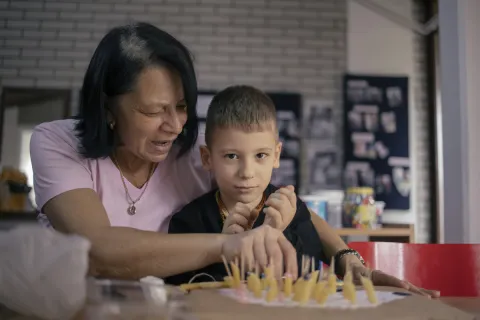
“Here, parents are partners and are involved in the entire process. Together, we first define goals that are truly specific to their child, and then we work on them together. By involving parents, support is no longer limited to sessions with therapists, speech therapists or special educators in institutions. Everything that is done during the sessions continues at home, where parents receive clear guidance on how to work with their child. In that way, support becomes continuous,” explains Jasmina Kandić Šipetić, psychotherapist and coordinator of the FECI team in Čačak. As the primary service provider, she has been supporting the Glišović family for the past two years.
Once a week, Svetlana, Goran and the boys visit Jasmina at the Development Counselling Centre, and she also regularly visits them at home.

“We always set goals together, based on how we as parents see our children and whether they are ready for those goals,” Svetlana explains. One of their biggest achievements, she says, was enrolling Aleksandar and Petar in kindergarten.
“Every two months, we all meet — Jasmina from the FECI team, the preschool support staff, the teachers who spend half the day with my children, and the personal assistant who is always there helping Aleksandar and Petar learn and progress. We all exchange ideas and experiences,” she adds.
Thanks to the joint efforts of the FECI team, the boys have now moved to an older kindergarten group
”They started using words, sitting at the table, taking part in shared meals and following the daily rhythm in kindergarten — sleeping, eating with the other children,” Jasmina says proudly.

The positive changes in Aleksandar and Petar can be seen every day. Their father Goran currently spends the most time with them while on extended parental leave.
“Our children were not functional in the sense that we had to feed and dress them. Gradually, with the help of FECI, they became more independent — they now eat on their own and have started saying words. The progress, both mentally and physically, has been enormous. Right now, we are working on dressing, trying to stop using nappies, improving fine motor skills and doing speech therapy exercises with them,” Goran explains.

In the meantime, Aleksandar’s eyesight improved after two surgeries. He now moves around more confidently and plays more with toys and children at in kindergarten.
“We have seen the biggest changes in Petar. He went from being a boy with an empty gaze to a boy with bright eyes who turns towards us. He used to be afraid to touch anything soft or hard, and he would not even bite a biscuit. Now he chews meat,” Svetlana says.
Their thirteen-year-old sister Jovana also takes part in daily family activities with her brothers. She practices daily routines with them and helps them develop new skills and achieve the goals set together with Jasmina.
“We throw balls together, I teach them how to draw, write and speak. We dance and listen to music. We go to the playground together and play there. We are all involved, 24/7. They are much more independent now — for example, at breakfast they sit down by themselves and eat, we just serve the food,” she explains.


Despite years of challenges and worries, this family remains happy and full of warmth. Part of that is thanks to the FECI team, which helps parents maintain confidence and emotional stability.
“Because what parents of children with developmental difficulties go through is extremely demanding, there are moments when we emotionally break down. In those moments, we call the FECI team,” says Goran. For Svetlana, the educational, emotional, organisational, and overall support provided by Jasmina and the entire team is invaluable.

“As a family, we function much better now. The FECI team taught me to be patient, to wait, and to understand that a lot can be achieved through consistent work. I would advise all parents to seek support as early as possible if they notice any speech or motor delays in their children,” she says.
Today, in 80% of districts in Serbia, children with developmental risks and delays achieve better developmental outcomes thanks to this type of support. Jasmina’s extensive experience working with children and families confirms this.
“With timely intervention and inclusion in programmes like FECI, we can make significant progress. In practice, we clearly see that when everyone is engaged and working together, all children can make progress,” Jasmina concludes.