Serbia gets an AI-based digital assistant for social protection
New tool makes it easier for citizens to access information about their rights to cash benefits
- Srpski
- English
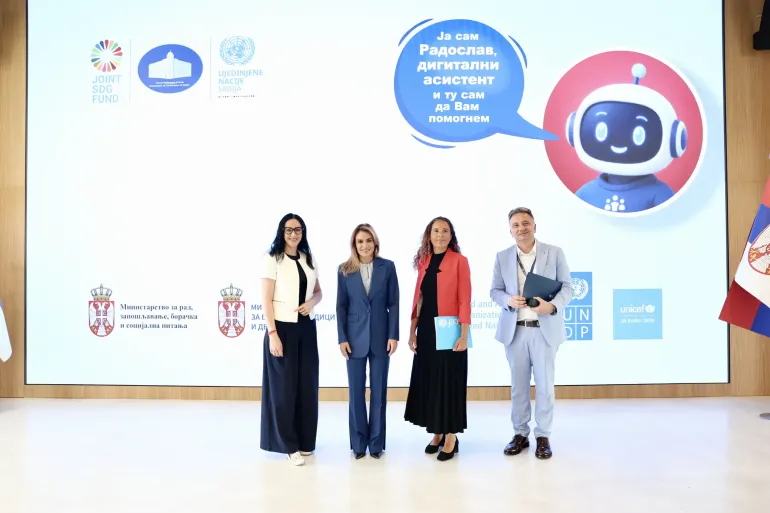
Belgrade, 22 July 2026 - As of today, citizens of Serbia have access to Radoslav, a digital assistant for social protection – an innovative, artificial intelligence-based tool that makes it easier to access information on entitlements and procedures for obtaining cash benefits from the social protection system. The tool provides citizens with reliable, accurate and timely information on five key cash benefits from the social protection system: financial social assistance, child allowance, allowance for assistance and care of another person, increased allowance for assistance and care of another person, and special cash benefit. Radoslav is available on the websites of the Ministry of Labour, Employment, Veteran and Social Affairs and the Ministry of Family Care and Demography.
The digital assistant was developed as part of the joint programme “Digital Services Development Centre – Clicking together with citizens”, led by the Office of the United Nations Resident Coordinator in Serbia and implemented by UNDP, FAO and UNICEF in Serbia, in cooperation with the Office for IT and eGovernment and with technical support from the International Telecommunication Union. Financial support for its implementation is provided by the United Nations Joint SDG Fund, with the support of the European Union and the governments of more than 15 countries.
Access to clear and reliable information is the first step towards realising one's rights. The digital assistant answers citizens' questions on whether they are eligible for a particular benefit, what documentation they need and how to submit an application. All answers are based on the applicable laws and by-laws of the Republic of Serbia in the field of social protection. The assistant is available in Serbian, 24 hours a day, seven days a week.
The development of the digital assistant is part of the efforts of the Ministry of Labour, Employment, Veteran and Social Affairs to make the social protection system more accessible, efficient and user-focused.
“For many citizens, the greatest challenge is not the entitlements themselves, but administrative barriers and a lack of accurate information. ‘Radoslav’ was created to remove these obstacles, prepare citizens for each next step, and help them approach the relevant institutions well informed, without unnecessary confusion or having to return because of missing documentation. At a time when citizens are exposed to a large amount of unverified information across different platforms, it is important that they have a place where they can get a quick, reliable and accurate answer. ‘Radoslav’ will serve as a bridge between citizens and institutions, reduce queues at counters, ease the burden on telephone lines, and enable more efficient communication with ministries and social work centres,” said Milica Đurđević Stamenkovski, Minister of Labour, Employment, Veteran and Social Affairs.
The Ministry of Family Care and Demography supports initiatives that make it easier for families to access information and services designed for their well-being.
“Last year, immediately after the adoption of the Law on the Exercise of Rights from the Alimony Fund, the Ministry of Family Care and Demography was among the first institutions to launch a digital assistant on its website, so that citizens would be fully informed in good time and able to exercise their rights more efficiently. Today we are taking a further step – in addition to information on social benefits and the use of the Alimony Fund, the new assistant also provides users with information on child allowance, an important form of support for the most vulnerable families and children. Through this initiative, we are demonstrating that our goal is for technology to serve citizens, parents, children and families, and for institutions to be accessible at any time and from anywhere in Serbia,” said Jelena Žarić Kovačević, Minister of Family Care and Demography.
The introduction of the digital assistant is part of a wider process of digital transformation of public services in Serbia, aimed at making them more accessible, efficient and responsive to citizens' needs.
“The Radoslav digital assistant is already the fifth AI assistant developed by the Office for Information Technologies and eGovernment, and represents another important step in the application of artificial intelligence in public administration. It is designed to improve communication between citizens and the Ministry of Labour, Employment, Veteran and Social Affairs and the Ministry of Family Care and Demography, with key benefits including constant access to information, faster and simpler access to services, and personalised support. It is particularly important to note that this digital assistant was developed on the Office for Information Technologies and eGovernment’s own infrastructure at the State Data Centre in Kragujevac, ensuring a high level of security, reliability and full control over the system. The genuine need among citizens for this type of communication is also confirmed by our AI digital assistant on the eGovernment Portal, which currently handles more than 45,000 queries a month, a figure that continues to grow,” said Dr Mihailo Jovanović, Director of the Office for Information Technologies and eGovernment.
As one of the partners in the development of the digital assistant, UNICEF supports the use of digital innovations that help families more easily access the information, services, and support they need to exercise their rights.
“Every family should have access to the information, services, and support they need to exercise their children's rights. This is especially important for the most vulnerable families, who often face additional barriers to accessing support systems. This assistant shows how digital innovations can help make the social protection system more accessible, more efficient, and even more focused on the needs of users. Our shared goal is for every child and every family to be able to exercise the rights they are entitled to and receive support when they need it most,” said Carole Vignaud, Deputy Representative of UNICEF in Serbia.
The digital assistant is not a replacement for social workers, but their collaborator. It allows staff at social work centres to devote more time to more complex cases that require individual assessment and direct support. When users need additional help or need to contact the relevant institutions, the digital assistant directs them to the appropriate services and experts.
This initiative represents an important step toward helping families more easily access information, exercise the rights they are entitled to, and receive support when they need it most.