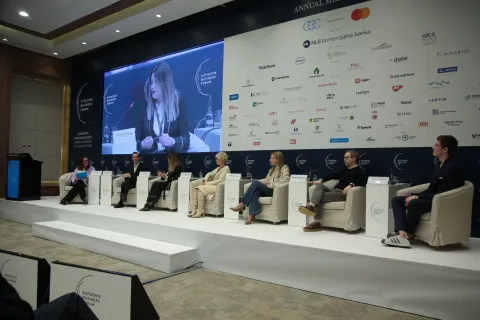
Kopaonik Business Forum 2026

Mr.Vlahović,
Dear business leaders and partners,
Let me start by thanking the Serbian Association of Economists for the opportunity to once again bring children’s perspective into this important forum.
For the fifth year in a row, young people are part of the Kopaonik Business Forum. And that matters.
The discussions here about competitiveness, productivity and industrial transformation will shape Serbia’s future. That workforce is today’s children.
We meet at a time of profound global uncertainty.
In UNICEF’s Prospects for Children: Global Outlook 2026, we identify three forces reshaping both economies and childhood: geopolitical fragmentation, strained public financing and technological acceleration. They are redefining labour markets, fiscal priorities and the speed of technological transition across regions.
Rising defence spending are impacting social investment in many countries. Public financing for essential services is under pressure. At the same time, artificial intelligence and digitalization are transforming labour demand faster than education and social systems can adjust.
When systems weaken, inequality widens.
When inequality widens, productivity declines.
When productivity declines, growth slows.
This global picture matters for Serbia.
According to the OECD Economic Convergence Scoreboard, Serbia has advanced in digital transformation and regulatory alignment with the European Union. But labour productivity remains below 40 per cent of EU levels. Education and training systems do not consistently equip young people with the skills required in a modern economy. Progress in digital literacy and upskilling among disadvantaged groups remains slow.
At the same time, Serbia faces demographic challenges. With 58,455 babies born last year, the future labour pool is shrinking. Fewer young people will enter the market in the coming decades. In this context, growth will depend increasingly on the skills and productivity of each worker.
In this context, every child carries greater economic weight. Every child matters is not anymore a human rights concept but an economic logic.
Yet nearly 1 in 5 children in Serbia is at risk of poverty.
The inequality begins early. Only 10.5 per cent of children from the poorest households attend preschool, and only 7 per cent of Roma children are enrolled.
Human capital does not appear at age twenty-five. It is built from birth.
Early nutrition affects cognitive development.
Early learning affects literacy.
Literacy affects school completion.
School completion affects employability.
Employability affects productivity and earnings.
When poverty interrupts this chain at the beginning, the economic cost is paid across a lifetime and across generations.
If Jovan does not go to preschool, he may enter primary school without strong literacy foundations. By adolescence, catching up becomes difficult. When he enters the labour market, his choices are fewer.
A gap at age four becomes a constraint at age twenty-four.
When children are given equitable access to learning and skills, they are able to realise their potential. That potential becomes human capital.
Now consider Milica.
If her school lacks digital equipment or structured digital learning, she may graduate without confidence in using advanced technologies. When companies shift toward automation and AI, she is less prepared to participate in that transition.
Again, the issue is not talent.
It is preparedness.
Artificial intelligence will reward those equipped to use it and marginalise those who are not. Countries that fail to close these gaps risk embedding structural inequality into their future labour force.
The divide is no longer only about access to schooling.
It is about access to the skills that shape competitiveness.
This is why the response must be twofold.
First, strengthen inclusive systems so that children in vulnerable situations are not left further behind.
Second, equip all children with foundational literacy, digital and AI fluency, critical thinking and clear school-to-work pathways.
This is economic policy.
It depends on financing.
Sustained public investment in early childhood, education and adaptive social protection determines whether human capital is built broadly or concentrated narrowly.
Today, child-responsive budgeting in early childhood development and parenting is embedded in only 30 per cent of local governments in Serbia.
Budgeting for children is not social spending.
It is growth policy.
UNICEF works with the Government of Serbia to strengthen early childhood development, improve inclusive education, support digital readiness and modernise social protection systems.
These are not parallel social agendas.
They are economic infrastructure.
The private sector has a direct stake in this architecture.
Competitiveness depends not only on tax structures, but on skills, institutional trust and predictable systems. Private engagement cannot replace public responsibility, but it can reinforce accountability for sustained and transparent financing of policies that build human capital.
I am grateful for the strategic long-term partnerships we have built with companies in Serbia, including Nelt Group, Banca Intesa and the Intesa Foundation, Yettel, Comtrade Distribution, OTP Bank and Grundfos.
Evidence shows that every dollar invested in children generates, on average, ten dollars in societal return over a lifetime.
Few investments offer comparable returns.
Ladies and gentlemen, In a tightening demographic landscape, Serbia cannot afford to waste talent.
It is economic logic.
Competitiveness and child wellbeing reinforce one another.
They converge in one place.
In people, starting with children.
Thank you.
Media contacts
O UNICEF-u
Prisutni smo u više od 190 zemalja i teritorija, a kroz sve što radimo promovišemo prava i dobrobit dece, posebno one koja su najugroženija i isključena. U potpunosti se finansiramo od dobrovoljnih priloga pojedinaca, država i vlada, fondacija i kompanija.
Pratite UNICEF Srbija na: Facebook-u, Twitter-u, YouTube-u, Instagram-u i LinkedIn-u.