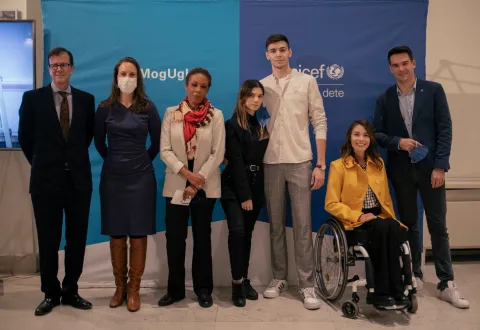
Conference Recommendations "Don't Leave Us for Later"
Second international conference on support for child, youth and adolescent mental health and wellbeing

- Srpski
- English
The "Support for Child, Adolescent, and Youth Mental Health and Psychosocial Wellbeing Second International Conference" provided the official platform for the signing of the Memorandum of Understanding (MOU) by six ministries: the Ministry of Health, the Ministry of Education, the Ministry of Tourism and Youth, the Ministry of Labour Employment, Veterans and Social Affairs, the Ministry of Human and Minority Rights and Social Dialogue, and the Ministry of Family Welfare and Demography. The conference convened a diverse array of experts, professionals, and policymakers, both on a national and international scale, with the primary goals of gathering valuable insights, formulating recommendations for the government, and facilitating the exchange of knowledge while sharing best practices. The conference's culmination featured the signing of the Memorandum of Understanding, which delineated sector-specific roles and responsibilities, and the essential recommendations were thoroughly discussed and addressed:
-
Support the development of a life cycle focused MHPSS service for children, adolescents, youth, and caregivers. The Memorandum of Understanding (MOU) promotes positive mental health and wellbeing as a holistic, lifelong concern that impacts every sector of development. The government should ensure that services for children and parents commence early in a child's life and continue through adolescence. Prioritizing early detection of risks and adversities in childhood, with swift interventions, is paramount. Ensuring the mental health of parents and caregivers should be a prerequisite.
-
Ensure full MOU implementation by establishing a National Multisectoral Working Group and developing a Multisectoral Action Plan. The government should create or strengthen a national multisectoral working group or coordination structure responsible for child and adolescent mental health and wellbeing. This body should coordinate the planning and implementation of the agreed MOU through a multisectoral action plan, ensuring a unified approach to MHPSS. At the national level, the MOU should be followed by a multisectoral action plan for MHPSS implementation, including cross-sectoral performance indicators to encourage collaboration among various sectors.
-
Increase and secure resource allocation for comprehensive MOU implementation at all levels. The government must guarantee the allocation of adequate public and other resources for child and adolescent MHPSS services across relevant sectors and ensure effective expenditure. Prioritizing joint fundraising with key development partners is essential. At the local level, local governments should be assisted in establishing or strengthening mental health priorities, raising awareness about the needs of children and adolescents regarding their mental health and wellbeing, and supporting the development of local multisectoral implementation plans, resource allocation, and coordination, particularly during crises.
-
Support the provision and access to evidence-based mental health care, standards, and resources. Relevant ministries should expand the full integration of child and adolescent MHPSS services into primary and community-level services for children, adolescents, and their families based on the MHPSS minimum services package. This includes reactivating primary healthcare counseling units, integrating services into schools and social welfare services, and implementing community-based approaches for child protection and family support. The government, with support from professional associations, training institutions, and development partners, must ensure that the multisectoral MHPSS workforce's capacity is enhanced across education, health, youth, and social welfare sectors, through both pre- and in-service professional development efforts that fully consider the needs of children and adolescents.
-
Strengthen information systems, evidence, and research on MHPSS. The government, in consultation with academic and development partners, should enhance data collection, utilization, and accessibility at national and subnational levels. This should include data and monitoring and evaluation mechanisms to identify mental health needs, support planning and implementation, track progress, and harmonize child and adolescent MHPSS-related indicators across sectors. Identify barriers and preferences for underserved communities, especially out-of-school children and adolescents, and those with disabilities, to ensure services are more accessible to these groups.
-
Increasing awareness about mental health and mental health conditions to address mental health-related stigma and discrimination and improve mental health literacy. The government, in coordination with all relevant acters and media, should implement community-wide, targeted awareness raising activities that combat stigma, discrimination, and abuse linked to mental health issues, and promote help-seeking behavior. This approach aims to mobilize communities to take positive action by providing clear information about the needs of children and how to fulfil them.


These recommendations are crucial for enhancing child and adolescent mental health and psychosocial support in Serbia, focusing on early intervention, resource allocation, collaboration, and comprehensive planning and they include recommendations by youth.
The pre-conference youth event engaged over 40 young individuals from across Serbia, with the primary objective of collecting valuable insights, formulating recommendations for the government, and facilitating the exchange of knowledge while sharing best practices. These recommendations, derived from the perspectives of young participants, were subsequently presented during the conference:
-
It is essential that everyone working with young people knows how to recognize signals and assist when one of us faces difficulties. Psychologists and educators are vital, but they are not enough. Therefore, it is crucial for teachers to receive additional training and resources to better understand our issues and know how to help us. We also believe that schools should teach us how to take care of ourselves, understand our emotions, and where to seek help when needed. These topics should become a mandatory part of the curriculum.
-
We want to know where to seek help for mental health issues. It is important for us to know who the experts are in our environment who can help us. We suggest making healthcare services more accessible to young people and having a safe space for young individuals with professionals they can turn to.
-
Young people in the social welfare system, especially those in foster families, require additional support as they face specific challenges. We propose providing them with mandatory counseling and support services.
-
It is often forgotten that each generation has its own language, needs, and challenges, leading to misunderstandings at times. We recommend utilizing existing and developing new mechanisms to ensure that young people are involved in creating mental health-related services because we can better understand our peers.
-
We propose the establishment of an organized, continuous peer support system both offline and online, promoting trust, anonymity, and a focus on young individuals. Peers are the first point of contact when facing a challenge, so it is important to build a high-quality peer support system.
-
Many of us are afraid to talk about our problems and seek help. We suggest implementing mental health education that originates from us, the youth, and professionals. We need to educate parents, the media, and other young people on how to discuss these matters without judgment