I got vaccinated not just for myself but for my family
As the COVID-19 vaccination program is implemented across the country, health agents are trying new and creative ways to vaccinate their communities

- Français
- English
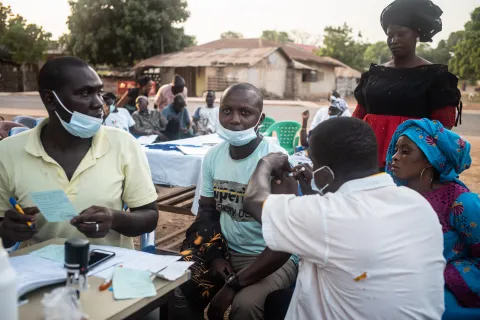
CASAMANCE (Senegal), 11 February 2022 – Early in the morning, Bourama Manka, 43, walked into the mass vaccination site in Marsassoum, Casamance, in southern Senegal, to get the COVID-19 vaccine. He was eager to receive the vaccine and finally protect himself and the ones he loves from the potentially devastating effects of the coronavirus.
"Like many, I have been watching the news about COVID-19 in Senegal and internationally and looking forward to a reprieve, which it seems will only come about with a vaccine" says Bourama Manka, 43, from the city of Marsassoum in Casamance, southern Senegal.
“Vaccines are a normal part of how I look after my health and the health of my kids. I understand that every medical intervention carries risk, but on balance, the benefits of vaccines far outweigh the risks for me and my family” he explained.

As the COVID-19 vaccination program is implemented across the country, health agents are trying new and creative ways to vaccinate their communities. The mass vaccination site set up in the city of Marsassoum will help the health workers reach people who have experienced barriers in vaccine access and help distribute life-saving shots more equitably and conveniently across the city.
Senegal recognized very early on that access to COVID-19 vaccines and a successful deployment could potentially reduce COVID-19 morbidity and mortality. These motivated authorities to work around the clock to reach the maximum of people.

"When I was called in, the doctor asked a couple more questions to confirm my understanding of the risks and benefits of the vaccine, then the nurse gave me the jab and I was sent back to wait for 15 minutes of observation" Bourama said.
"I got vaccinated because the coronavirus is a very dangerous disease that has wreaked havoc in the world. If you have been vaccinated, you are better protected. I know people who had the coronavirus and were very sick. Now I'm glad I did, I feel safer. For myself and for my family” he said.
For Bourama, getting to this moment meant overcoming many barriers that could have made him stay home. The issue of vaccine hesitancy remains an obstacle in his neighborhood. "Concerns about safety, side effects and effectiveness are widespread in my village" he said. "Access to social media has also facilitated the spread of misinformation and conspiracy theories."

To tackle the spread of misinformation and rumours around vaccinations, UNICEF has provided support to the Ministry of Health for the implementation of a digital-based strategy. Adolescent and youth volunteers were also engaged in disseminating key messages, tracking down rumors, and disseminating appropriate response. Religious leaders joined hands to build trust in COVID-19 vaccine as they inspire other leaders to take action, spread the message and help contain the pandemic.
As vaccine supply increases and communication campaigns expand, changes in hesitancy are being observed in the country. As of end of January, Senegal has vaccinated a total of 1.4 million people with at least one dose, and nearly one million with the two doses, which however represent only 11% of the total targeted populations.

New variants emerged in 2021 resulting in a 192% increase in cases compared to 2020, with a cumulative fatality rate of 2.5%. The pandemic response however witnessed a breakthrough when vaccines were introduced early in 2020, thanks mainly to the COVAX initiative and its partners that provided 75% of the total number of doses for Senegal.
Throughout the crisis, UNICEF has been working closely with the Government and its partners to step up the response and prevent further proliferation of the COVID-19 virus in the country. As well as leading the procurement and supply of COVID-19 vaccine, UNICEF, together with WHO and other partners, is helping the country strengthen its cold and supply chains, training health workers, and working with communities in addressing misinformation and building trust in vaccines and in the health systems that deliver lifesaving vaccines.

This initiative has been made possible thanks to the financial support of the Covax Donors, USAID, GAVI The Vaccine Alliance, the Government of Japan, the French Committee for UNICEF, the United Kingdom Committee for UNICEF and the Spanish Committee for UNICEF