The Power of Internet Connectivity Enhances Learning
How the Airtel-UNICEF Reimagine Education programme empowers students, teachers, and families to learn online in Rwanda.

It is lunchtime at Nyarubuye Primary School and ecstatic screams fill the school yard as the children have fun. The grounds are alive with green-clad students engaging in different activities; some play football, some tag, and some swing on the low branches of small trees that spot the compound. Friendly and curious smiles from the active students add warmth to an already sunny day in Rwanda’s Rwamagana District.
Eric, 13, is one of the students playing football. He deftly leaps and dribbles as his opponents on the field attempt to steal the ball. One succeeds, and Eric takes a break, panting and smiling. His joy and enthusiasm are palpable, and it so happens that he carries the same positive attitude to class.

“I love attending classes. I ask many questions during the classes, which makes my friends laugh and they tease me, but I don’t mind,” he says cheerfully. “I come from a poor household. My parents aren’t always able to afford my school fees, but the school always finds a way to keep me here, so I always try to make the most of it.”
Eric’s inquisitiveness allows him to be always among the top five in all subjects, and he expects to perform even better now that his school has undergone an internet transformation.
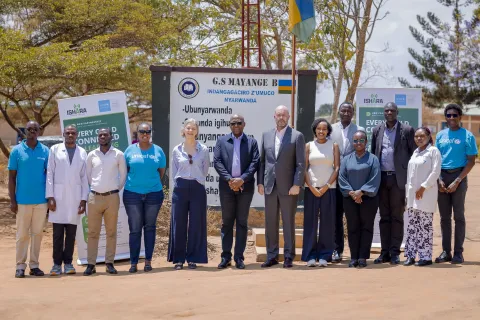
Through UNICEF’s inter-regional partnership with Airtel, “Reimagine Education”, thousands of schools across 13 countries in Africa are being connected to the internet. More than half of primary and secondary schools in Rwanda are not connected to the internet, limiting, 21 schools are already using the internet provided by Airtel, with 200 more to be connected soon. In Nyarubuye Primary school, teachers and students could not be more ecstatic.

“Internet is expensive. It is tough to afford internet bundles daily,” says Theodomir Gatete, an English teacher at Nyarubuye who has been in the profession for 20 years.
The internet was installed at this school two terms ago. Since then, Theodomir feels more confident in the quality of the education he is now able to give to his students.
“When I prepare lessons, I can research and find current, relevant, and detailed information that benefits my students. I can also access resources that demonstrate to me different and innovative techniques of teaching them certain topics, which I then practice with my students” he explains.
He can now search exactly what he is looking for and browse the options for the best resources available. From textbooks that are not available in hard copy to tutorial videos for children, a wealth of information is now at his fingertips, ready to be shared with his students. As an English teacher, one of the internet’s main applications in his classroom is in improving vocabulary and pronunciation.

“English is not our mother tongue. Even as a teacher, I can get things wrong. Whenever I am unsure of how a word is pronounced, I can easily search for the proper way to pronounce it and play it for my students too. My own vocabulary and pronunciation have significantly improved,” Theodomir acknowledges.
For new teaching approaches, he adopts techniques from different videos on YouTube and other social media platforms. “I learn from people like Teacher Andre Kerlin on TikTok. Since I am from a French-speaking background, he helps me grasp certain concepts better, which allows me to teach them better,” he says, smiling as he taps his phone screen to play a video of a young man, adding, “I also borrow his fun and passionate approach, and my students love it!”
Eric agrees. He thinks lessons have become more interesting and informative since their school was connected.

“Nobody knows everything,” says Eric, adding, “Before our school was connected, sometimes I would ask questions for which the teacher did not have an immediate answer. In such a case, I would have to count on my teacher to remember to look for an answer after school, which they often forgot because they are busy people.”
When faced with these situations, Eric would try asking a relative who is a teacher elsewhere to hopefully get an answer. When he did, Eric would also have to remember to share the answer with his classmates. But now, if the teacher doesn’t know the answer, he can immediately look it up on his mobile phone and inform the whole class.
The impact of the internet goes beyond the classroom too. The head teacher is responsible for frequently updating the School Data Management System (SDMS), which is online. The system records real-time data for 777 students and 20 teachers, including student grades and attendance, and is used to request money to run the school. Before, when an information request would come to him, to make an entry, he would have to travel to a location with an internet connection.

“I don’t have to do that anymore. I am connected from morning to evening, and can respond to any urgent requests,” says Seth Mugisha, Nyarubuye Primary School’s head teacher. “And when the connection cuts off, we call a technician provided by Airtel who immediately resolves the issue,” he adds.
The internet spills over into the households surrounding the school too. Alphonsine Muhawenimana, a parent of three, lives right next to Nyarubuye Primary School, which her children attend. She counts it a blessing that the internet connection enables her to always access learning material for her children, benefiting them both in and out of school.
Currently, the school does not have devices that students can directly connect through, so they must rely on the content from their teachers. However, after school and during holidays, students who live close by bring their parents’ mobile devices and connect, keeping their learning journey alive.

Through the Airtel-UNICEF partnership, students, teachers, and caregivers across Rwanda can now access up to nine educational platforms at no cost when using an Airtel sim card. These include the e-learning platforms for Rwanda Basic Education Board, Rwanda TVET Board, Rwanda Polytechnic, and University of Rwanda.
Itetero is also accessible free of charge, not forgetting the recently launched e-learning hub for young people entering the job market, Ingazi-Passport to Earning. School administrators and teachers can also freely access the SDMS, the Teacher Management Information System, and the NESA Comprehensive Assessment Management Information System.
The future of education in Rwanda is bright. With continued investment in internet connectivity and innovative learning platforms, students like Eric will have the tools they need to reach their full potential. Through this unprecedented partnership, Airtel and UNICEF are bringing learning resources ever closer to children, families, and communities.