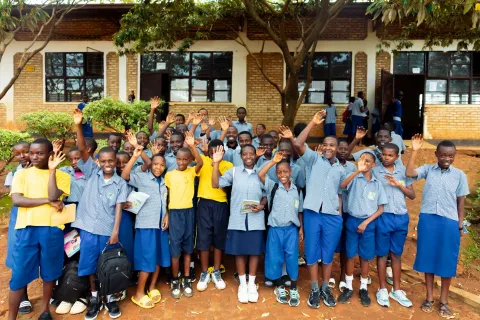
Inclusive education is a reality in Rwanda
Disability is not inability; a primary school in Rwanda demonstrates it well.

As we drive from Kigali, Rwanda’s capital, to Bugesera district, we see a beautiful landscape of surrounding hills and lakes. After the tarmac road ends, a dusty, unpaved road continues for about a kilometer, leading to the Gitwe Primary School (PS). The school receives children from the nearby communities.
Established in 2004, the school has 16 teachers (nine females and seven males) and one administrative staff. The headmistress is Mrs. Rosette Musabyeyezu.
Gitwe PS provides an educational facility of four years of nursery and six years of primary education. It has a total strength of 645 students, including ten children with special needs. But this was not the case until 2019.
“When I joined the school in 2006, the teachers could not support children with disabilities, as we did not have the capacities, training, and sensitivities to cater to different needs. Hence, there was no student with disabilities admitted to the school until 2020”, shares the headmistress, Mrs. Musabyeyezu. She further added that children with disabilities stayed home and received no stimulation or education.
In 2019, the teachers and school administration received support from UNICEF Rwanda on three aspects: accessibility, capacity building of teachers in inclusive education, and assessment and referral of children to social services. Thereafter, the school welcomed its first visually impaired child in 2019. Since then, several of the children with disabilities have completed primary education.
A shyly smiling Emelyne came to meet the headmistress. She is 19 years old and has a cognitive disability. She has difficulty recognising letters and can’t write well (dyslexia).
Emelyne started in this school four years back and was admitted to the first grade in primary school.
“I love coming to school because I have learned a lot. Earlier, I would accompany my parents to the farm all day. Now, I enjoy playing with my classmates and sharing meals provided through the school feeding programme. My closest friends are Angel and Nadia. They help me in writing and are very supportive.”

According to the Ministry of Education (MINEDUC) electronic management information system data of March 2023, out of a total of 4,159,782 learners in the education system, 38,937 (0.9%) have disabilities. In primary education, learners with disabilities make up about 1.1 per cent or 29,994 out of 2.742 million total learners. In secondary education, 4,849 (0.6%) students have disabilities out of the total number of students.
Only 14.6 percent, 15,569 teachers, were trained in special needs and inclusive education. There is an urgent need to train teachers in inclusive pedagogies.
There are 3,301 schools (68.1%) with adapted infrastructures accessible to learners with disabilities.
Gitwe welcomes children with other disabilities, too. The school has four students with physical disabilities, three with hearing impairment, and three with intellectual disabilities.
Meeting Jacques Butera, a young man of 15 years studying in grade six, was a pleasure. Jacques studied at a different school in Kibenga from Primary one to Primary three. During the Primary Three Christmas holidays, Jacques accidentally put his hand in a millet blending machine and lost his right arm, which was his primary arm.
Jacques has a beautiful handwriting; however, his journey has been quite challenging.

"Earlier, I used my right hand to write and do all my chores. After the accident, I was forced to use my left hand. It was tough initially, but I was determined to learn to use my left hand for everything. It took me a while to catch up with my classmates after losing my arm”. Jacques shared.
When asked which subject was his favorite, Jacques mentioned social studies, which he understands well. The teachers are supportive, and while teaching, if Jacques requires anything to be repeated, they do it willingly.
“ I live with my parents and three siblings. I help with chores at home and can ride a bicycle with one hand when sent to run errands and grocery shopping. I am pretty independent. I even wash my clothes”, a proud Jaques says.
Mrs. Rosette mentioned, “We inform the examination center when the children with disabilities appear for examinations so they can be supported with extra time to finish their exams. As in Jacques' case, he might need more time than the others, who do not have disabilities, to finish his examination”.
The school has ensured the establishment of ramps and toilets with handrail support for easy access for children with disabilities, indicating a fully integrated, inclusive approach.

However, this is not the case with all schools in Rwanda, as they don’t provide accessible infrastructure for children with disabilities. All schools’ environment and facilities should be accessible to children with disabilities. This also applies to play facilities. It is unfortunate that in Rwanda, 99 per cent of schools lack disability-adapted play facilities, hence depriving children with disabilities of their right to leisure/play. There is a need to support schools with disability-adapted facilities.
Gitwe leads by setting a very good example for other schools that must be inclusive. The needs of all students must always be met, irrespective of whether they have disabilities. Teachers’ sensitisation and capacities to cater to different needs is another significant step towards inclusivity at Gitwe. The teachers are invested in the well-being and learning outcomes of the students at school and home.
UNICEF Rwanda is grateful for the contribution of UNICEF Switzerland, which led to this beautiful initiative of mainstreaming the needs of children with disabilities in regular schools.