Each day across Pakistan, estimates suggest that more than 700 newborn babies die -- the highest rate in South Asia and one of the highest globally. The depth of sadness and lost potential is difficult to grasp, not least for mothers. Sadder yet is that these deaths are, for the most part, avoidable.
There was a time when such losses could be attributed to a lack of skilled health workers at birth. But in Pakistan, around 69 per cent of births are attended by a professional. Nor can these losses be attributed to women not giving birth in health centres because around 66 per cent of births take place in bespoke facilities.
In Pakistan, one of the leading causes of newborn mortality is due to prematurity attributed to malnutrition in mothers.

Around 42 per cent of women of reproductive age are anaemic; the rates are higher in rural areas. In addition, micronutrient deficiencies – iron, zinc, vitamin A, vitamin D and calcium – compound their ailments and contribute to conditions such as low birth weight and premature babies. Infants born small because of maternal malnutrition are more likely to suffer wasting and stunting in early life.
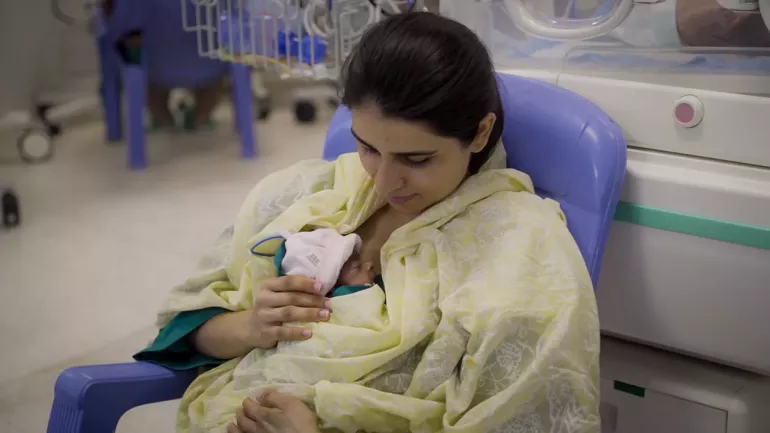
Rubina gently cradles her 15-day old baby girl to her bare chest. Baby Fatima was born weighing just 1.3kg. As we congratulate her, she tells us that out of six pregnancies, this is only the second baby to survive. She is, understandably, cautious in the face of our felicitations.
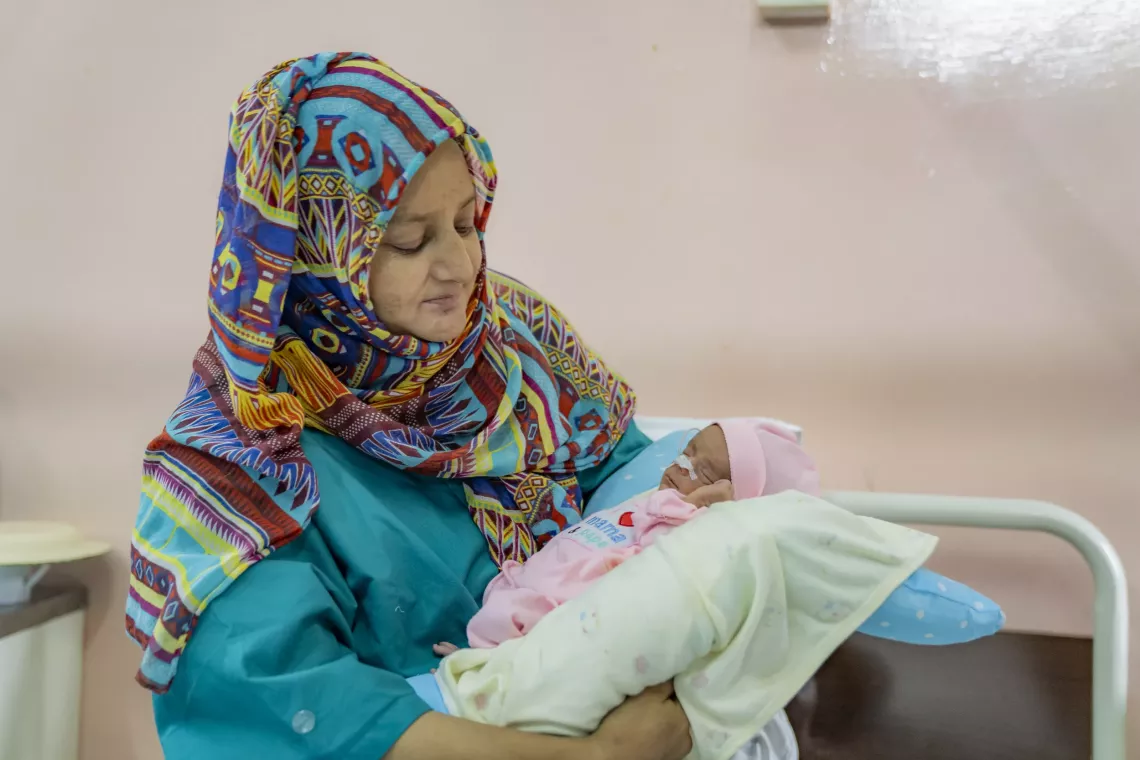
A premature baby is one born too early, before the 37th week of gestation. Vulnerable, fragile and delicate, these pintsize infants need specialized care but, in too many cases, they don’t get it. This is partly due to a lack of incubators, healthcare professionals not resuscitating them at birth, and sepsis taking grip in the earliest hours of life. It’s also due to many healthcare professionals in Pakistan not practicing one of the most simple and cost-effective ways to save newborn lives: Kangaroo Mother Care (KMC).
But this is changing thanks to Dr. Sadia Riaz, Head of Neonatology in the Pakistan Institute of Medical Science (PIMS) in Islamabad. If you didn’t know that she is the pioneer of Kangaroo Mother Care in Islamabad Capital Territory (ICT) region in Pakistan, a short conversation will quickly help you understand her passion and her remarkable progress.
Author of the National Guidelines for Kangaroo Mother Care, her eyes sparkle as she speaks. This isn’t a job; it’s a vocation. Through her determined advocacy efforts, she opened the first Kangaroo Mother Care unit in 2019. Today, there are 65 KMC units across the country. They have saved the lives of over 18,000 babies.

Kangaroo Mother Care is the simple act of placing an infant on the mother’s chest and binding them together after birth -- and the days and weeks thereafter. Feeling skin-to-skin contact strengthens the bond between mother and child, alleviates stress, builds the baby’s resilience in a way that no incubator or medication can, and stimulates all five senses in an infant: smell, sight, sound, taste and touch.
“What is more ingenious than a mother’s body?” Dr. Sadia asks us.
We look puzzled.
“When a baby is bound to his mother’s body and his temperature drops, the mother’s temperature increases instinctively. And when a baby’s temperature increases, the mother’s temperature decreases. Mother is the best incubator,” she says with a smile.
Championing Kangaroo Mother Care in UNICEF Pakistan is Dr. Samia Rizwan. She has supported Dr. Sadia since 2019. They are a formidable pair. One gets the impression that nothing will stand in their way until every mother and every newborn in Pakistan is safe and well. As part of this effort, UNICEF provides each new mother with a Kangaroo Mother Care Kit – small bags that contain a baby cap, a camisole/sling for mother, front-buttoning gown and front opening baby vests – as well as capacity building with health colleagues.

In the Kangaroo Mother Care Unit at PIMS, which is free for all, we speak to Mishal, a new mum. At 26, she’s just had her first baby, a little boy called Abray. Weighing a meagre 1.7kg, he was immediately taken from her after birth and placed in the ICU for 10 days. She cried the whole time they were separated.
Today, sitting up in bed with Abray bound to her chest, she smiles as she tells us, “When I cuddle my baby and he’s wearing clothes, it feels good. But when his skin is next to mine, it feels much better. I feel close to him, and I relax. I can see that he relaxes too. It relieves me of any sadness or distraction I’m feeling.”
“This is the first time I hear of Kangaroo Mother Care,” she continues. “I will return home to my friends and tell them to do this with their babies.”
Expanding this network of mother-advocates is high on Dr. Sadia’s to-do list. Each mother who passes through her care is added to a WhatsApp support group so that they can all stay in touch and share experiences as their babies grow healthier each day. As the bonds between mother and baby are strong, so too are the bonds between the mothers who spend those first precious and precarious days together, willing their infants to fight for life.
Once they return home, Community Health Workers play a vital role in visiting the mothers and babies to check their progress and make sure that KMC is working well, and issue prompt referrals to nearby clinics if needed.
In another example of how she is breaking paths and challenging stereotypes, Dr. Sadia tells us that she encourages fathers to practice Kangaroo Mother Care as well, taking the opportunity while they are in a private room to counsel them on how to care for mother and infant.
So, why aren’t there more Kangaroo Mother Care units in Pakistan, I ask Dr. Sadia.
“They don’t know what it is or how easy it is or how little it costs,” she tells us. All we need is space in a health facility, some beds and few resources, such as presence of a nurse and heat to keep the room warm. Mothers don’t even need to buy a special sling; they can use their dupatta! If there’s an existing space in a health facility, she estimates the cost to be nominal.
“It’s a modest investment for a country like Pakistan – with such a high return.”
That’s why Dr. Sadia, Dr. Samia, UNICEF Pakistan and their partners share a dream. By November 2025, they want to see Kangaroo Mother Care units in Pakistan increase from the current 65 to at least 166, one in each district. The combination of political will and parental love could save thousands of newborn babies -- one snuggle at a time.