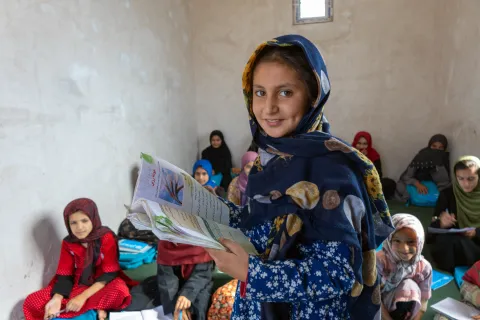
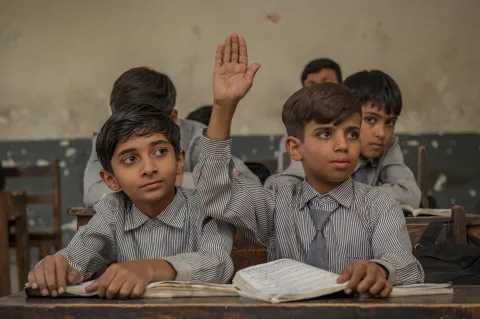
“I want to become a government officer and make sure laws about dowry and child marriage are enforced,” said sixteen-year-old Afsana Khatun, who we met at a school in Nepal’s Madesh Province.
About two years ago, Afsana dropped out of a local madrassa, a religious Muslim school. Back then, she didn’t hold such ambitions. She assumed this was the end of her learning journey.
After spending a year at home, doing household chores, things changed. Social Organization District Coordination Committee, Parsa, UNICEF’s partner organization, encouraged her to enrol in a programme to help out-of-school adolescent girls re-enter formal education and gain vocational skills. Supporting Adolescent Girls’ Education (SAGE ) helps those at risk of early marriage or exploitation over a nine- month period. SAGE equipped Afsana with new skills; introduced her to peers with similar experiences; and rekindled her love of learning. As a result, she recently enrolled at Shree Nepal Rashtriya Secondary School along with 53 other SAGE graduates.
Afsana’s story underscores the transformative power of education. Learning isn’t just about acquiring knowledge; it’s a catalyst for change that can uplift communities and countries.
Change, however, takes time, especially in traditional communities with engrained social structures and expectations.
But there is reason to hope.
“How can my family rise out of poverty, if my daughter can’t get an education?” One mother asked us.
Such a salient question strikes at the heart of the challenges in Nepal where about 15 per cent of adolescent girls drop out by upper secondary level, and 30 per cent of adolescent girls aged 15-19 are not learning, employed or receiving employability skills.
The statistics on child marriage are equally troubling. One in three young women are married as children, and nearly 40 per cent of those married before 18 give birth before 18.
The consequences are profound. Cycles of poverty, early marriage and exploitation persist through generations.
Investing in girls' education is one circuit-breaker. When girls stay in school, they gain knowledge, grow in confidence, and learn new skills. This helps them break the cycle of poverty that so often traps women into cycles of lost opportunities and unfulfilled potential.
But breaking these vicious cycles takes a village, as the saying goes. During our visit, we spoke with teachers, local officials, and parents. For opinions to change about girls, and for girls to realise their full rights, they need the support of family and community. By working together, they can challenge and change deep-rooted beliefs and pave the way for a lifetime of opportunities for girls, including keeping them in school, learning.
“Our municipality has begun allocating public funds for programme like SAGE,” Sharmila Bista Mahato, the Deputy Chairperson of Sakhuwa Prasauni Rural Municipality, told us. It was encouraging to hear such progressive approaches. It made us believe that change is possible even in the most remote communities.
Afsana’s father, who once considered marrying off his younger daughters, changed his mind when his community struggled to find qualified female health workers. Despite needing someone with a tenth-grade education, they could only find someone who had just passed eighth grade.
“There is a huge need for women to work in health services, so if we can educate our daughters, there are lots of opportunities for them. That has inspired me to send my two daughters to school. If our daughter goes to work in a hospital, for example, she will not be working just for our family, but the entire community would benefit.”
As we celebrate small successes, we must also acknowledge that programs like SAGE only reach a fraction of the girls who need support. Scaling up such programmes while tailoring them to meet the needs of girls, especially married adolescent girls, is crucial.
Earlier this year in June, the South Asia Association for Regional Cooperation (SAARC) in partnership with UNICEF, WHO and UNFPA held a Regional Dialogue on Adolescent Pregnancy in South Asia in Kathmandu. For the first time, member states came together to address the unique needs of pregnant, parenting and married adolescent girls, many of whom are denied opportunities and forced to leave school due to social pressure. This dialogue was a crucial step forward as too many girls across South Asia, particularly in Nepal, are denied opportunities once they marry. Without broader reach and innovative approaches, too many girls will continue to be left behind, denying Nepal’s economy the opportunity to burgeon as it could with an educated and economically active female workforce.
Expanding and innovating these programmes to address diverse community needs is essential for building a more productive and prosperous nation. Investing in girls’ education isn’t just about their personal advancement, it’s a move towards a brighter, more equitable future for all. UNICEF urges the Government, donors and partners to increase their investments in girls’ education and lay the groundwork for a more inclusive future.
As Afsana wisely put it, “When a girl is educated, she educates her whole family.” This truth underscores the importance of scaling-up these initiatives. As these programs continue to grow, so the ripples of progress will also grow — reaching further, touching more lives, and showing that when girls rise, everyone rises with them.