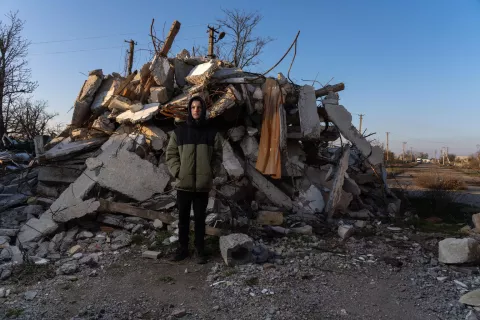
Romania extends a warm welcome to refugee Ukrainian mothers and their children
Hundreds of thousands of Ukrainian mothers and children have crossed the border into Romania, many yet to decide on a destination. Authorities expedite and support their transit or stay, together with humanitarian groups.

- English
- Română
ROMANIA, Isaccea, March 5, 2022 - On the morning of February 24, Valentina Burcov, 72, a Ukrainian born and raised in the county of Tulcea in Romania, went to the border at Isaccea to help out. She has been there, ever since, every day.
She was not alone. A wave of support spontaneously arose in Romania beyond the small Ukrainian and Russian minority living close to the border. Romanians volunteered and donated accommodation, hot meals, snacks, toiletries, blankets, and toys.
Valentina has seen thousands of mothers and children get off the ferry. Few speak English or Romanian, and she is one of the volunteers who helps with the translation.
“The first thing they say to us is please don’t cry, you’ll scare the children. We’re barely keeping it in for ourselves,” reports Valentina, who also says mothers thank for all the help they are offered for free. “I tell them nobody will be left without shelter.” The headquarters of the Ukrainian minority in Tulcea is now packed, and people continue to offer free lodging in addition to resources mobilized by the authorities.
Within days, the volunteer body at the Isaccea refugee transit point had members from seven different Romanian NGOs including The Red Cross and ADRA. It became large enough that the commander from the Romanian General Inspectorate for Emergency Situations, who oversees the protection of civilians on-site, needed a coordinator.
The need was promptly covered by the General Directorate for Social Services and Child Protection in the county of Tulcea, which, together with The National Authority for Consumer Protection, rotated their staff on-site in three shifts to identify and immediately support vulnerable children and their mothers.
Emergency help for fleeing mothers and children
The mothers and children who cross the Danube into Romania at Isaccea come mostly from the Odessa region, and sometimes as far as Kyiv and Kharkiv. Many have been on the road for days, and not always have a place to go.
They also need legal advice about their traveling documents in Romania and beyond, often speak only Ukrainian, and have been told by relatives where it might be safe to go close to the border but have no destination or direct contact. Romanian authorities have organized to expedite the processing of documents, medical assistance, travel arrangements, and accommodation. All the facilities are sanitized before every inflow of refugees. Up to 200 people can sleep on-site in heated tents until documents are processed, but almost everyone is on their way in under two hours.
Off the ferry, mothers with small children, pregnant women, and those in need of medical assistance are given priority at the frontier. When children travel unaccompanied, as has been the case with three brothers going to their mother, in Portugal, the frontier police and social services intervene and establish contact with parents and make sure their journey continues safely.
“The night they learned they would not be immediately on their way was difficult for them,” says Laura Micu, deputy director of child protection services in the county of Tulcea, who, together with their colleagues, transferred the children to a safe center and had a social worker in communication with them immediately.
Social services and the civilian authority for emergencies also organized to welcome larger groups of institutionalized children under 10, many with disabilities. All the children are now safe in two placement centers in Romania.