Crossing the bridge of toys
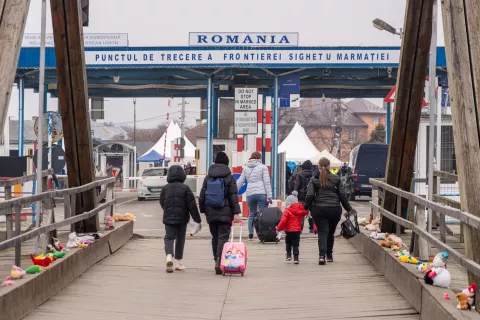
At a frontier point in northern Romania, one father started offering Ukrainian children his daughters’ plush toys. Volunteers, NGOs and authorities joined in.

- English
- Română
ROMANIA, Sighetu Marmației, 18 March 2022 - The day the war broke out in Ukraine, Adrian drove to the border to see how he could help families coming in. The next day, he fueled up his car and started shuttling people to local bed and breakfasts for free.
Since then, Adrian and his wife spent most of their down time at the border crossing. He developed a routine of waking up at 3 AM, going to the frontier, continuing to work and going back to the border after hours. They helped with transit or offered hot meals. One night, he remembers serving 150 liters of hot tea.
When the wave of solidarity brought more volunteers to the border, Adrian found new ways to help. He noticed tired looking women, struggling to carry both small children and their luggage. He brought his passport, crossed the bridge into Ukraine and offered to carry their bags.
Walking into a foreign country and not speaking the language, they were reluctant at first. “The mothers looked scared, the children started to run,” says Adrian, who is also a father. He realized that his presence, as a strange man, was bringing anxiety instead of the smiles he wanted to bring to their faces.

So, he decided to change tactics and enlist the help of one of his daughters, Bianca, also a volunteer at the frontier point.
“Toys are very important in the life of a child,” says Bianca who will soon turn 16. She happily gave all her toys, only “to see faces light up with joy.”
Commander in chief of the Border Police in Sighetu Marmației, Adi Ioan Pop saw children’s and mothers’ reactions and quickly stepped up to support and contribute to Adrian’s initiative.

“They trusted him and allowed to help,” the commander in chief says about Adrian, who offered toys to children, taking their luggage to the control point, then going back and starting over with another family.
Adrian quickly exhausted his daughter’ supply of toys. Luckily, donations from NGOs, the Red Cross, Maltez and the Association We are their voice (Asociatia Suntem Vocea Lor) started flowing in. Volunteers, NGOs and border police placed toys and fruit on the bridge and invited children to help themselves.
Soon, more and more incoming children held tight to teddy bears, penguins or other plush animals.

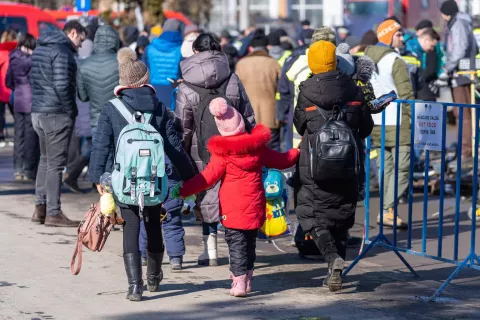
Olena crossed the bridge on March 14 with her six-year-old daughter Afina, stepdaughters Sasha, 21, and Eva, who is also six. “I saw volunteers give toys to our kids. I just start to cry; I couldn't believe that everybody can help us. You know, in Ukraine we just see everybody fighting.”
Like Olena and Afina, mothers and children crossing the border into Romania left their homes and their families after sleepless nights of waiting for the war to end. Many took what they thought was their last chance to leave and have been on the road for days, sometimes under heavy shelling.
Talking to their children about the war was something many parents have not found easy. Volunteers have spoken with children who said they were going to the seaside. Others said they were running away from the war.
Mothers who crossed the border at Sighetu Marmației and stopped to rest in the Mother and Child tent at the Blue Dot said they saw their children became afraid to sleep, or afraid to come out of the house. Drawings children made in the tent show tanks and weapons, grey dinosaurs or dark, rainy skies.
The tent is a space for mothers and children available in the Blue Dot centre where families are now offered the first point of contact and services: registration, legal advice, psychological counselling, and emergency health services. They are also provided with toiletries, baby food, hot meals, transportation, and accommodation if needed.
The Blue Dot in Sighetu Marmației was the first opened in Romania, in close partnership between UNICEF in Romania, the Ministry of Family and Youth through The National Authority for the Protection of the Rights of the Child and Adoption, The General Directorate of Social Assistance and Child Protection, the County Council of Maramures, and many other regional and local authorities and NGOs.
The team offering them support through the Blue Dot unites authorities and volunteers from The County Council of Maramures, The Prefecture of Maramures, The General Directorate for Child Protection, The City of Sighetul Marmatiei, at least 210 volunteers from over 15 nongovernmental organizations, the Red Cross, Maltez, The Orthodox Church of Romania, The Orthodox Diocese of Maramures, The Ukrainian Diocese, The Ukrainian Deanery, neo protestant churches and the Jewish community in Romania.