Romania listens to its children: the first roadmap for preventing violence against children, developed with the contribution of more than 1,000 children
An initiative supported by the European Commission’s Technical Support Instrument has helped Romania and Poland to strengthen their response to protect children
- English
- Română
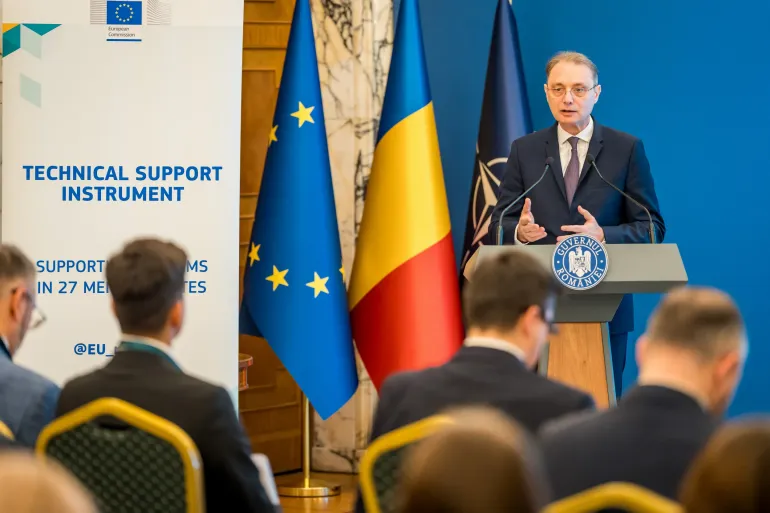
BUCHAREST, 9 November 2026 - Romania’s first National Roadmap for preventing and combating violence against children was presented today at a conference hosted by the Romanian Government. The document sets out courses of action based on evidence and the perspectives of over 1,000 children from different backgrounds and life contexts.
The event was attended by representatives of the Romanian and Polish authorities, the European Commission and UNICEF, as well as professionals and children. The roadmap is one of the outcomes of the project ‘Strengthening the response to violence against children through better-informed policies and institutional capacity building’ (24RO32), carried out with the support of the European Commission’s Technical Support Instrument and implemented by UNICEF, in collaboration with the national authorities of the two countries.
The children’s contribution to the drafting of the document highlighted several key needs: faster intervention by adults in situations of violence; informing children about the places and people they can turn to for help; and the existence of accessible, safe and trustworthy reporting mechanisms.
“When a child asks for help, they must know that we will listen to them and take timely action to protect them. The project to strengthen the response to violence against children, carried out by the National Authority for the Protection of Children’s Rights and Adoption together with partners in Poland, the European Commission and UNICEF, helps us to better understand the issue and what concrete steps we can take. The roadmap includes a comprehensive set of measures, ranging from prevention and early identification of violence to intervention, recovery and reintegration. The next step is for the relevant institutions to work together to put these measures into practice, and I wish to assure you of the Romanian Government’s support,” said Prime Minister Luca Niculescu.
“The findings of the reports launched today give Romania, for the first time, a clear picture of where violence happens, who is most at risk and where the system falls short. They show that violence against children is predictable - and so it can be prevented. Through the Technical Support Instrument, the European Commission is proud to have supported Romania and Poland in building this evidence and learning from each other. Now the Roadmap must turn it into action: coordinated, properly resourced and centred on the child," said Judit Rozsa, Director for the Technical Support Instrument, European Commission (SG REFORM).
“Violence against children follows identifiable patterns, as highlighted in the reports published today. If we can anticipate where violence occurs, against whom and by whom, our response must be just as predictable: present in every school, community and family, planned for the coming years and supported by resources that ensure its continuity. As a Member of Parliament, I initiated the anti-bullying law and I believe we must continue along this path. The implementation of the Roadmap requires a coordinated approach, to which the Ministry of Labour will contribute alongside all the institutions responsible for child safety,” said Petre-Florin Manole, Minister of Labour, Family, Youth and Social Solidarity.
“An effective system for protecting children who have experienced violence must be based on a thorough assessment, inter-agency cooperation and proven solutions. Mapping existing services, analysing the legal and organisational frameworks, and identifying good practices are key steps in laying the foundations for the development of specialist centres for children affected by violence in Poland. This will enable us to establish standards that address the real needs of children and their families, whilst ensuring consistent, accessible and coordinated support. This is an important step towards a systemic solution that places the safety, welfare and rights of the child at the centre of multidisciplinary efforts,” said Mateusz Korzeniowski, Deputy Director, Department of Family and Juvenile Affairs, Ministry of Justice, Poland.
“Violence against children often begins in familiar places and is perpetrated by people children know and trust. But it does not stop there. Increasingly, it extends into the online world, where harm can spread quickly and reach far beyond the original incident. Together with government institutions, civil society and communities, UNICEF has helped advance reforms that better protect children from violence. The evidence presented today reinforces the need to continue investing in prevention, early intervention and quality services so that every child can be safe, heard and supported” said Anna Riatti, UNICEF Representative to Romania.
In Romania, the project was coordinated by the National Authority for the Protection of Children’s Rights and Adoption (ANPDCA) under the Ministry of Labour, Family, Youth and Social Solidarity. The roadmap developed as part of the project addresses the main factors that contribute to violence against children and sets out concrete actions to strengthen prevention, improve early identification and reporting, ensure coordinated support across sectors, expand access to services for vulnerable children, and strengthen legislation, data collection and monitoring. Other outcomes of the project include the completion of a national study on the prevalence of violence against children, an assessment of the legislative framework, an analysis of European practices regarding inter-institutional cooperation, as well as the mapping of support services and an assessment of the capacity of professionals in the field.
The prevalence study shows that 28.2 per cent of children in Romania have been affected by at least one form of violence during their lifetime, 7.5 per cent of children have experienced repeated episodes of violence in the last year, and 4 per cent have been affected by several forms of violence in the same year. Children who have experienced violence most often tell a parent, friend or teacher, and the information does not always reach the relevant authorities.
Another important finding shows that violence is becoming increasingly widespread online, where perpetrators can remain anonymous and the negative effects can spread rapidly.
Based on the study’s findings, an action plan has been developed, structured around seven strategic areas, aimed at the coordinated involvement of all institutions with responsibilities for the protection of children’s rights, at both central and local levels. The proposed measures include clarifying the responsibilities of institutions and improving collaboration between them, the development of integrated support services for child victims of violence, including through the expansion of Barnahus-type services (designed to prevent the re-traumatisation of children), the training of professionals working with children, the development of parenting programmes, and the creation of more accessible and safer mechanisms through which children can seek help and report incidents of violence. The plan also aims to improve data collection and use so that policies and interventions better reflect the realities within communities.
The project is also launching the digital campaign ‘What do you think? Red flag or not?’, dedicated to preventing online violence against children and adolescents. The campaign is based on an important reality: not all forms of online violence are easy to recognise. Pressure, manipulation or the violation of personal boundaries can stay hidden behind behaviour disguised as jokes, concern, friendship or interest. Through the interactive resources available on redflagzone.ro, adolescents, parents and professionals can learn to recognise these behaviours more easily and identify situations where help is needed.
The project provides a foundation for improving the way in which Romania prevents and combats violence against children. Its findings help to shape measures to strengthen cooperation between institutions, improve responses to cases of violence and ensure that services are accessible and tailored to the needs of each child.
Media contacts
About UNICEF
UNICEF promotes the rights and wellbeing of every child, in everything we do. Together with our partners, we work in 190 countries and territories to translate that commitment into practical action, focusing special effort on reaching the most vulnerable and excluded children, to the benefit of all children, everywhere.
For more information about UNICEF and its work for children, visit www.unicef.org.