From Risk to Relief: Daru Hospital’s new incinerator
State-of-the-art incinerator to end a decade’s accumulation of medical waste

For ten years, hospital staff in Daru, Western Province, had no way to safely dispose of hazardous medical waste after its incinerator was decommissioned.
Used needles and expired drugs, packed into 44-gallon barrels over the decade still sit on hospital grounds waiting to be safely destroyed. For a long time, other hospital waste ended up buried and burned behind the hospital, or dumped at the town’s main site, none of which are safe for people or the environment.
But that is now a thing of the past. In late October, UNICEF handed over a new state-of-the-art incinerator.
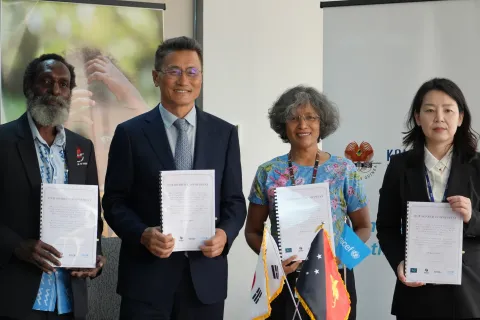
In a simple and low-key ceremony, Dr Miriam Boga, Chief Executive Officer of the Western Provincial Health Authority and Dr Satish Gupta, Chief of UNICEF’s Health program, signed the handover certificate atop an empty 44-gallon drum outside the building housing the incinerator.
It was an unassuming moment, but its impact on hospital safety and infection control for thousands of patients, staff and the wider community, will be far reaching.


UNICEF installed two incinerator units, one in Daru Hospital, and the other in Kiunga District Hospital. Both, generously supported by the Government of Japan represent a K3 million investment.
“For ten years, we’ve been packing barrels with sharps and expired drugs while waiting to safely dispose of them. We openly burn other hospital waste or dump them at the town dump site, and the infection risk is everywhere. It may be a quiet handover today, but this is a huge step forward for the hospital and our community. I thank the Government of Japan and UNICEF for this investment.”

"It is a very proud moment to handover this state-of-the-art incinerator system which will not only prevent the spread of diseases such as Hepatitis B and HIV, but it will also contribute to safe environment and climate resilience," Dr. Satish Gupta, Chief of UNICEF's Health program in Papua New Guinea, adds.


Daru Island, just five kilometers in length, is home to about 31, 000 people. Its hospital is the only major hospital in the South Fly District that also serves patients that arrive daily in boats from the Delta Fly District on PNG’s mainland. It’s a very busy hospital.
For a community already battling high rates of tuberculosis, proper waste management is critical. TB can spread quickly in hospital environments when infected fluids and sputum are not managed properly. By reducing exposure to infectious materials, the new incinerator will play a direct role in preventing diseases like TB from spreading.


Completed almost nine months after construction began in early January 2025, this new state-of-the-art incinerator minimizes environmental impact through a water-filtration system that releases only clean steam and is safely flushed through the normal sewer system.
"This new incinerator system burns hospital waste at a very high temperature. It's inbuilt chimney filters the air so that no toxic gas are released into the atmosphere."

With the incinerator now completed, the hospital will be able to diligently implement its infection control measures.
“We are set to go. We were waiting for the official commissioning of the incinerator before starting our first burn,” adds Dr Boga.
Charlie Ming, the hospital’s electrician is the main operator of the incinerator.
“It is my first time to operate this. I was trained for it. As an electrician, I work everywhere so now it is my responsibility to take care of the hospital waste. We are going to start with all the sharps that have been accumulating for the past 10 years, Charlie explains. We did a test a couple of days ago, burning 50 kilograms of waste and it worked perfectly. It took another 48 hours to cool down completely.”


Six hospitals across Papua New Guinea are getting new state-of-the art incinerators like this. Made possible through a generous contribution from the Government of Japan as part of a COVID 19 Emergency Response initiative, UNICEF, working through the National Department of Health and relevant Provincial Health Authorities, is helping install these facilities to safely dispose of medical waste and strengthen control infection. These hospitals include Daru, Alotau, Wewak, Kavieng and Lorengau Provincial Hospitals and Kiunga District Hospital.