Parliamentary Committee Launches Bold National Review to Secure the Future of PNG’s Children
Landmark inquiry calls for renewed national commitment to children

Port Moresby, 15 October 2025 – “Now is the time for all of us to think about our children,” declared Governor Powes Parkop, Chair of the Special Parliamentary Committee on Children and Youth Well-being, as he opened the Committee’s first-ever inquiry session in Parliament this week. “They are the generation that will take this country to 2075 when our country becomes 100 years.”
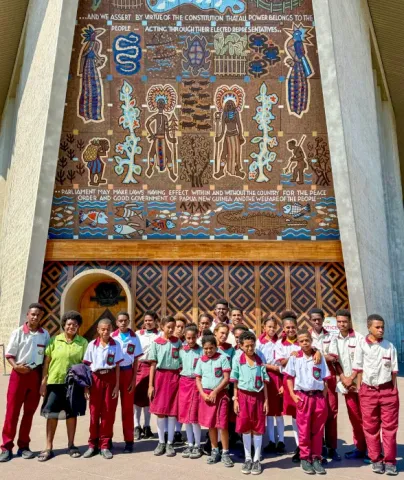
As Papua New Guinea marks 50 years of independence, the Committee’s inaugural session marked a historic moment — setting the foundation for stronger parliamentary oversight, accountability, and action to improve the lives of children and youth across the country.
Over two days, the inquiry brought together Members of Parliament, Provincial Governors, key government departments, and development partners including UNICEF. It examined challenges and progress in health, education, nutrition, child protection, WASH, and provincial governance, signaling a new era of results-focused collaboration.
Children’s Health and Nutrition: “From the Womb to the Tomb”
Health was at the center of the Committee’s deliberations. Acting Health Secretary Mr. Ken Wai emphasized the Department’s life-cycle responsibility — “looking after a human being from the womb to the tomb.”
Despite gains in life expectancy, the Committee noted that national immunization coverage remains critically low at 47%, with provinces such as Madang at only 22%. The Committee pressed for stronger coordination between the National Department of Health (NDoH) and Provincial Health Authorities (PHAs) to close gaps and improve accountability.
Governor Parkop called for urgency: “We cannot continue to normalize poor child health outcomes or accept malnutrition as routine. Poor nutrition is robbing our children of their potential and our nation of its future.”
The NDoH committed to finalizing amendments to the PHA Act to strengthen provincial oversight and to fast-track approval of the Village Health Assistant (VHA) Policy by 2026. The Department also pledged to roll out a National Nutrition Survey in 2026 and to use the National Nutrition Summit for greater cross-sectoral coordination.
Education and Early Childhood Development: Building Foundations for the Future
The Committee reviewed evidence showing that while over 80% of children enter primary school, only 5–10% reach university or college. Governor Parkop urged a fundamental rethink: “Education is the great equalizer — but only if every child is able to stay in school, learn, and thrive.”
The Department of Education presented progress on the Early Childhood Education (ECE) Policy, which plans for two years of pre-primary learning (K1–K2) alongside the education 1-6-6 reform. However, challenges remain — including ECE teachers not yet on payroll and limited provincial funding for early learning centers.
The Committee recommended that ECE teacher salaries be integrated into the 2026 national budget, and that the Department finalize the national ECE expansion plan, including teacher registration, curriculum rollout, and improved WASH facilities in schools.
Child Protection: Strengthening Accountability and Action
The Committee raised deep concern over the slow implementation of the Lukautim Pikinini Act (2015) and the limited operational capacity of the National Office of Child and Family Services (NOCFS). Only 60 of 130 approved positions are currently filled, and the National Child and Family Services Council has been inactive since 2023.
Governor Parkop stressed that child protection cannot remain as an afterthought:
“Every day a child faces abuse, neglect, or violence, we fail in our duty. Protection must be at the heart of government responsibility.”
NOCFS committed to expanding the number of child protection officers to 180 by 2025, reactivating the National Child and Family Services Council by early 2026, and rolling out Provincial Child and Family Services Councils across all provinces.
The Committee directed DfCDR and NOCFS to submit a reform and staffing plan by end-2025 and to clarify institutional oversight to ensure greater accountability.
Water, Sanitation and Hygiene (WASH): Time for Action, Not Delay
The inquiry revealed that the National WASH Authority Bill has been delayed for nearly seven years, hindering consistent service delivery. Although K106 million was allocated to WASH between 2019 and 2025, funding distribution has been uneven.
The Department of National Planning and Monitoring (DNPM) announced that the 10-Year National WASH Master Plan (2026–2035) was being finalized with UNICEF, the World Bank, and other partners.
The Committee called on DNPM to expedite approval of the WASH Authority Bill and strengthen funding transparency to ensure every child has access to clean water and sanitation.
Provinces and Partnerships: Leading by Example
Governor Noah Kool of Simbu shared how the province is leveraging partnerships with churches and NGOs to expand early childhood centers and maternal health outreach — despite limited resources.
Civil society representatives, including Magna Carta and ChildFund, echoed the need for stronger government–NGO collaboration, predictable funding, and community-led accountability.
UNICEF’s Regional Director for East Asia and the Pacific, Ms. June Kunugi, commended the Committee’s leadership, reaffirming UNICEF’s commitment to support PNG in advancing child rights and well-being.
The Way Forward: A National Call to Action
The Committee resolved to:
- Share the Parliamentary Report with actionable recommendations at the upcoming Parliament session;
- Hold departments and provinces accountable through quarterly progress reviews;
- Advocate for increased fiscal prioritization for children in the 2026 Budget; and
- Promote whole-of-government coordination for integrated child and youth service delivery.
Governor Parkop concluded with a vision of unity and purpose:
“This Committee is not just about oversight. It’s about building a nation where every child survives, learns, and is protected. The next 50 years must belong to our children — and the time to act is now.”
Background - The Special Parliamentary Committee on Children and Youth Well-being was established by Parliament to strengthen oversight and policy coherence on child and youth issues. Its first inquiry, held from 14–15 October 2025 at the National Parliament, reviewed performance and progress in key sectors, including health, education, nutrition, child protection, and WASH.
Media contacts
About UNICEF
UNICEF promotes the rights and wellbeing of every child, in everything we do. Together with our partners, we work in 190 countries and territories to translate that commitment into practical action, focusing special effort on reaching the most vulnerable and excluded children, to the benefit of all children, everywhere.
For more information about UNICEF and its work for children in Papua New Guinea, visit https://www.unicef.org/png/