Life-saving polio vaccines arrive in PNG to protect the nation’s future
Emergency immunisation campaign to reach 3 million children under 10 as national polio response ramps up

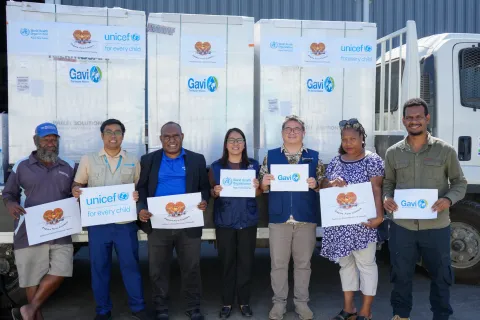
Port Moresby, 13 June 2025 — Papua New Guinea (PNG) has taken a major step in the fight against polio, with the arrival of more than 4.6 million life-saving vaccine doses to kickstart a nationwide immunisation blitz.
The shipment of novel oral polio vaccine type 2 (nOPV2) touched down in the capital Port Moresby in the early hours of Friday.
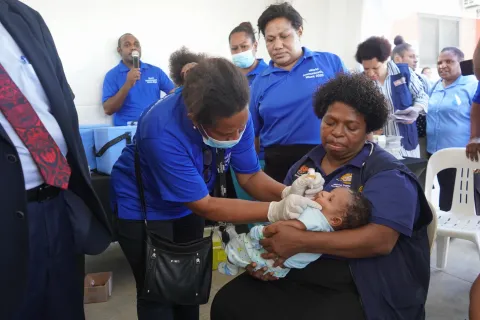
It will launch the first round of emergency vaccinations to stop the spread of poliovirus.
With a second shipment scheduled for July, health authorities aim to vaccinate every child under 10 years of age — nearly 3 million children in total.
The intensive two-round campaign is supported by the World Health Organization (WHO), UNICEF, and the Australian Government.
The vaccine delivery comes just weeks after PNG declared a national health emergency.
Circulating poliovirus was detected in environmental samples and healthy children.
“This is an urgent race to protect our children and stop the virus in its tracks,” said Dr Veera Mendonca, UNICEF Papua New Guinea Representative.
“The arrival of these vaccines is a vital first step. Now we need to get them to every child.”
Recognising the seriousness of the situation, Australian High Commissioner to Papua New Guinea H.E. Ewen McDonald said his country was pleased to provide an immediate contribution of AUD 5 million to support PNG’s response.
“Our funding will help deliver an integrated vaccination campaign, combining polio vaccines with other routine childhood immunisations — to give children across PNG the best possible start in life.
The arrival in Port Moresby today of a large shipment of polio vaccines is an important milestone.”
H.E. Mr McDonald said Australia would continue to work with PNG to protect children, reduce the risk of future outbreaks, and support a healthier, more resilient region.
The vaccines will be distributed across the country in the coming weeks.
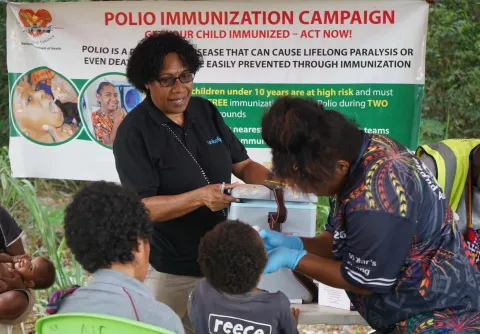
Health workers will deploy by air, foot, boat, helicopter and vehicle to reach children in even the most remote villages.
PNG had been polio-free for 25 years until a previous outbreak in 2018.
The current outbreak was detected in April and May through environmental surveillance in Morobe Province and Port Moresby.
No cases of paralysis have been reported.
The detection of the virus in environmental samples and healthy children shows why vaccination is urgently needed to protect all children. “Routine immunisation coverage is still too low in many areas, putting children at real risk,” said Dr Mendonca.
“This outbreak is a wake-up call. We must act now — by strengthening routine immunisation and tackling the polio outbreak — to protect our children and prevent this from happening again.”
UNICEF, WHO and the Australian Government are working with the National Department of Health.
The partners are supporting the campaign with vaccines, cold chain equipment, transport, training, operational costs, communication and community engagement.
“We need all hands on deck to stop this outbreak as quickly as possible,” said Dr Sevil Huseynova, WHO Representative in Papua New Guinea.
“Polio is a preventable disease, and vaccines are our most powerful tool.
The arrival of this first shipment of vaccines is an important milestone. We urge all parents and caregivers to bring their children for vaccination — this is the best way to keep them safe.”
Health Minister Elias Kapavore said the government was fully committed to protecting every child in Papua New Guinea from polio.
“This vaccination campaign is a vital part of our national emergency response.
We are calling on all health workers, provincial health authorities, community leaders and families to join forces and ensure that no child is left behind.
Together, we can stop this outbreak and safeguard the health of our nation’s children.”
The arrival of the vaccines marks the next phase in PNG’s emergency response to the outbreak.
The country was declared polio-free in 2000 but experienced a previous outbreak in 2018.
In April and May this year, circulating poliovirus was again detected in environmental samples and healthy children in Lae and Port Moresby.
The detection triggered the activation of a national emergency response.
The Government of Papua New Guinea, with support from UNICEF, WHO, the Australian Government and other partners, is now working to strengthen surveillance.
It will prepare for two rounds of nationwide polio vaccination and engage communities across the country to ensure every child is protected.
Media contacts
About UNICEF
UNICEF promotes the rights and wellbeing of every child, in everything we do. Together with our partners, we work in 190 countries and territories to translate that commitment into practical action, focusing special effort on reaching the most vulnerable and excluded children, to the benefit of all children, everywhere.
For more information about UNICEF and its work for children in Papua New Guinea, visit https://www.unicef.org/png/