A Second Chance to Dream
For out-of-school youth, alternative learning is more than an option—it is a chance to restart and rebuild dreams once paused

Every morning in Bongao, Tawi-Tawi, a small group of learners quietly gather in a borrowed classroom at Salamat Elementary School.
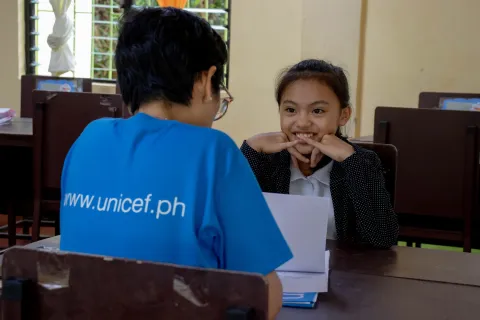
Teacher Nadzmin Dugasan begins another day of teaching in the Alternative Learning System (ALS), a government programme that provides non-formal education for out-of-school adolescents and youth, helping them continue learning and earn certifications equivalent to formal schooling.
The room they use is a temporary space. For more than seven years, Teacher Nadzmin has held classes wherever he could—sometimes in proper classrooms, but often in markets, beside small community stores, or anywhere his learners happen to be working.
“My classes depend on the availability of my students. We agree on a schedule that works for them. This school year, we meet every Monday, Wednesday and Friday because that’s when they’re available,” he said.


In this island province at the country’s southern edge, out-of-school adolescents and youth face many barriers: poverty, distance, discrimination and the daily struggle to survive.
Among them is 23-year-old Jubilyn Mustaman, the eldest of 14 siblings. In 2019, she left school to work after her father was injured and could no longer provide for the family.


Jubilyn was in Grade 11 at the time. She worked as a cafe server, helped run their small food business, and cared for her younger siblings while her father recovered.
For her and her family, it was a difficult but necessary decision. Yet for Jubilyn, it still hurts to think about the years she had to pause her education.
Seeing her former classmates graduating, posting photos in their uniforms, and planning their futures fills her with both pride and sadness.
“I wish it could be that simple for me. Some have already graduated and yet I’m still stuck because of everything I’m going through,” she said.
In the same classroom sits 22-year-old Illis Halilurla Abdulmuhit, a Badjao learner and a member of the lesbian, gay, bisexual, transgender, and queer (LGBTQ+) community

At 16, he left formal school after struggling to continue his studies without family support and while facing discrimination both at home and in his conservative community.
“Before my father died, I was told to just stop studying because I’m gay and studying is expensive. It was painful to hear, really. It felt like I had no rights,” he said.
What hurt even more was the bullying he faced simply for being himself. “I just wanted them to respect me too because I’m human, just like them. Their words cut deeply,” Ilis recalled.
Across the room is 15-year-old Haikal Sarji Alsi, a Filipino born in Malaysia who never had the chance to attend formal school there. His family eventually moved to the Philippines and settled in Tawi-Tawi, where Haikal was finally able to study until Grade 6.
However, tragedy struck when their house burned down, and their boat, which was their primary source of livelihood, sank.

Soon after the pandemic hit, Haikal had to stop schooling. Modular learning did not work out for him. Without a teacher’s guidance, he felt like he was not really learning anything.
As the pandemic worsened, his family returned to Malaysia, where Haikal had to work instead. He never went back to school there.
“When I saw kids my age going to school while I was working, I thought, ‘If I had continued, I would be in Junior High School by now.’ So, I told myself, if I ever get the chance to study again, I will really grab it,” Haikal said.
Towards more inclusive education
To better support learners like Jubilyn, Illis, and Haikal, UNICEF and BDO Foundation, in partnership with the Ministry of Basic, Higher and Technical Education (MBHTE), are strengthening teacher development and expanding the ALS programme in the province.
These efforts aim to equip 3,000 out-of-school youth in the Bangsamoro region with essential skills and opportunities.
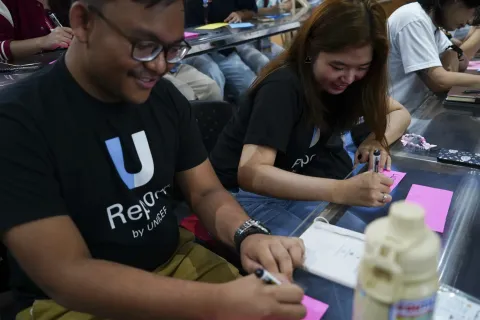
As part of this partnership, ALS teachers in Tawi-Tawi joined a learning session in October on Digital Literacy, Universal Design for Learning, and Education in Emergencies.
“The capacity-building for ALS teachers intends to respond to the needs they expressed. We want to make sure also that even after the project ends, ALS teachers are still able to support one another through peer mentorship and coaching,” said Rolando Villamero Jr., Education Specialist of the UNICEF Mindanao Field Office.
For Teacher Nadzmin, the sessions have been a tremendous help.
“This is an answered prayer because UNICEF and BDO Foundation are bringing closer to ALS Tawi-Tawi the concepts of teaching methods and digital literacy,” he explained.
Where hope springs anew
For Jubilyn, Illis, and Haikal, ALS is not simply an alternative, it is an opportunity to begin again, to continue what was paused, and to rebuild dreams they almost lost.

"I’m happy when Sir Nadz teaches. I had been waiting for this for so long, to go back to school, but I couldn’t because of money and my family responsibilities. I’m grateful to ALS for helping me return to my studies,” Jubilyn shared.
"I enrolled in ALS because I have many dreams in life. I want to show my parents that even without their support, I can continue my studies," Ilis said.
And for Haikal, who is now living in Tawi-Tawi with his older brother and sister and back to studying, each lesson in ALS is a step towards bigger things.
"Inshallah, I hope I pass the ALS exam for the second time. My greatest motivation for this is to bring my family back here to the Philippines so we can finally be together and start ebuilding our lives here," he said.
About the partnership
UNICEF Philippines and BDO Foundation have partnered to support the government’s Alternative Learning System (ALS) programme, which provides flexible, non-formal education for out-of-school children, youth, and adolescents so that they can return to formal schooling or gain practical skills for work.
The partnership includes holding training workshops for ALS teachers, building two ALS learning centers, and supporting activities that expand learning opportunities in Basilan, Tawi-Tawi, and Maguindanao, to give more out-of-school learners a meaningful second chance at education.