Strengthening cold chain in Pacific Island Countries and Territories
Read more about the lifesaving cold chain supplies the Government of Japan has been supporting UNICEF deliver
Geographical challenges, logistical constraints, limited to no power supply in remote rural communities and outer islands, coupled with the COVID-19 pandemic and closed borders – reaching children in Pacific Island Countries and Territories (PICTs) with access to life-saving vaccines is no easy task.
How do you deliver life-saving vaccines in hard-to-reach communities and outer islands in the Pacific?
It is all thanks to a chain of precisely coordinated events in temperature-controlled environments that makes it possible for vaccines to be stored and transported under correct conditions in order to maintain its quality and potency.
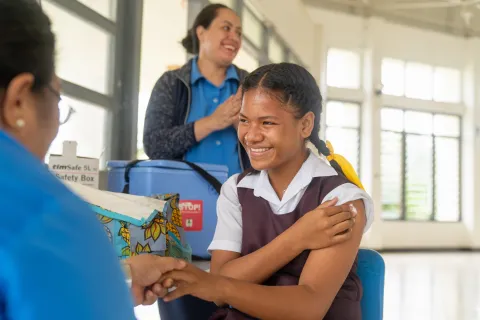
This is called a cold chain - which allows health workers to deliver life-saving vaccines to every last child, no matter where they live.
Like anywhere else in the world, vaccines in the Pacific are transported from cold rooms to refrigerators in cold boxes and vaccine carriers, with health workers traveling by boat, car and often times on foot to ensure children in some of the hardest to reach communities have access to life-saving vaccines.
But, with limited to no power supply, how do you store vaccines in remote rural health centres?
Through the use of solar-powered vaccine refrigerators!
Like this health centre in Beqa Island, Fiji, which can now easily store vaccines thanks to the solar-powered vaccine refrigerator. The refrigerator directly connects to solar panels, making it the most ideal for remote communities and outer islands.
Government of Japan’s strong partnership with UNICEF helps strengthen cold chain storage capacity
The Government of Japan and UNICEF’s partnership has been critical in helping strengthen cold chain storage capacity in the Pacific, helping Pacific Island government’s reach children like 4-year-old Mere with access to life-saving vaccines.
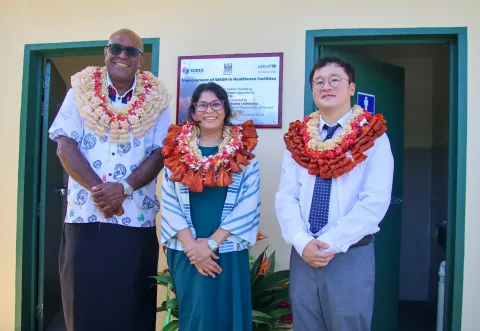
UNICEF and Government of Japan’s strong partnership resulted in 234 health facilities in Fiji, Samoa, Solomon Islands and Vanuatu supported with the procurement of cold chain equipment, together with logistical support for installation.
Through this partnership, Cook Islands, Tuvalu, Niue, Samoa, Solomon Islands and Tonga received motorcycles, boats, vehicles, and generators to support health workers delivery of essential health services.
Additionally, over 500 health workers were trained on the use of cold chain equipment, with an additional 2,230 health workers trained on the use of and monitoring of the cold chain equipment and COVID-19 vaccines.