Children lead national push for safer, hate‑free digital spaces

- English
- Македонски
- Shqip
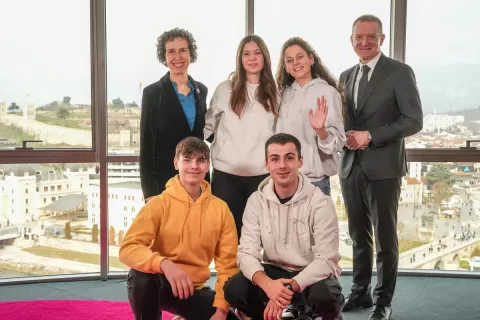
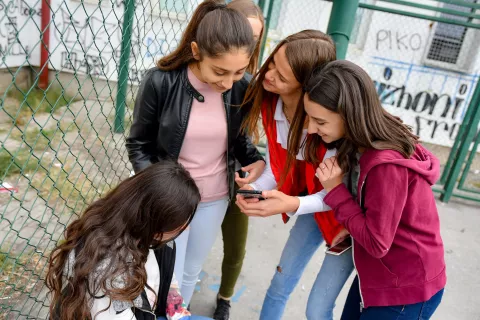
Skopje, 25 February 2026: Children and adolescents took centre stage today at a child‑led event on peer advocacy against cyberbullying and online hate speech, organised by UNICEF and Foundation Telekom for Macedonia, and in collaboration with the Scout Association of Macedonia. Showcasing their own ideas and solutions, they called for support to create safer and more inclusive digital environments.
Five teams of child advocates presented creative ideas for initiatives aimed at making online spaces safer and free from hate. They include a youth-led digital series featuring podcast-style debates on online hate, parent–child modules to encourage open discussions about cyberbullying, and an effort to strengthen the role of child ombudsmen in schools to protect digital rights. In addition, two ideas for youth-run online platforms were introduced, offering practical advice and peer support for children facing online pressure and mental health challenges.
The young people also presented a new Toolkit for the Prevention of Cyberbullying and Hate Speech, co‑created and tested with children and experts. Designed for teachers, psychologists, social workers, and youth workers, the resource has 19 interactive activities that promote digital safety, empathy, responsible online behaviour, and awareness of how online actions impact others.

Reflecting on the initiatives, Vesna Janevska, Minister of Education and Science, and Stefan Andonovski, Minister of Digital Transformation, both expressed support for child‑led action. They emphasized the importance of coordinated efforts across education, digital policy, families, and institutions.
“As a Ministry, we are working continuously to strengthen systemic action against all forms of violence. Every school has a legal obligation to seek support from the Pedagogical Service when faced with inappropriate or problematic behaviour among students. For the purpose of prevention and to provide greater support to schools, we have created the email address [email protected], where students, teachers, parents and all concerned parties can report any form of violence,” said Minister Janevska, expressing gratitude to all partners of the Ministry involved in addressing peer violence. “In the current school year, there have been 34 reports, but none related to online violence. This does not mean that it does not exist, which is why we encourage young people, when they are faced with such situations, to report them immediately so that they can receive the necessary support and assistance.”
“What left the strongest impression on me is that the initiatives combine online and offline activities and tools to protect children and young people. Cyber violence is a challenge that did not exist at the time when your parents were growing up, which is why it is crucial to work together — with parents, schools, professional services and young people themselves. We, as institutions, are at your disposal and will support you with additional tools that will be useful to you,” said Stefan Andonovski, Minister of Digital Transformation.

Goran Markovic, CEO of Makedonski Telekom and President of the Telekom Foundation for Macedonia, highlighted the importance of supporting young people so that they themselves can lead the positive change: “When we started this journey with UNICEF, we knew for sure that online hate is one of the biggest threats to equal digital society and we must fight it. We also know this negative phenomenon especially affects children and young people, and we need to give them voice, tools and power to create a safer, more humane online world. While they are leading this fight, all of us have the responsibility to protect them.”
Lesley Miller, UNICEF Representative, praised the leadership and creativity demonstrated by the young presenters: “Today we witnessed what meaningful child participation truly looks like. The ideas presented are thoughtful, creative, and rooted in real experience. They show that children and adolescents must be part of the solution. We are proud to support them in turning these ideas into action, so that every child can feel safe and respected in digital spaces. Protecting children online is a shared responsibility. We call on the tech industry, regulators, parents, teachers and governments to fulfil their responsibilities for ensuring children are protected and safe online.”

The initiatives and the toolkit presented are part of a #NetWithoutHate movement led by children and adolescents who are standing up for a digital world where everyone feels safe, respected, and heard. With support by UNICEF and the Foundation Telekom for Macedonia partnership, they are co‑creating solutions, strengthening peer‑to‑peer advocacy, and turning lived experiences into action nationwide. Over the next year, the child and adolescent advocates will be implementing their initiatives and taking them around the country to get more children involved.
By bringing together children, institutions, the private sector, and civil society, the event demonstrated how peer‑led action, backed by strong partnerships, can contribute to safer, more inclusive online spaces and help build a digital culture based on empathy, respect, and responsibility.
Media contacts
About UNICEF
UNICEF, the United Nations agency for children, works to protect the rights of every child, everywhere, especially the most disadvantaged children and in the toughest places to reach. Across more than 190 countries and territories, we do whatever it takes to help children survive, thrive, and fulfil their potential.