The Woman Standing Between a Child and Hunger
In Yobe State, Hadiza Maina Adam is helping ensure that life-saving nutrition supplies reach the children who need them most.

The phone rarely stops ringing.
Sometimes it is a health worker reporting a shortage of nutrition supplies in a remote clinic. Sometimes it is a local government official needing urgent guidance. Occasionally, it is news of something more troubling, a report that life-saving food meant for malnourished children may have been diverted before reaching its destination.
For Hadiza Maina Adam, these are not just administrative challenges. They are matters of life and death.
"Whenever I hear there is a problem with nutrition supplies, I immediately start asking questions," she says. "Because somewhere, a child could be waiting."
As State Nutrition Officer for Yobe State in northeast Nigeria, Hadiza oversees one of the most important and least visible battles in the fight against child malnutrition. Most people see the child who recovers. Few see the complex system that makes that recovery possible.
The trucks that transport therapeutic food. The warehouses that store it. The monitoring teams that track every carton. The officials who ensure that supplies reach the right clinic, the right health worker and ultimately the right child.
For nearly two decades, Hadiza has been part of that fight. She began her career in a remote local government area, working directly with communities and caregivers. Today, she coordinates nutrition activities across all 17 local government areas of Yobe State.
The scale of responsibility is enormous. Yet when she talks about her work, she rarely speaks about systems or logistics.
She speaks about children.
"I always think about the mothers," she says. "I think about the children who arrive at clinics weak and severely malnourished. That is what motivates me every day."
The challenge facing Yobe is immense. Years of conflict have disrupted livelihoods and limited access to farmland. In parts of northern Yobe, flooding destroys crops and livelihoods. In southern areas, drought leaves families struggling to produce enough food.
The result is a crisis that continues to place thousands of children at risk.
"Insurgency remains one of the biggest drivers of malnutrition," Hadiza explains. "When people cannot safely access their farms, food becomes scarce. Families suffer and children suffer most."
For Hadiza, solving the problem requires more than treating malnutrition after it occurs. It requires building systems that prevent children from falling into crisis in the first place. One of her proudest achievements has been helping strengthen Yobe's nutrition supply chain.
It is not the kind of work that attracts headlines. But it saves lives. Working with state authorities, local governments and partners, Hadiza helped operationalise a system through which the state now supports transportation of nutrition commodities across Yobe. The move has improved sustainability and allowed humanitarian resources to be used more efficiently.
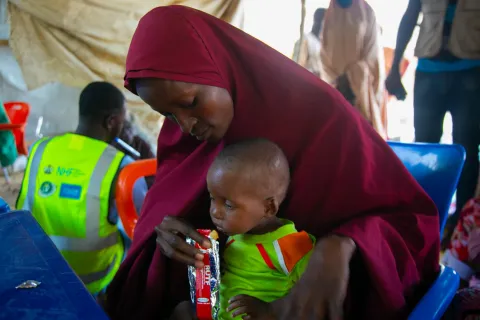
More importantly, it helps ensure that Ready-to-Use Therapeutic Food, commonly known as RUTF, reaches health facilities when it is needed most. For a severely malnourished child, a simple carton of RUTF can mean the difference between life and death. That is why Hadiza has little tolerance for anything that threatens the supply chain.

Several years ago, reports emerged that nutrition commodities had been diverted in one local government area. For many officials, it could have been viewed as any unfortunate incident.
For Hadiza, it was unacceptable.
"We immediately worked with the local government chairman to investigate," she recalls. "A task force was established, the commodities were recovered and measures were put in place to prevent it from happening again."
The experience reinforced something she had long believed. The fight against malnutrition does not end when funding is secured or supplies arrive in the state. The real challenge is ensuring they reach the child for whom they were intended.
Today, monitoring committees operate across all 17 local government areas, meeting regularly and reporting potential issues before they become larger problems.
"The state has zero tolerance for aid diversion," Hadiza says firmly. "These supplies belong to vulnerable children. Every carton matters."
Her determination has been matched by growing political commitment. When funding gaps threatened nutrition services in 2020, the Yobe State Government approved funding for the procurement of Ready-to-Use Therapeutic Food to prevent stockouts.

More recently, the state committed counterpart funding to the Child Nutrition Fund, helping secure thousands of cartons of therapeutic food for vulnerable children.
For Hadiza, these decisions represent more than budget lines. They represent lives protected. Children treated. Families given hope. Yet despite the progress, she remains realistic about the work ahead.
Yobe's malnutrition burden remains high. Too many families continue to struggle with food insecurity. Too many children still arrive at health facilities dangerously undernourished.
"We have made progress," she says. "But we still have a long way to go. We need to focus more on prevention. We need to address the factors driving malnutrition before children become sick."
At the end of a long day, after the meetings have ended and the reports have been reviewed, Hadiza returns home to her own family.
There, the nutrition officer becomes simply a mother. Weekends are spent cooking meals, helping with homework, cleaning the house and enjoying time with her four children. Her youngest daughter often claims a special place beside her during homework sessions.
Those moments matter. They remind her why she does what she does. Because every mother wants the same thing. To see her child healthy. To see them grow. To see them thrive.
As she reflects on the future of northeast Nigeria, Hadiza's wish is remarkably simple.
"I pray for peace," she says softly. "Peace would mean families can return to their farms. Peace would mean better food security. Peace would mean healthier children."
For nearly twenty years, she has dedicated her career to protecting children from one of the region's deadliest threats. Not from behind a podium. Not in front of television cameras. But through countless decisions, investigations, meetings and warehouse visits that most people will never see.
Because somewhere in Yobe today, a child is recovering from malnutrition. And there is a good chance that Hadiza Maina Adam had something to do with it.