Why Hauwa no longer misses school
A conflict-affected teenage girl no longer misses attending school thanks to a vocational training to produce reusable cloth pads
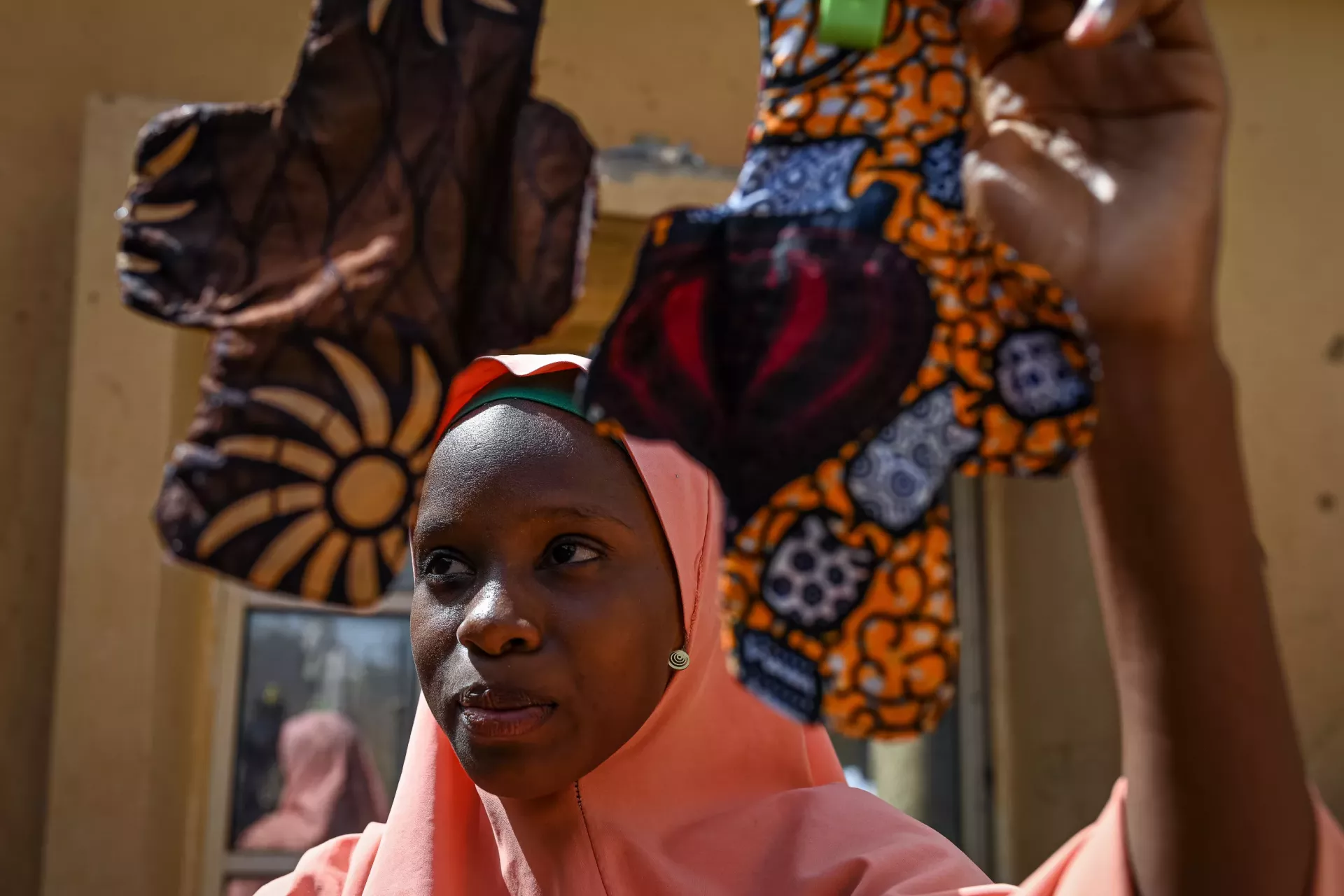
15-year-old Hauwa Yakubu is a proud owner of six reusable pads. The schoolgirl who lives in Gashua, a bustling town in northeast Nigeria keeps her pile in a clean nylon sack tucked inside a wooden box in her room. These are her most prized possessions.
Made from local cotton fabric and a slice of waterproof foam, these sanitary pads are her latest project from a recent training for schoolgirls that she attended which is organised by the Yobe State Government and supported by UNICEF.
It took a lot of trial and error, but I was able to make six decent pads at the end of the training. Now, I am an expert. I am working on three more pads now, says Hauwa.
The two-day training, funded by the German Development Bank (BMZ), under the ongoing Resilience and Peace project in northeast Nigeria aims to address barriers to the retention of girls in schools and provides them with the skills to manage their menstrual period better.

When I started my period last year, my elder sisters cut out rags for me to use. I had different rags, but they did not make me comfortable. I was walking funny because I had to keep my legs together whenever I used the rags, otherwise, you would think the rag was about to fall off. They can also easily stain your clothes and embarrass you. Because of this, I remember that I missed school two times last year during my period.
I was among the girls in my school selected this year to be trained on making of reusable pads. I didn’t have experience in sewing before this. The trainers were very kind and patient. We wasted a lot of fabric trying to learn the trade, but it was fun, and we were able to understand the process quickly, says Hauwa.
Poor menstrual hygiene management has been linked to absenteeism from school, poor concentration in class and missed education opportunities among schoolgirls. According to a recent study in selected schools supported by UNICEF in Nigeria, schoolgirls face a variety of challenges in managing their monthly period. Findings from the study revealed that most of the schools have dirty toilets with broken doors, inadequate water, sanitation and hygiene facilities as well as lack of knowledge about puberty and menstruation.
The study also associated lack of access to materials for hygienic management of menstruation management to missed educational opportunities, putting girls at risk of dropping out of school, early marriage and teenage pregnancy.
I want to be a medical doctor and I feel more encouraged to pursue my dreams after the training. I want to help girls, women and children in my community,’’ she says.

The training project is also making positive impact in communities affected by conflict in Bade Local Government in Yobe State and Shani Local Government in Borno State. The project is encouraging the local production of reusable pads and empowering vulnerable women to bandy together to establish cottage industries and form cooperatives in order to earn an income.
For Hauwa however, it is a new day. “I am more confident of myself during my period, and I have even trained my elder and younger sisters how to produce the pads,’’ she adds.