From Smart Schools to Smarter Learning: Enugu Teachers Gain Digital Skills to Transform Classrooms
With support from UNICEF and partners, 600 teachers across 30 SMART Schools are gaining the practical skills and confidence to turn technology investments into more engaging learning experiences for children.

ENUGU, Nigeria -For Mrs. Anah Henrietta, a teacher at one of Enugu State's SMART Green Schools, the promise of technology in the classroom is becoming more than an idea. It is becoming a practical tool for helping children learn.
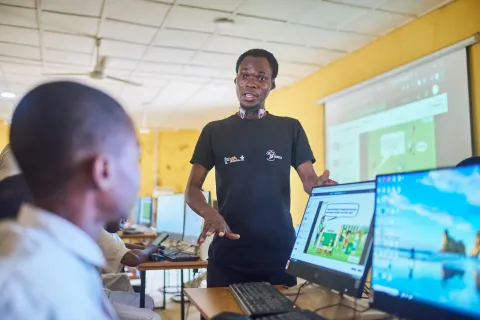
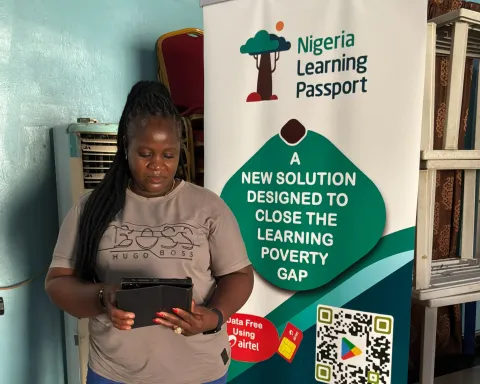
Sitting among fellow educators during a hands-on training session, Henrietta listened attentively as trainers demonstrated how digital tools, including smart boards and the Nigeria Learning Passport (NLP), can be integrated into everyday teaching.
For teachers like Henrietta, the training represents an important shift, from simply having access to technology to knowing how to use it confidently and creatively to support children's learning.
The training is part of a broader effort by the Enugu State Government, in collaboration with the Enugu State Universal Basic Education Board (SUBEB), the Federal Ministry of Education and UNICEF, with support from Microsoft and the Global Partnership for Education (GPE) through the Transforming Education initiative, to strengthen the state's education system through the SMART School Initiative.
At the heart of the initiative is a simple but important principle: technology alone cannot transform education. Teachers must have the skills and confidence to make it work for children.
As Enugu State continues to invest in SMART Schools and digital learning infrastructure, UNICEF and its partners are supporting teachers to translate those investments into meaningful classroom experiences.
Through step-down training, 600 teachers across 30 SMART Schools are strengthening their digital and pedagogical skills.
The training also brings together Centre for Experiential Learning and Innovation (CELI) Mentors and Experiential Learning (EL) Innovators, who will serve as champions of digital innovation in their schools and support fellow teachers to adopt new approaches to teaching and learning.
During a three-day practical session, educators explored the use of smart boards and the Nigeria Learning Passport, a digital learning platform that provides children and teachers with access to quality learning resources.
Harold Kpojime, UNICEF Nigeria's National Consultant for the deployment of the Nigeria Learning Passport, led practical demonstrations during the training.
"Digital learning is most impactful when teachers have the confidence and practical skills to use technology effectively," Harold said. "This training is helping CELI Mentors and Experiential Learning Innovators become champions of digital innovation, supporting other educators to integrate tools such as the Nigeria Learning Passport and smart boards into everyday teaching and learning."
For teachers participating in the sessions, the practical approach is helping bridge the gap between technology and classroom practice.


Rather than learning about digital tools in theory, educators are given opportunities to experiment, ask questions, practise their skills and explore how technology can respond to the needs of their pupils.
Beyond infrastructure, the SMART School Initiative comes at a time when education systems are increasingly looking to technology to expand access to quality learning and make classrooms more engaging and inclusive.
Yet providing devices, connectivity and digital infrastructure is only one part of the equation.
For Mr. Believe Eke, Education Specialist at UNICEF Nigeria, investing in teachers is critical to ensuring technology delivers lasting benefits for children.
"In a systemic effort to strengthen learning through the SMART School Initiative, investing in teachers' capacity is essential to ensuring that the programme goes beyond providing technology and infrastructure to transforming how teaching and learning take place," he said.
By equipping CELI Mentors and Experiential Learning Innovators with practical digital and pedagogical skills, Eke explained, UNICEF and its partners are helping build a network of educators who can support their peers, encourage innovation and promote the meaningful use of technology in classrooms.
"This is at the heart of UNICEF's partnership with the Enugu State Government, ensuring that investments in digital learning translate into better teaching and more engaging learning experiences for every child," he added.

A partnership centered on children
The SMART School Initiative brings together government leadership and the technical and financial support of partners committed to transforming education in Nigeria.
The Enugu State Government's investment in SMART Schools provides a strong foundation for expanding modern learning opportunities, while UNICEF, the Federal Ministry of Education, Microsoft and GPE are supporting efforts to strengthen teachers' capacity to use digital tools effectively.
For children, the true measure of this investment will not be the presence of a smart board in a classroom or access to a digital learning platform. It will be whether those tools help them become more curious, engaged and confident learners.
That is why strengthening teachers remains central to the SMART School vision.
As teachers such as Henrietta gain new skills and confidence in using technology, they are better positioned to create classrooms where children learn through interaction, exploration and access to digital resources alongside traditional teaching methods.
The impact can extend far beyond the training room. A teacher who gains new digital skills can share them with colleagues. A trained mentor can support other educators. And a more confident teacher can create richer learning opportunities for children.
Ultimately, the partnership is about ensuring that investment in technology becomes an investment in children.
By placing teachers at the centre of digital transformation, Enugu State, UNICEF and partners are helping build an education system where innovation is not simply about introducing new technology, but about using it purposefully to improve learning and give every child a stronger foundation for success.